
Pulp Fiction, 1897 · page 27 of 192
The Argosy, Vol. XXIV No. 2 — page 27: what you’re looking at
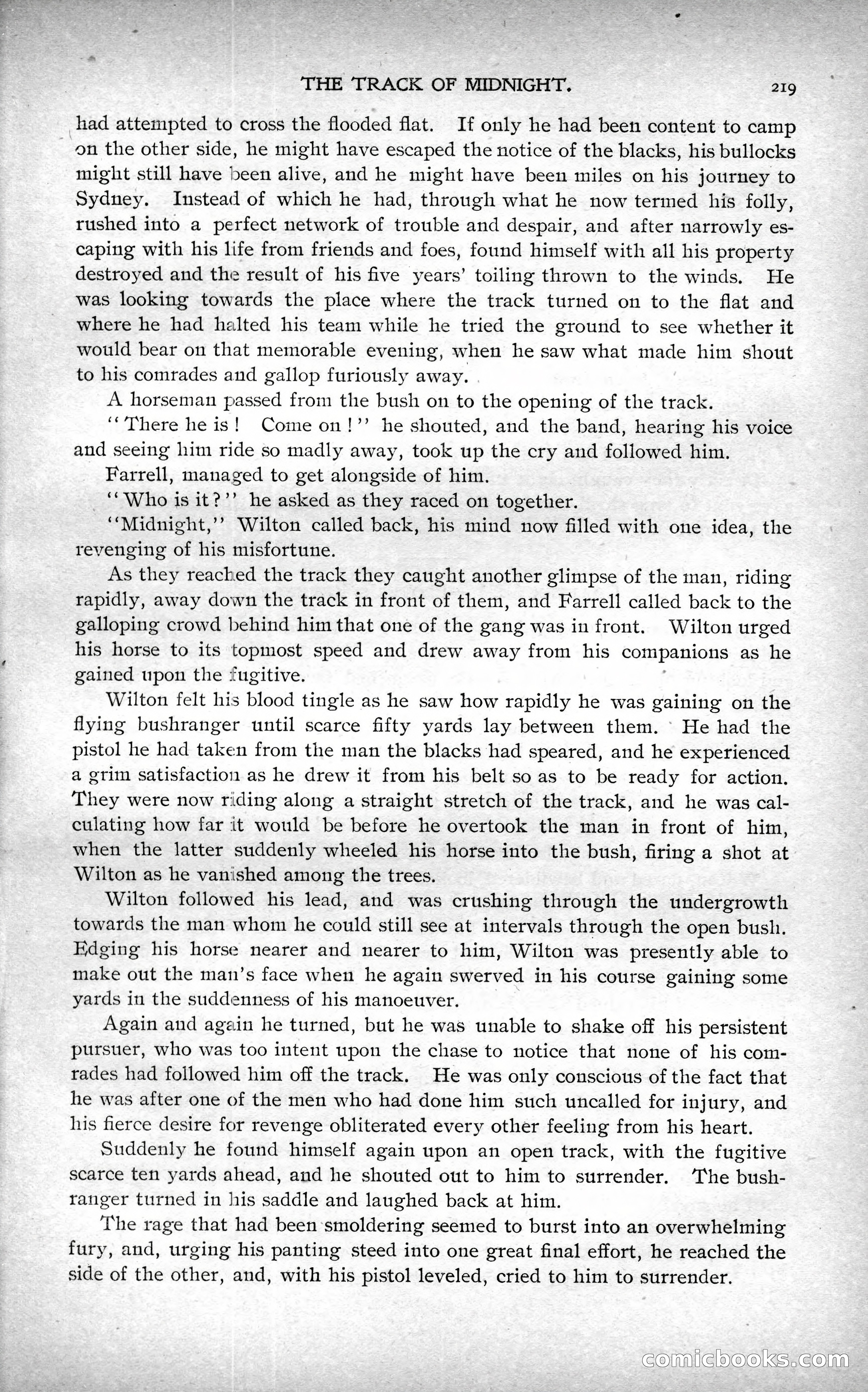
A restored page from Pulp Fiction, 1897. Page through the whole issue in the reader above.
📄 Transcribed text from this page (OCR, searchable)
Machine-transcribed from the original scan — historical spelling and the odd misread are preserved.
THE ‘TRACK OF MIDNIGHT. 219 had attempted to cross the flooded flat. If only he had been content to camp on the other side, he might have escaped the notice of the blacks, his bullocks might still have been alive, and he might have been miles on his journey to Sydney. Instead of which he had, through what he now termed his folly, rushed into a perfect network of trouble and despair, and after narrowly es- caping with his life from friends and foes, found himself with all his property destroyed and the result of his five years’ toiling thrown to the winds. He was looking towards the place where the track turned on to the flat and where he had halted his team while he tried the ground to see whether it would bear on that memorable evening, when he saw what made him shout to his comrades and gallop furiously away. A horseman passed from the bush on to the opening of the track. ‘“There he is! Come on!’’ he shouted, and the band, hearing his voice and seeing him ride so madly away, took up the cry and followed him. Farrell, managed to get alongside of him. ‘“Who is it?’’ he asked as they raced on together. ‘“Midnight,’? Wilton called back, his mind now filled with one idea, the revenging of his misfortune. As they reached the track they caught another glimpse of the man, riding rapidly, away down the track in front of them, and Farrell called back to the galloping crowd behind him that one of the gang was in front. Wilton urged his horse to its topmost speed and drew away from his companions as he gained upon the fugitive. Wilton felt his blood tingle as he saw how rapidly he was gaining on the flying bushranger until scarce fifty yards lay between them. ° He had the pistol he had taken from the man the blacks had speared, and he experienced a grim satisfaction as he drew it from his belt so as to be ready for action. They were now riding along a straight stretch of the track, and he was cal- culating how far it would be before he overtook the man in front of him, when the latter suddenly wheeled his horse into the bush, firing a shot at Wilton as he vanished among the trees. Wilton followed his lead, and was crushing through the undergrowth towards the man whom he could still see at intervals through the open bush. Edging his horse nearer and nearer to him, Wilton was presently able to make out the man’s face when he again swerved in his course gaining some yards in the suddenness of his manoeuver. e Again and again he turned, but he was unable to shake off his persistent pursuer, who was too intent upon the chase to notice that none of his com- rades had followed him off the track. He was only conscious of the fact that he was after one of the men who had done him such uncalled for injury, and his fierce desire for revenge obliterated every other feeling from his heart. Suddenly he found himself again upon an open track, with the fugitive scarce ten yards ahead, and he shouted out to him to surrender. ‘The bush- ranger turned in his saddle and laughed back at him. The rage that had been smoldering seemed to burst into an overwhelming fury, and, urging his panting steed into one great final effort, he reached the side of the other, and, with his pistol leveled, cried to him to surrender. Copmmiclaoolks |