
Pulp Fiction, 1897 · page 148 of 192
The Argosy, Vol. XXIV No. 2 — page 148: what you’re looking at
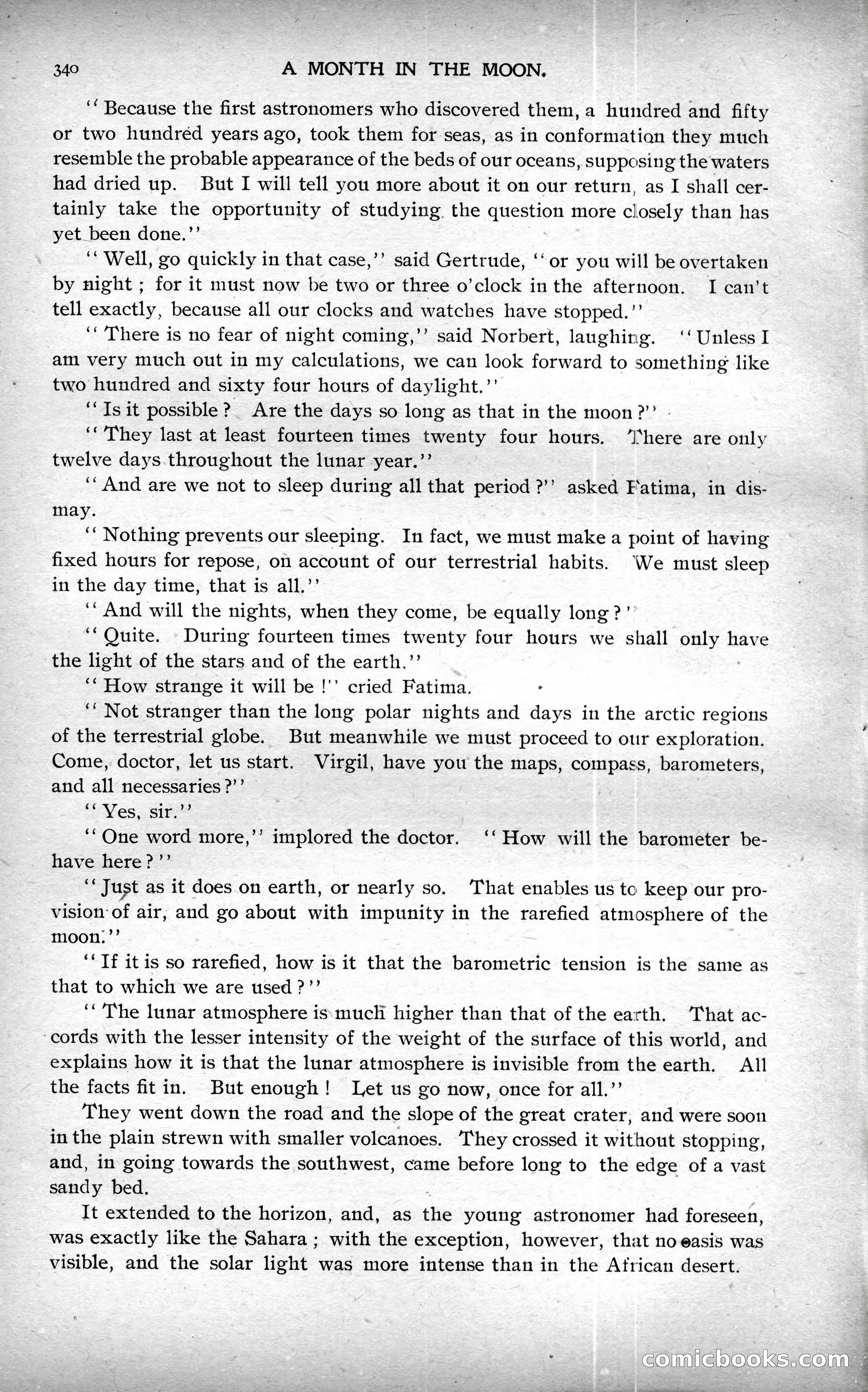
A restored page from Pulp Fiction, 1897. Page through the whole issue in the reader above.
📄 Transcribed text from this page (OCR, searchable)
Machine-transcribed from the original scan — historical spelling and the odd misread are preserved.
340 A MONTH IN THE MOON. ‘Because the first astronomers who discovered them, a hundred and fifty or two hundréd years ago, took them for seas, as in conformation they much resemble the probable appearance of the beds of our oceans, supposing the waters had dried up. But I will tell you more about it on our return, as I shall cer- tainly take the opportunity of studying the question more closely than has yet been done.’’ ‘Well, go quickly in that case,’’ said Gertrude, ‘‘or you will be overtaken by night ; for it must now be two or three o’clock in the afternoon. I can’t tell exactly, because all our clocks and watches have stopped.’’ ‘“ There is no fear of night coming,’’ said Norbert, laughing. ‘‘ Unless I am very much out in my calculations, we can look forward to something like two hundred and sixty four hours of daylight.’’ ‘““Is it possible ?_ Are the days so long as that in the moon?’ - ‘They last at least fourteen times twenty four hours. ‘I‘here are only twelve days throughout the lunar year.’’ ‘And are we not to sleep during all that period?’ asked Fatima, in dis- may. ‘‘ Nothing prevents our sleeping. In fact, we must make a point of having fixed hours for repose, on account of our terrestrial habits. We must sleep in the day time, that is all.’’ ‘And will the nights, when they come, be equally long?’ ‘Quite. During fourteen times twenty four hours we shall only have the light of the stars and of the earth.’’ ‘* How strange it will be !'’ cried Fatima. ‘" Not stranger than the long polar nights and days in the arctic regions of the terrestrial globe. But meanwhile we must proceed to our exploration. Come, doctor, let us start. Virgil, have you the maps, compass, barometers, and all necessaries ?”’ ‘* Yes, sir.’ ‘“One word more, have here ?’’ ‘« Just as it does on earth, or nearly so. That enables us to keep our pro- vision of air, and go about with impunity in the rarefied atmosphere of the moon.”’ “Tf it is so rarefied, how is it that the barometric tension is the same as that to which we are used ?’’ ‘The lunar atmosphere is much higher than that of the earth. ‘That ac- ‘cords with the lesser intensity of the weight of the surface of this world, and explains how it is that the lunar atmosphere is invisible from the earth. All the facts fitin. But enough! Let us go now, once for all.”’ They went down the road and the slope of the great crater, and were soon in the plain strewn with smaller volcanoes. They crossed it without stopping, and, in going towards the southwest, came before long to the edge of a vast sandy bed. : It extended to the horizon, and, as the young astronomer had foreseen, was exactly like the Sahara; with the exception, however, that noeasis was visible, and the solar light was more intense than in the African desert. 3 implored the doctor. ‘‘ How will the barometer be- (EAniicel ooyvoy x S| Tage te eee