
Pulp Fiction, 1897 · page 134 of 192
The Argosy, Vol. XXIV No. 2 — page 134: what you’re looking at
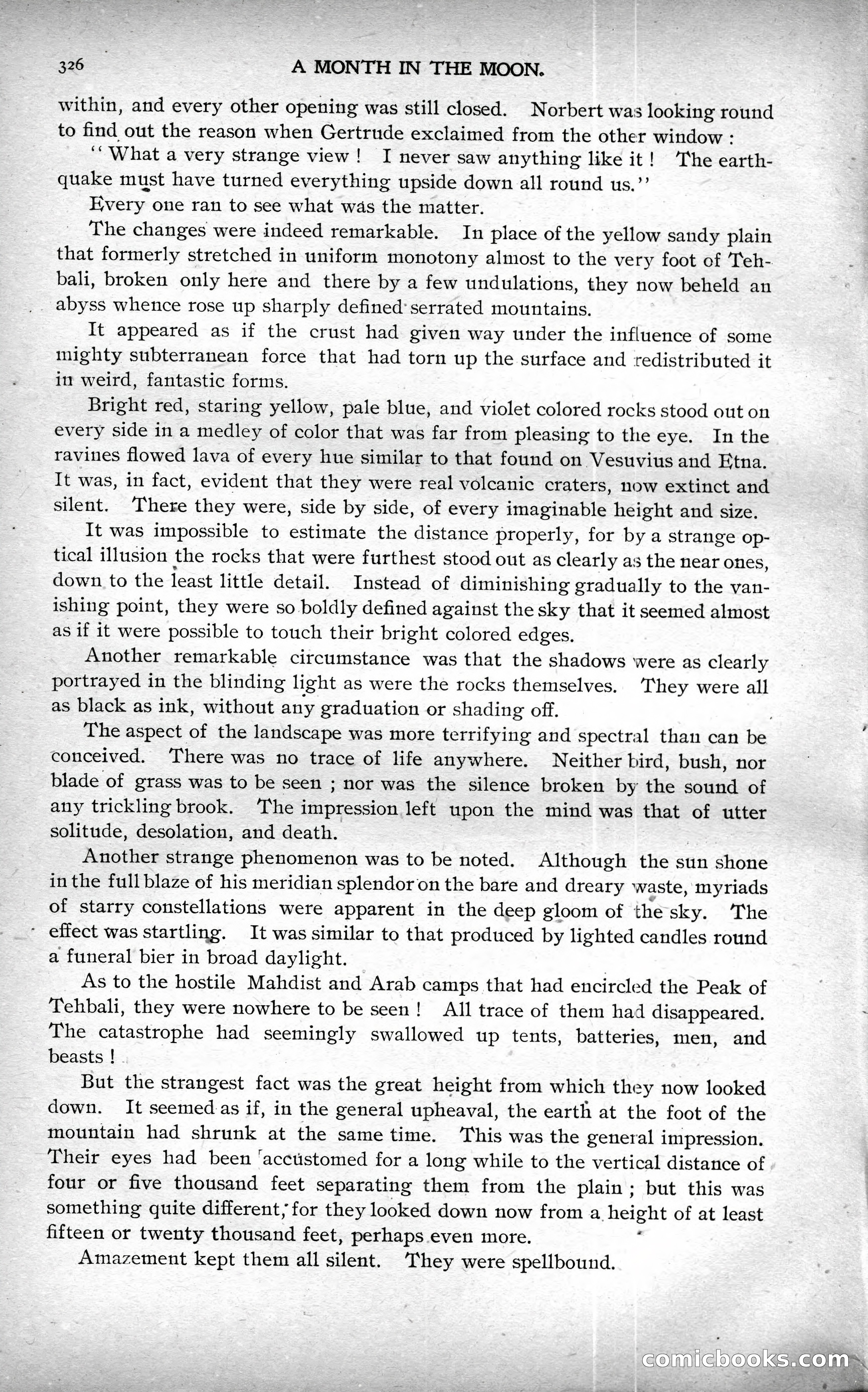
A restored page from Pulp Fiction, 1897. Page through the whole issue in the reader above.
📄 Transcribed text from this page (OCR, searchable)
Machine-transcribed from the original scan — historical spelling and the odd misread are preserved.
326 A MONTH IN THE MOON. within, and every other opening was still closed. Norbert was looking round to find out the reason when Gertrude exclaimed from the other window - ‘What a very strange view! I never saw anything like it! ‘The earth- quake must have turned everything upside down all round us.”’ Every one ran to see what was the matter. The changes were indeed remarkable. In place of the yellow sandy plain that formerly stretched in uniform monotony almost to the very foot of Teh-. bali, broken only here and there by a few undulations, they now beheld an abyss whence rose up sharply defined’ serrated mountains. It appeared as if the crust had given way under the influence of some mighty subterranean force that had torn up the surface and redistributed it im weird, fantastic forms. Bright red, staring yellow, pale blue, and violet colored rocks stood out on every side in a medley of color that was far from pleasing to the eye. In the ravines flowed lava of every hue similar to that found on Vesuvius and Etna. It was, in fact, evident that they were real volcanic craters, now extinct and silent. There they were, side by side, of every imaginable height and size. It was impossible to estimate the distance properly, for by a strange op- tical illusion the rocks that were furthest stood out as clearly as the near ones, down to the least little detail. Instead of diminishing gradually to the van- ishing point, they were so boldly defined against the sky that it seemed almost as if it were possible to touch their bright colored edges. Another remarkable circumstance was that the shadows were as clearly portrayed in the blinding light as were the rocks themselves. They were all as black as ink, without any graduation or shading off. The aspect of the landscape was more terrifying and spectral than can be conceived. ‘There was no trace of life anywhere. Neither bird, bush, nor blade of grass was to be seen ; nor was the silence broken by the sound of any trickling brook. ‘The i ee left upon the mind was that of utter solitude, desolation, and death. | Another strange phenomenon was to be noted. Although the sun shone in the full blaze of his meridian splendor on the bare and dreary waste, myriads of starry constellations were apparent in the deep gloom of the sky. ‘The ' effect was startling. It was similar to that produced by lighted candles round a funeral bier in broad daylight. | As to the hostile Mahdist and Arab camps that had encircled the Peak of Tehbali, they were nowhere to be seen! All trace of them had disappeared. The catastrophe had seemingly swallowed up tents, batteries, men, and beasts ! _ But the strangest fact was the great height from which they now looked down. It seemed-as if, in the general upheaval, the earth at the foot of the mountain had shrunk at the same time. ‘This was the general i impression. Their eyes had been ‘accustomed for a long while to the vertical distance of four or five thousand feet separating them from the plain; but this was something quite different; for they looked down now from a neight of at least fifteen or twenty thousand feet, perhaps even more. Amazement kept them all silent. They were spellbound. a (E(0) mi iboo cS