
Pulp Fiction, 1897 · page 83 of 192
The Argosy, Vol. XXIV, No. 1 — page 83: what you’re looking at
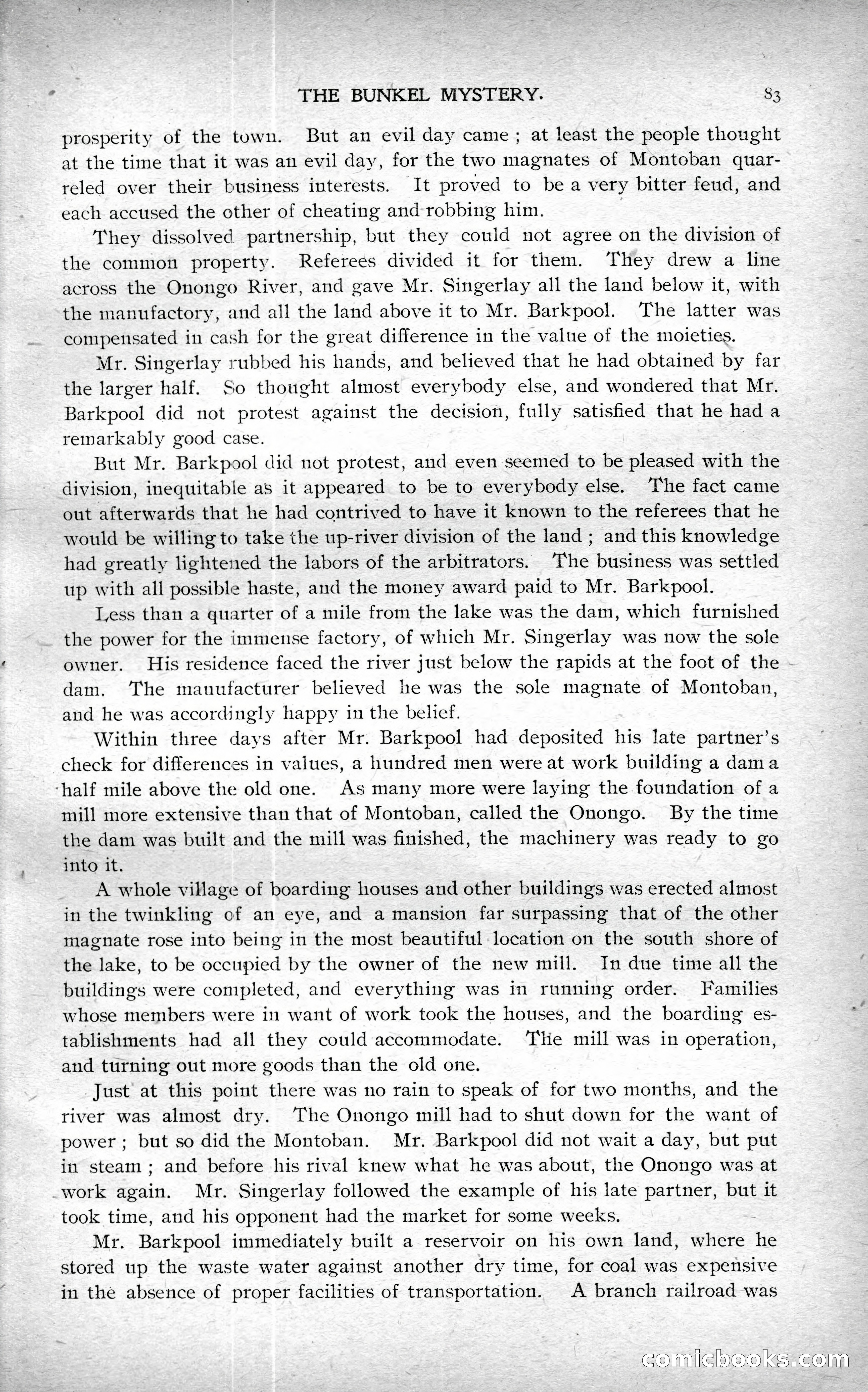
A restored page from Pulp Fiction, 1897. Page through the whole issue in the reader above.
📄 Transcribed text from this page (OCR, searchable)
Machine-transcribed from the original scan — historical spelling and the odd misread are preserved.
THE BUNKEL MYSTERY. 83 prosperity of the town. But an evil day came ; at least the people thought at the time that it was an evil day, for the two magnates of Montoban quar- reled over their business interests. It proved to be a very bitter feud, and each accused the other of cheating and robbing him. They dissolved partnership, but they could not agree on the division of the common property. Referees divided it for them. They drew a line across the Onongo River, and gave Mr. Singerlay all the land below it, with the manufactory, and all the land above it to Mr. Barkpool. The latter was compensated in cash for the great difference in the value of the moieties. Mr. Singerlay rubbed his hands, and believed that he had obtained by far the larger half. So thought almost everybody else, and wondered that Mr. Barkpool did not protest against the decision, fully satisfied that he had a remarkably good case. : But Mr. Barkpool did not protest, and even seemed to be pleased with the division, inequitable as it appeared to be to everybody else. The fact came out afterwards that he had contrived to have it known to the referees that he would be willing to take the up-river division of the land ; and this knowledge had greatly lightened the labors of the arbitrators. The business was settled up with all possible haste, and the money award paid to Mr. Barkpool. Less than a quarter of a mile from the lake was the dam, which furnished the power for the immense factory, of which Mr. Singerlay was now the sole owner. His residence faced the river just below the rapids at the foot of the dam. ‘The manufacturer believed he was the sole magnate of Montoban, and he was accordingly happy in the belief. Within three days after Mr. Barkpool had deposited his late partner’s check for differences in values, a hundred men were at work building a dama ‘half mile above the old one. As many more were laying the foundation of a mill more extensive than that of Montoban, called the Onongo. By the time the dam was built and the mill was finished, the machinery was ready to go into it. A whole village of boarding houses and other buildings was erected almost in the twinkling of an eye, and a mansion far surpassing that of the other magnate rose into being in the most beautiful location on the south shore of the lake, to be occupied by the owner of the new mill. In due time all the buildings were completed, and everything was in running order. Families whose members were in want of work took the houses, and the boarding es- tablishments had all they could accommodate. ‘Tlie mill was in operation, and turning out more goods than the old one. Just at this point there was no rain to speak of for two months, and the river was almost dry. The Onongo mill had to shut down for the want of power ; but so did the Montoban. Mr. Barkpool did not wait a day, but put in steam; and before his rival knew what he was about, the Onongo was at -work again. Mr. Singerlay followed the example of his late partner, but it took time, and his opponent had the market for some weeks. Mr. Barkpool immediately built a reservoir on his own land, where he stored up the waste water against another dry time, for coal was expensive in the absence of proper facilities of transportation. A branch railroad was CoORniclaoolks 3