
Pulp Fiction, 1897 · page 142 of 192
The Argosy, Vol. XXIV, No. 1 — page 142: what you’re looking at
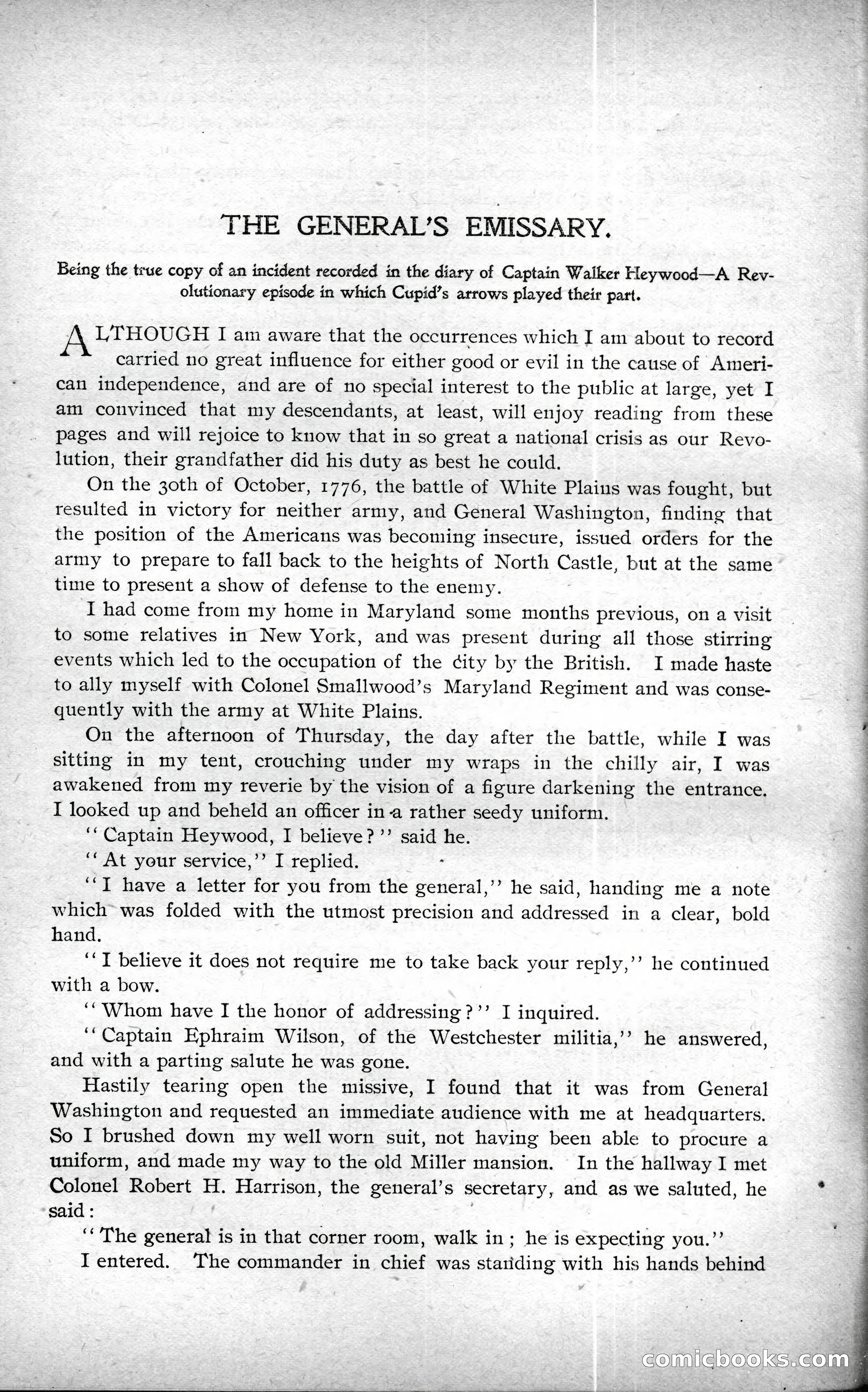
A restored page from Pulp Fiction, 1897. Page through the whole issue in the reader above.
📄 Transcribed text from this page (OCR, searchable)
Machine-transcribed from the original scan — historical spelling and the odd misread are preserved.
THE GENERAL’S EMISSARY. Being the true copy of an incident recorded in the diary of Captain Walker Heywood—A Rev- olutionary episode in which Cupid’s arrows played their part. jy LTHOUGH I am aware that the occurrences which I am about to record carried no great influence for either good or evil in the cause of Ameri- can independence, and are of no special interest to the public at large, yet I am convinced that my descendants, at least, will enjoy reading from these pages and will rejoice to know that in so great a national crisis as our Revo- lution, their grandfather did his duty as best he could. On the 30th of October, 1776, the battle of White Plains was fought, but resulted in victory for neither army, and General Washington, finding that the position of the Americans was becoming insecure, issued orders for the army to prepare to fall back to the heights of North Castle, but at the same time to present a show of defense to the enemy. I had come from my home in Maryland some months previous, on a visit to some relatives in New York, and was present during all those stirring events which led to the occupation of the ¢ity by the British. I made haste to ally myself with Colonel Smallwood’s Maryland Regiment and was conse- quently with the army at White Plains. On the afternoon of Thursday, the day after the battle, while I was sitting in my tent, crouching under my wraps in the chilly air, I was awakened from my reverie by the vision of a figure darkening the entrance. I looked up and beheld an officer in-a rather seedy uniform. ‘Captain Heywood, I believe?’ said he. ‘“ At your service,’’ I replied. ‘I have a letter for you from the general,’’ he said, handing me a note which’ was folded with the utmost precision and addressed in a clear, bold hand. ‘I believe it does not require me to take back your reply,’’ he continued with a bow. ‘“ Whom have I the honor of addressing ?’’ I inquired. ‘Captain Ephraim Wilson, of the Westchester militia,’’? he answered, and with a parting salute he was gone. Hastily tearing open the missive, I found that it was from General Washington and requested an immediate audience with me at headquarters. So I brushed down my well worn suit, not having been able to procure a uniform, and made my way to the old Miller mansion. In the hallway I met Colonel Robert H. Harrison, the general’s secretary, and as we saluted, he said: “The general is in that corner room, walk in; he is expecting you.”’ Ientered. The commander in chief was stariding with his hands behind oF eA Pa ee Pre a 3 ecomichbook