
Pulp Fiction, 1897 · page 102 of 192
The Argosy, Vol. XXIV, No. 1 — page 102: what you’re looking at
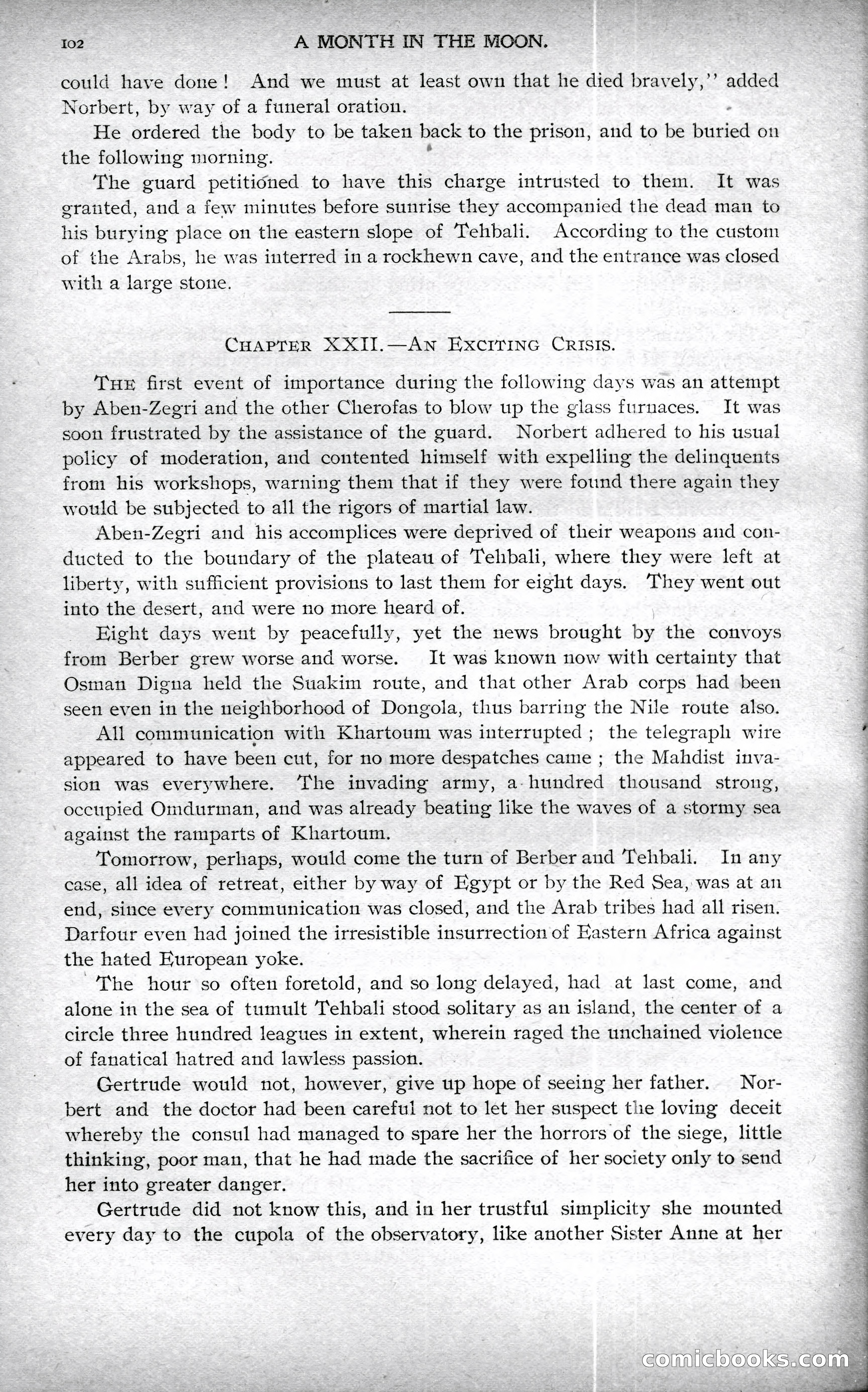
A restored page from Pulp Fiction, 1897. Page through the whole issue in the reader above.
📄 Transcribed text from this page (OCR, searchable)
Machine-transcribed from the original scan — historical spelling and the odd misread are preserved.
102 A MONTH IN THE MOON. could have done! And we must at least own that he died bravely,’’ added Norbert, by way of a funeral oration. He ordered the body to be taken back to the prison, and to be buried on the following morning. The guard petitioned to have this charge intrusted to them. It was erated, and a few minutes before sunrise they accompanied the dead man to his burying place on the eastern slope of Tehbali. According to the custom of the Arabs, he was interred in a rockhewn cave, and the entrance was closed with a large stone. CHAPTER XXII.—AN EXCITING CRISIS. Tue first event of importance during the following days was an attempt by Aben-Zegri and the other Cherofas to blow up the glass furnaces. It was soon frustrated by the assistance of the guard. Norbert adhered to his usual policy of moderation, and contented himself with expelling the delinquents from his workshops, warning them that if they were found there again they would be subjected to all the rigors of martial law. Aben-Zegri and his accomplices were deprived of their weapons and con- ducted to the boundary of the plateau of Tehbali, where they were left at liberty, with sufficient provisions to last them for eight days. They went out into the desert, and were no more heard of. Eight days went by peacefully, yet the news brought by the convoys from Berber grew worse and worse. It was known now with certainty that Osman Digna held the Suakim route, and that other Arab corps had been seen even in the neighborhood of Dongola, thus barring the Nile route also. All communication with Khartoum was interrupted ; the telegraph wire appeared to have been cut, for no more despatches came ; the Mahdist inva- sion was everywhere. ‘The invading army, a- hundred thousand strong, occupied Omdurman, and was already beating like the waves of a stormy sea against the ramparts of Khartoum. Tomorrow, perhaps, would come the turn of Berber and Tehbali. In any case, all idea of retreat, either by way of Egypt or by the Red Sea, was at an end, since every communication was closed, and the Arab tribes had all risen. Darfour even had joined the irresistible insurrection of Kastern Africa against the hated European yoke. The hour so often foretold, and so long delayed, had at last come, and alone in the sea of tumult Tehbali stood solitary as an island, the center of a circle three hundred leagues in extent, wherein raged the unchained violence of fanatical hatred and lawless passion. Gertrude would not, however, give up hope of seeing her father. Nor- bert and the doctor had been careful not to let her suspect the loving deceit whereby the consul had managed to spare her the horrors of the siege, little thinking, poor man, that he had made the sacrifice of her society only to send her into greater danger. Gertrude did not know this, and in her trustful simplicity she mounted every day to the cupola of the observatory, like another Sister Anne at her (COMME NOC KS 5} (E(0) = i Teer ee Pee om aunt — | oe PR ae eee ee