
Pulp Fiction, 1922 · page 86 of 180
Argosy, Vol. 147, No. 1 — page 86: what you’re looking at
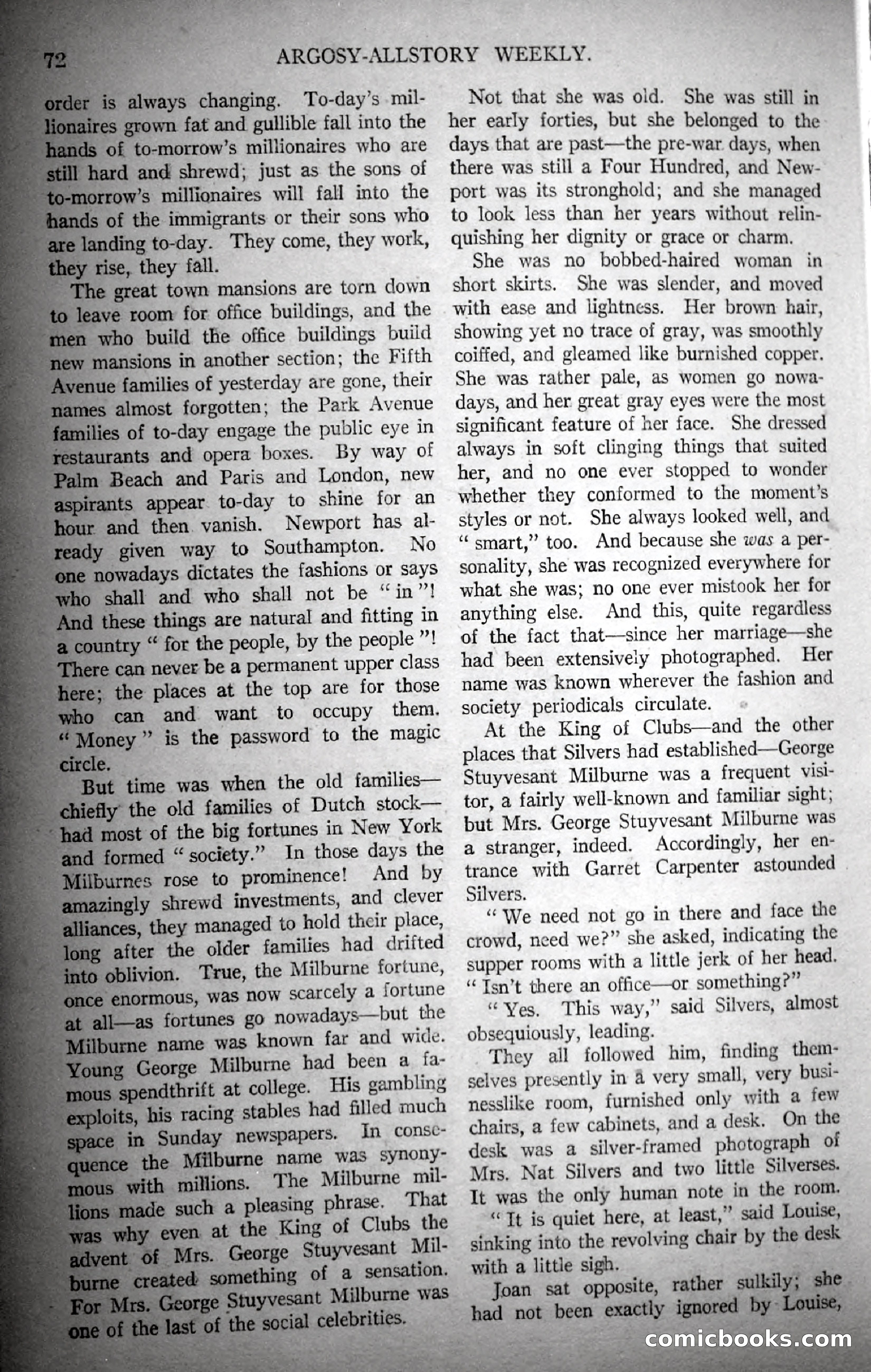
A restored page from Pulp Fiction, 1922. Page through the whole issue in the reader above.
📄 Transcribed text from this page (OCR, searchable)
Machine-transcribed from the original scan — historical spelling and the odd misread are preserved.
| ARGOSY-ALLSTORY WEEKLY. s always changing. To-day’s mil- es grown fat and gullible fall into the ; of to-morrow’s millionaires who are hard and shrewd; just as the sons of srrow’s millionaires will fall into the the immigrants or their sons who ing to-day. They come, they work, rise, they fall. The great town mansions are torn down 2 room for office buildings, and the | who build the office buildings build nsions in another section; the Fifth enue families of yesterday are gone, their ames almost forgotten; the Park -Avenue milies of to-day engage the public eye in jurants and opera boxes. By way of m Beach and Paris and London, new irants appear to-day to shine for an our and then vanish. Newport has al- eady given way to Southampton. No e nowadays dictates the fashions or says all and who shall not be “in”! ese things are natural and fitting in for the people, by the people ”! here can never be a permanent upper class e; the places at the top are for those peg = 10 can and want to occupy them. a Money ” is the password to the magic But time was when the old families— * the old families of Dutch stock— st of the big fortunes in New York ned “society.” In those days the es rose to prominence! And by y shrewd investments, and clever ances, they managed to hold their place, + after the older families had drifted ivion. True, the Milburne fortune, s enormous, was now scarcely a fortune ali—as fortunes go nowadays—but the Ibume name was known far and wide. ¥ eorge Milburne had been a fa- spendthrift at college. His gambling its, his racing stables had filled much in Sunday newspapers. In consc- ‘the Milburne name was synony- ade such a pleasing phrase. That ogg King of Clubs the a, Ay Cy L: é.. 37% Of. 8) SPARE ary — sat « - ‘ € — 4 me ie ee a ae ; _.: 2 Not that she was old. She was still in her early forties, but she belonged to the days that are past—the pre-war days, when there was still a Four Hundred, and New- port was its stronghold; and she managed to look less than her years without relin- quishing her dignity or grace or charm. She was no bobbed-haired woman in short skirts. She was slender, and moved with ease and lightness. Her brown hair, showing yet no trace of gray, was smoothly coiffed, and gleamed like burnished copper. She was rather pale, as women go nowa- days, and her great gray eyes were the most significant feature of her face. She dressed always in soft clinging things that suited her, and no one ever stopped to wonder whether they conformed to the moment’s styles or not. She always looked well, and “smart,” too. And because she was a per- sonality, she was recognized everywhere for what she was; no one ever mistook her for anything else. And this, quite regardless of the fact that—since her marriage—she had been extensively photographed. Her name was known wherever the fashion and society periodicals circulate. At the King of Clubs—and the other places that Silvers had established—George Stuyvesant Milburne was a frequent visl- tor, a fairly well-known and familiar sight; but Mrs. George Stuyvesant Milburne was a stranger, indeed. Accordingly, her en- trance with Garret Carpenter astounded Silvers. “We need not go in there and face the crowd, need we?” she asked, indicating the supper rooms with a little jerk of her head. “Tsn’t there an office—or something?” “Ves, This way,” said Silvers, almost obsequiously, leading. They all followed him, finding them- selves presently in 4 very small, very busi- nesslike room, furnished only with a few chairs, a few cabinets, and a desk. On the desk was a silver-framed photograph of Mrs. Nat Silvers and two little Silverses. It was the only human note in the room. “Tt is quiet here, at least,” said Louise, sinking into the revolving chair by the desk with a little sigh. ea as “t. oe am of 0) “* Tet) i ee boo ’ Pi Fae i. ge - a. IC ks.com =e om Pg —_- * ._