
Pulp Fiction, 1922 · page 81 of 180
Argosy, Vol. 147, No. 1 — page 81: what you’re looking at
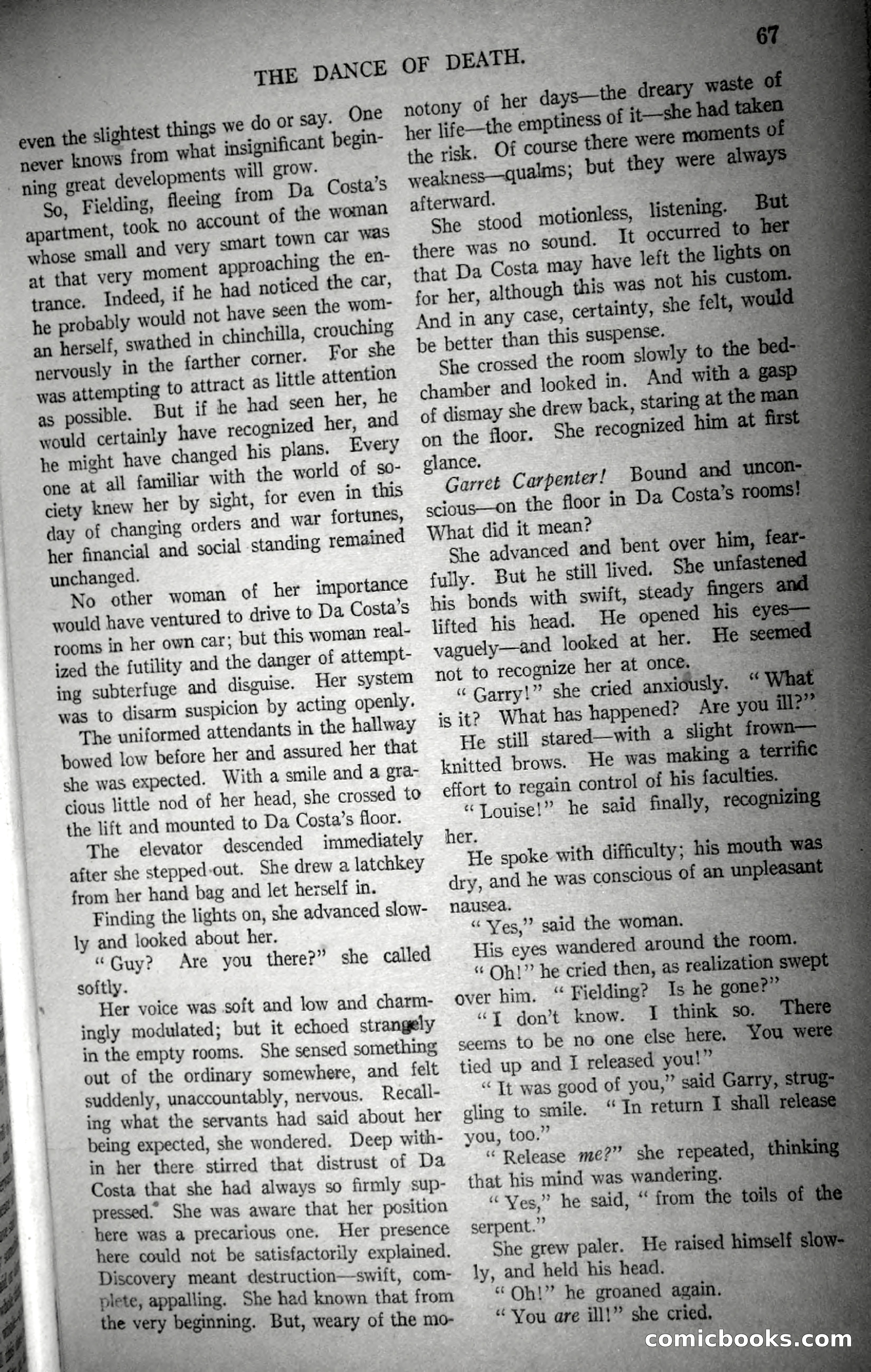
A restored page from Pulp Fiction, 1922. Page through the whole issue in the reader above.
📄 Transcribed text from this page (OCR, searchable)
Machine-transcribed from the original scan — historical spelling and the odd misread are preserved.
“ « * ‘2.4 ~ oven the slightest things We do or say. One notony of her days—me SL a oars from what insignificant begin- her life—the emptiness of 1b" ~ - ning great developments will grow. the risk. Of course range So, Fielding, fleeing from Da Costa’s weakness—qualms; t they Werke apartment, took no account of the woman afterward. oa whose small and very smart town car Was She stood motionless, 1! at that very moment approaching the en- there was no sound. Tt occurred (0 trance. Indeed, if he had noticed the car, that Da Costa may have left the lig hts he probably would not have seen the wom- for her, although this was not his | cust an herself, swathed in chinchilla, crouching And in any case, certainty, she elt, W nervously in the farther corner. For she be better than this suspense. was attempting to attract as little attention She crossed the room slowly to as possible. But if he had seen her, he chamber and looked in. d itl would certainly have recognized her, and of dismay she drew back, staring at the he might have changed his plans. Every on the floor. She recognized him at ? one at all familiar with the world of so- glance. ee ciety knew her by sight, for even in this Garret Carpenter! Bound and un scjous—on the floor in Da Costa’s rool day of changing orders and war fortunes, her financial and social standing remained What did it mean? E She advanced and bent over ® Ir unchanged. No other woman of her importance fully. But he still lived. drive to Da Costa’s his ponds with swift, steady fi this woman real- lifted his head. He opened h es vaguely—and looked at her. He set eee would have ventured to rooms in her own car, but ‘zed the futility and the danger of attempt- ing subterfuge and disguise. Her system not to recognize her at Once. sais was to disarm suspicion by acting openly. «“ Garry!” she cried dusly. Y The uniformed attendants in the hallway is it? What has happened? Are. bowed low before her and assured her that He still stared—with a slight | che was expected. With a smile and a gra- knitted brows. He was making a cious little nod of her head, she crossed to effort to regain control of his fac 1 the lift and mounted to Da Costa’s floor. “ Louise!” he said finally, Tel The elevator descended immediately her. an after she stepped-out. She drew a latchkey He spoke with difficulty ; his mouth from her hand bag and let herself in. dry, and he was conscious of an Finding the lights on, she advanced slow- nausea. | SR ly and looked about her. ‘Year said the woman. “Guy? Are you there?” she called His eyes wandered around tk , softly. “ Qh!” he cried then, as realiz _ Her voice was soft and low and charm- over him. © Fielding? Is he ¢ ) ingly modulated; but it echoed strangely “J don’t know. If think | in the empty rooms. She sensed something seems to be no one else here. | out of the ordinary somewhere, and felt tied up and I released you!” 38 suddenly, unaccountably, nervous. Recall- “Tt was good of you,” said | ing what the servants had said about her gling to smile. “ In return 1 | ne seeies, she wondered. Deep with- you, too.” a ) er there stirred that distrust of Da " “ Release me?” us Costa that she had always so firmly sup- that his mind a pee "2 pressed. She was aware that her position “Yes,” he said, “ from the | | ht was a precarious one. Her presence serpent.” an a could not be satisfactorily explained. She grew paler. He ré a iscovery meant destruction—swiit, com- ly, and held his hea. ee plete, appalling. She had known th “f : +: 2 Spee le es a .~ at from “ Oh!” he aned agai ee - the very beginning. Bu ; groaned SEB Ae lee atid t, weary of the mo- ‘You are ill!” she ¢ Reon ee ic | * ; . orate = f » a ae - o. (ae a a) | “aad. ~ae = ,