
Pulp Fiction, 1922 · page 76 of 180
Argosy, Vol. 147, No. 1 — page 76: what you’re looking at
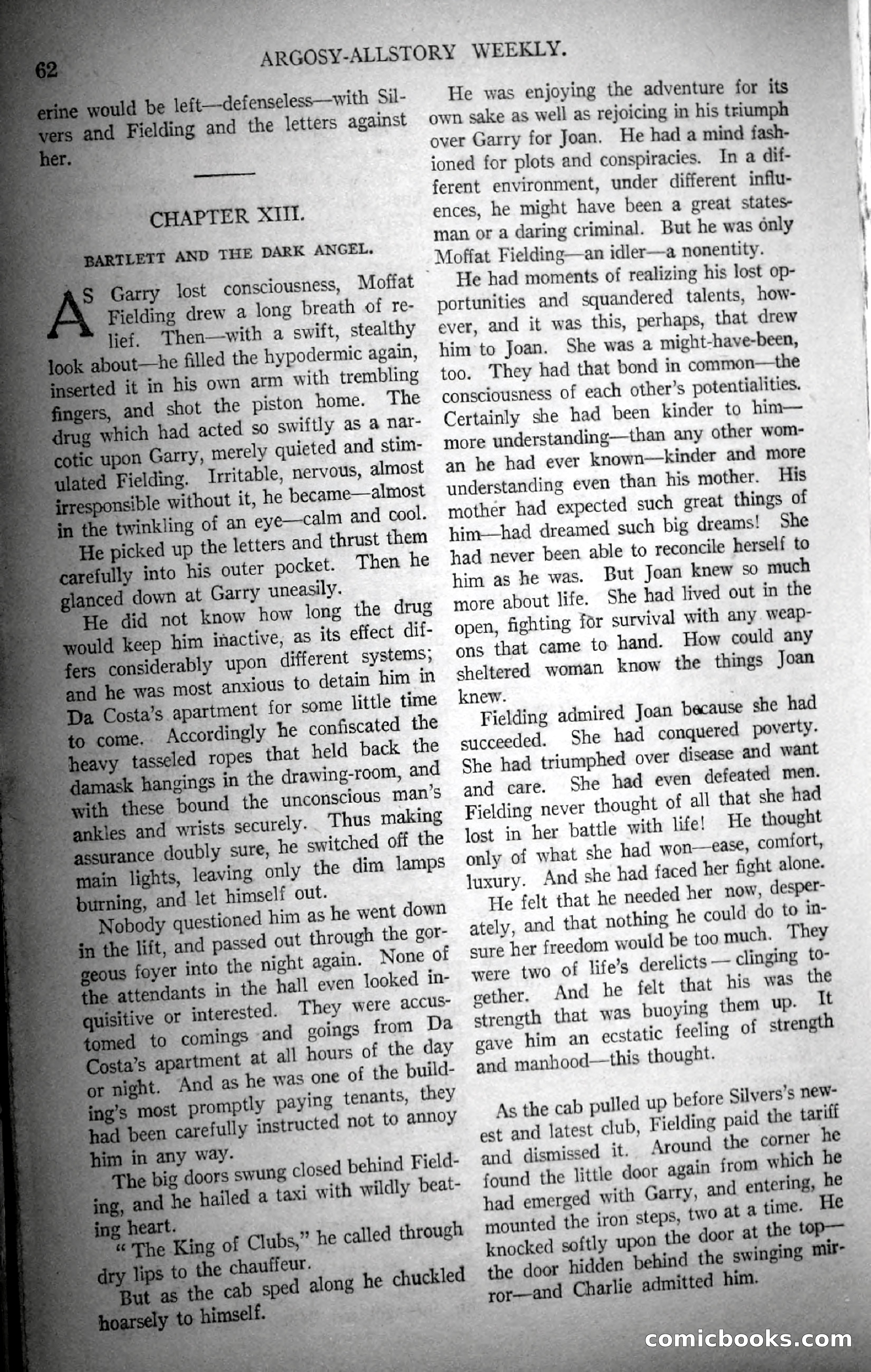
A restored page from Pulp Fiction, 1922. Page through the whole issue in the reader above.
📄 Transcribed text from this page (OCR, searchable)
Machine-transcribed from the original scan — historical spelling and the odd misread are preserved.
Sots _ < a na a i, B iy oP ¥ . * y " ‘ ¥ > = “em a ‘ i ] ARGOSY-ALLSTORY WEEKLY. cvaaed ; é Id be left—defenseless—with Sil- 1 Fie ding and the letters against “a rh —_—_—_—_—_— §> BTS CHAPTER XIIl pi AND THE DARK ANGEL. ; ding drew a long breath of re- ‘ie Then—with a swift, stealthy about—he filled the hypodermic again, a a es on * \Y Jk efully into his outer pocket. ced down at Garry uneasily. considerably ing, and let himself out. JU > 6 comings and goings from 5a . ane ‘And as he was one of the = AL. sj a ak ' : oO Clubs,” he called through ry lost consciousness, Moffat | d it in his own arm with trembling ers, and shot the piston home. The which had acted so swiftly as a nar- > upon Garry, merely quieted and stim- d Fielding. Irritable, nervous, almost nsible without it, he became—almost nkling of an eye—calm and cool. <ed up the letters and thrust them Then he did not know how long the drug 1 keep him inactive, as its effect dif- | upon different systems; he was most anxious to detain him in ‘osta’s apartment for some little time ne. Accordingly he confiscated the y ti sseled ropes that held back the ask har gings in the drawing-room, and these bound the unconscious man’s es and wrists securely. Thus making ance doubly sure, he switched off the chts. leaving only the dim lamps ) dy questioned him as he went down e lift, and passed out through the gor- is foyer into the night again. None of att dar s in the hall even looked in- tive or interested. They were accus- 1 Da strength that was buoying apa tment at all hours of the day gave him an ecstatic feeling of strength build- most promptly paying tenants, they peen carefully instructed not to annoy e big doors swung closed behind Field- d he hailed a taxi with wildly beat- He was enjoying the adventure for its own sake as well as rejoicing in his triumph over Garry for Joan. He hada mind fash- ioned for plots and conspiracies. In a dif- ferent environment, under different influ- ences, he might have been a great states- man or a daring criminal. But he was only Moffat Fielding—an idler—a nonentity. He had moments of realizing his lost op- portunities and squandered talents, how- ever, and it was this, perhaps, that drew him to Joan. She was a might-have-been, too. They had that bond in common—the consciousness of each other’s potentialities. Certainly she had been kinder to him— more understanding—than any other wom- an he had ever known—kinder and more understanding even than his mother. His mother had expected such great things of him—had dreamed such big dreams! She had never been able to reconcile herself to him as he was. But Joan knew so much more about life. She had lived out in the open, fighting for survival with any weap- ons that came to hand. How could any sheltered woman know the things Joan knew. , Fielding admired Joan because she had succeeded. She had conquered poverty. She had triumphed over disease and want and care. she had even defeated men. Fielding never thought of all that she had lost in her battle with life! only of what she had won—ease, comfort, luxury. And she had faced her fight alone. He felt that he needed her now, desper- ately, and that nothing he could do to in- sure her freedom would be too much. They were two of life’s derelicts — clinging to- And he felt that his was the them up. It gether. and manhood—this thought. est and latest club, Fielding paid and dismissed it. found the little door again from W had emerged with Garr mounted the iron steps, two at a time. knocked softly upon the ~ See one ror—and Charlie admitted him. i ius « @ ’ . Asie ie SAS eee ‘ S tm ae! oe Ae it 3 a ~ % °2 - - 4, — ee get f fy * fee Ae da gowt a > tees co i ee comicbooks.com . 7 ° ¥ x ~ Z J! i 3 He thought As the cab pulled up before Silvers’s new- the tariff Around the corner h hich he , and entering, he door at the top-—~