
Pulp Fiction, 1922 · page 163 of 180
Argosy, Vol. 147, No. 1 — page 163: what you’re looking at
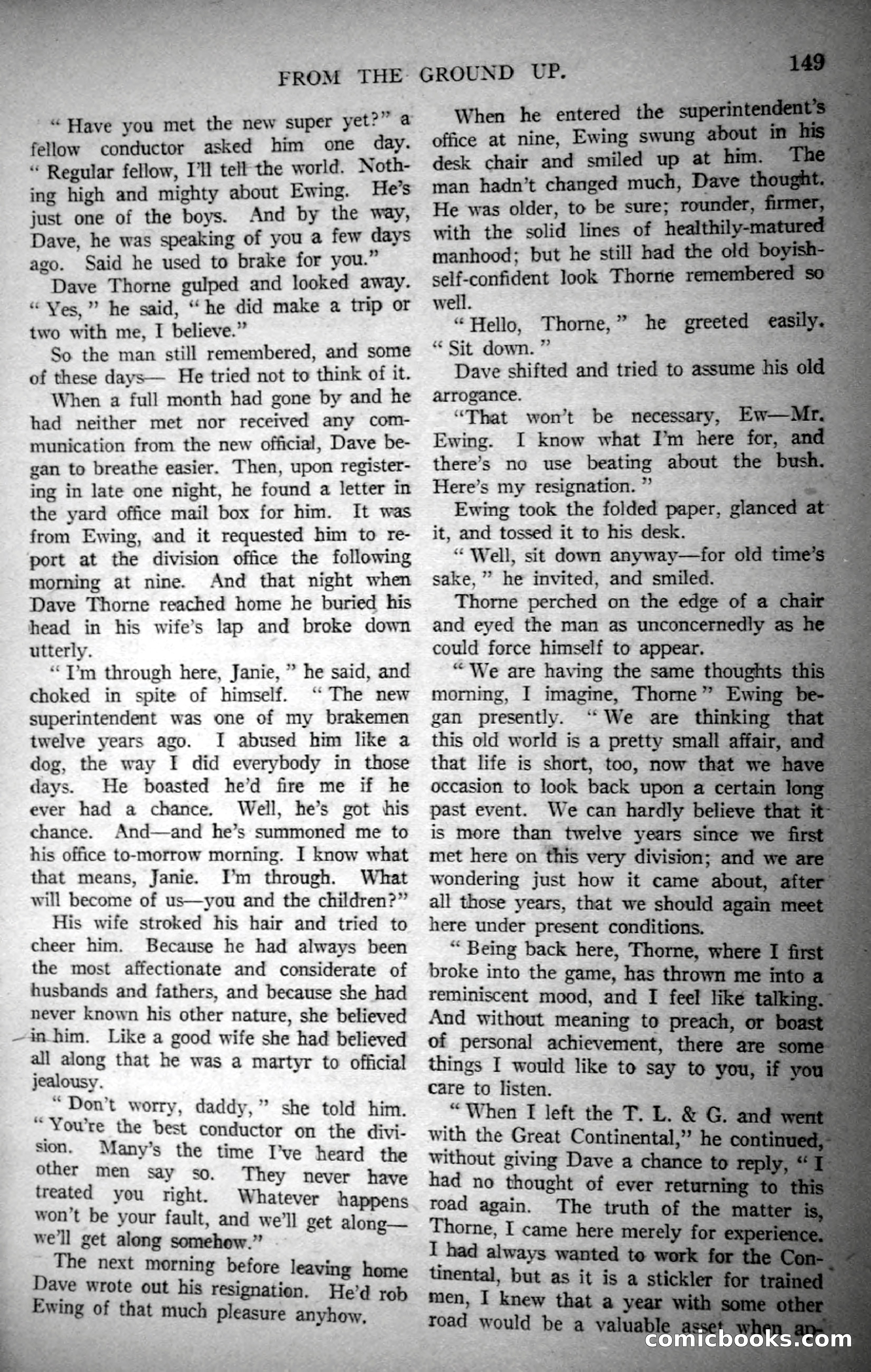
A restored page from Pulp Fiction, 1922. Page through the whole issue in the reader above.
📄 Transcribed text from this page (OCR, searchable)
Machine-transcribed from the original scan — historical spelling and the odd misread are preserved.
FROM THE GROUND UP. “Have you met the new super yet?” a fellow conductor asked him one day. “ Regular fellow, I'll tell the world. Noth- ing high and mighty about Ewing. He’s just one of the boys. And by the way, Dave, he was speaking of you a few days ago. Said he used to brake for you.” Dave Thorne gulped and looked away. “Ves,” he said, “he did make a trip or two with me, I believe.” So the man still remembered, and some of these days— He tried not to think of it. When a full month had gone by and he had neither met nor received any com- munication from the new official, Dave be- gan to breathe easier. Then, upon register- ing in late one night, he found a letter in the yard office mail box for him. It was from Ewing, and it requested him to re- port at the division office the following morning at nine. And that night when Dave Thorne reached home he buried his head in his wife’s lap and broke down utterly. ‘“T’m through here, Janie, ” he said, and choked in spite of himself. “The new superintendent was one of my brakemen twelve years ago. I abused him like a dog, the way I did everybody in those days. He boasted he’d fire me if he ever had a chance. Well, he’s got his chance. And—and he’s summoned me to his office to-morrow morning. I know what that means, Janie. I’m through. What will become of us—you and the children?” His wife stroked his hair and tried to cheer him. Because he had always been the most affectionate and considerate of husbands and fathers, and because she had never known his other nature, she believed —inhim. Like a good wife she had believed all along that he was a martyr to official jealousy. “ Don’t worry, daddy,” she told him. “You're the best conductor on the divi- sion. Many’s the time I’ve heard the other men say so. They never have treated you right. Whatever happens won’t be your fault, and we'll get along— we'll get along somehow.” The next morning before lea | _ Ein wrote out his resignation. weidoae g of that much pleasure anyhow, When fe entered the sup is = at nine, Ewing swung _ desk chair and smiled up at man hadn’t changed much, FE He was older, to be sure; re anc nder, , s “3 with the solid lines of healtt ily-mature manhood; but he still had the old 1 bered SA- self-confident look Thorrie mbered well. “Hello, Thorne,” he pected * Sit down. ” Dave shifted and tried to assume h arrogance. | “That won’t be necessary, Er ] Mr. Ewing. I know what I’m here for, and there’s no use beating about the Here’s my resignation. ” Ewing took the folded paper, it, and tossed it to his desk. “ Well, sit down anyway—for old t sake, ” he invited, and smiled. = Thorne perched on the edge of a oi and eyed the man as unconcernedly a: could force himself to appear. Be “We are having the same a morning, I imagine, Thorne” Ew “a € gan presently. “We are thinkir pe d this old world is a pretty small ¢ that life is short, too, now thera occasion to look back upon a certa in| ong past event. We can hardly believe that is more than twelve years since ve | met here on this very division; and y wondering just how it came about, all those years, that we should again m here under present conditions, = “ Being back here, Thorne, ¥ broke into the game, has thrown reminiscent mood, and I feel like ta And without meaning to peach, rr of personal achievement, nee things I would like to say to y care to listen. ‘ “When I left the T. L. & G. a with the Great Continental,” ] 3 CO without giving Dave a chance t or had no thought of ever ret ring poten again. The truth of t orne, I came here merely fo I had always wanted to wor tinental, but as it is as men, I knew tite z road would oul he gee soa 3 ~comicbooks. com ’ ‘ “ =memb £ ” : ancec $ i “. ; — Sa houghts a |