
Pulp Fiction, 1922 · page 161 of 180
Argosy, Vol. 147, No. 1 — page 161: what you’re looking at
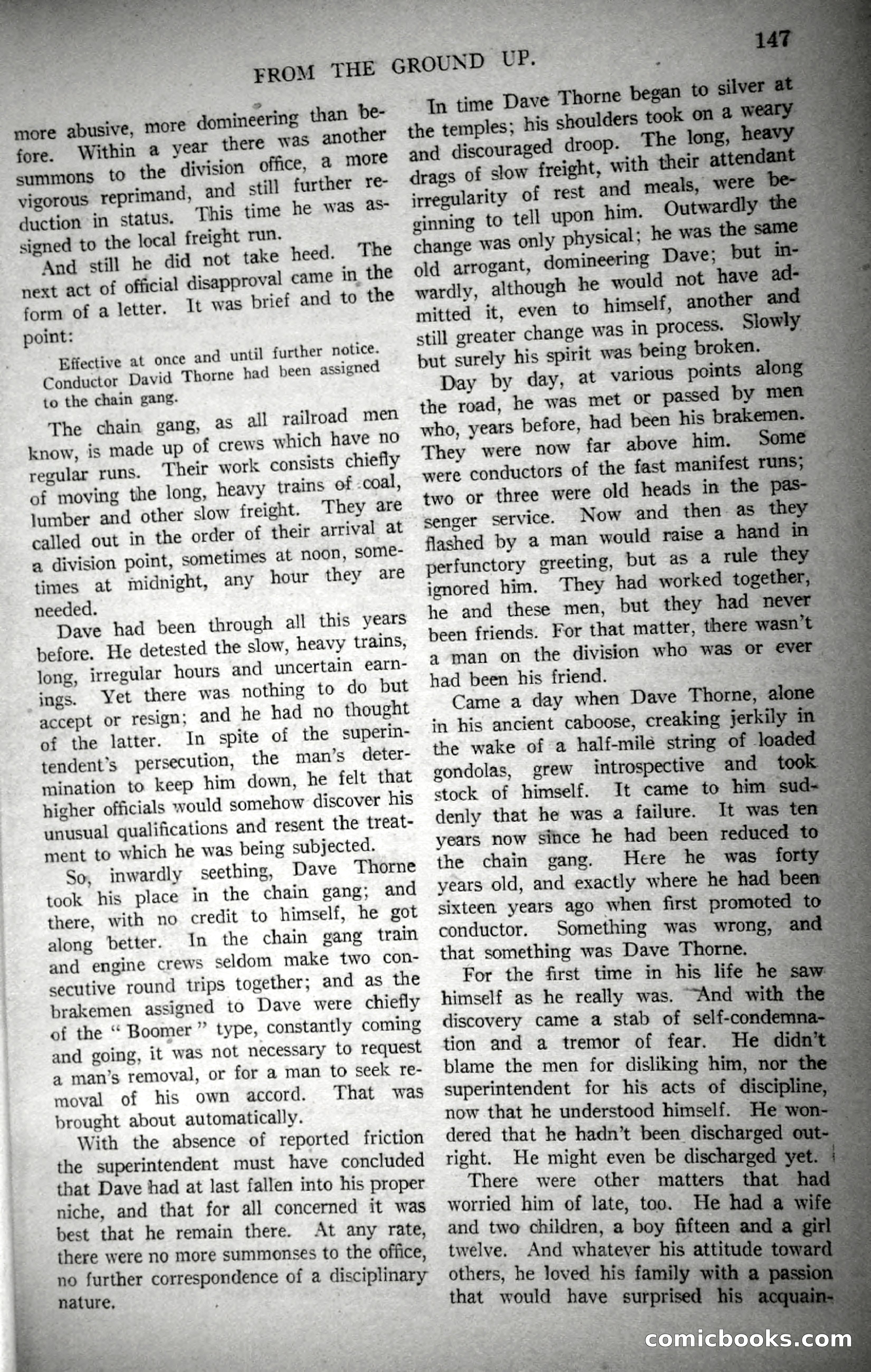
A restored page from Pulp Fiction, 1922. Page through the whole issue in the reader above.
📄 Transcribed text from this page (OCR, searchable)
Machine-transcribed from the original scan — historical spelling and the odd misread are preserved.
° fee OS ee 2 DUS A Spe SS Fe - = 4 tS ee : 4 - ‘ > aod FROM THE GROUND UP. aa ie more aoate, more domineering than be- —«‘Im time Dave Tee oe . 2 fore. Within a year there wa another the temples, his took esi” summons to the division office, a more and disco veer gee vigorous reprimand, and still further re- drags of slow reigh ae their oer duction in status. This time he was aS- irregularity of rest a — asi signed to the local freight run. ginning to tell upon = : waa i} And still he did not take heed. The change was oe bee — next act of official disapproval came In. the old arrogant, ineeri eet sp Ao ge ‘ form of a letter. It was brief and to the point: Effective at once and until further notice. Conductor David Thorne had been assigned to the chain gang. The chain gang, as all railroad men know, is made up of crews which have no regular runs. Their work consists chiefly of moving the long, heavy trains of -coal, lumber and other slow freight. They are called out in the order of their arrival at a division point, sometimes at noon, some- times at midnight, any hour they are needed. Dave had been through all this years before. He detested the slow, heavy trains, long, irregular hours and uncertain earn- ings. Yet there was nothing to do but accept or resign; and he had no thought of the latter. In spite of the superin- tendent’s persecution, the man’s deter- mination to keep him down, he felt that higher officials would somehow discover his unusual qualifications and resent the treat- ment to which he was being subjected. So, inwardly seething, Dave Thorne took his place in the chain gang, and there, with no credit to himself, he got along better. In the chain gang train and engine crews seldom make two con- secutive round trips together; and as the brakemen assigned to Dave were chiefly of the “ Boomer” type, constantly coming and going, it was not necessary to request 4 man’s removal, or for a man to seek re- moval of his own accord. That was brought about automatically. With the absence of reported friction the superintendent must have concluded that Dave had at last fallen into his proper niche, and that for all concerned it was best that he remain there. At any rate, there were no more summonses to the office, no further correspondence of a disciplinary nature, | wardly, although he a mitted it, even to himself, another and — still greater change Was in process. Slowly — but surely his spirit was being broken. — 3 Day by day, at various points along — the road, he was met Or passed by 1 who, years before, had been his brake They were now far above him. Some — were conductors of the fast manifest runs; two or three were old heads in the pas- senger service. Now and then as they flashed by a man would raise a hand in perfunctory greeting, but as @ rule they ignored him. They had worked together, he and these men, but they had never been friends. For that matter, there wasn t a man on the division who was or ever : had been his friend. air. Came a day when Dave Thorne, alone ~ ‘1 his ancient caboose, creaking jerkily i the wake of a half-mile string of lo: gondolas, grew introspective and — took stock of himself. It came to him suc denly that he was a failure. It vas ten years now Sie he had been redu the chain gang. Here he was ior years old, and exactly where he had beet sixteen years ago when first promoted te conductor. Something was wrong, that something was Dave Thorne. eee For the first time in his life he saw himself as he really was. “And with the discovery came a stab of self conde tion and a tremor of fear. He blame the men for disliking him, nor t superintendent for his acts of disci now that he understood himself. # le W dered that he hadn’t been discharged right. He might even be dischar x¢ There were other matters 1 worried him of late, too. He had ¢ and two children, a boy fifteen and ; twelve. And whatever his attitude t others, he loved his famil rw th a that would have surprised as A oF omicbooks.com