
Pulp Fiction, 1922 · page 147 of 180
Argosy, Vol. 147, No. 1 — page 147: what you’re looking at
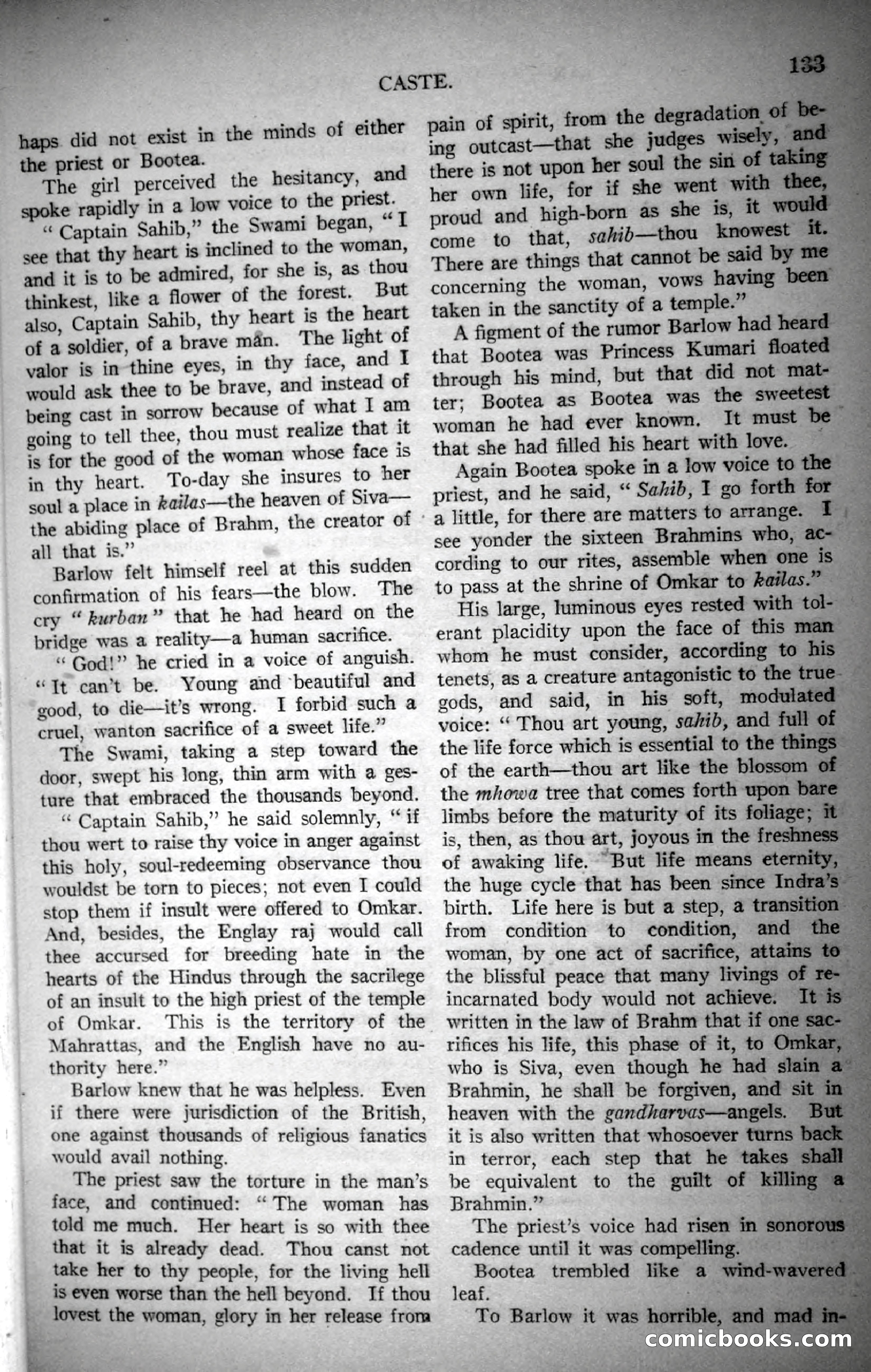
A restored page from Pulp Fiction, 1922. Page through the whole issue in the reader above.
📄 Transcribed text from this page (OCR, searchable)
Machine-transcribed from the original scan — historical spelling and the odd misread are preserved.
haps did not exist in the minds of either the priest or Bootea. The girl perceived the hesitancy, and spoke rapi y in a low voice to the priest. “ Captain Sahib,” the Swami began, see that thy heart is inclined to the woman, and it is to be admired, for she is, as thou thinkest, like a flower of the forest. But also, Captain Sahib, thy heart is the heart of a soldier, of a brave man. The light of valor is in thine eyes, in thy face, and I would ask thee to be brave, and instead of being cast in sorrow because of what I am going to tell thee, thou must realize that it is for the good of the woman whose face is in thy heart. To-day she insures to her soul a place in kailas—the heaven of Siva— the abiding place of Brahm, the creator of all that is.” Barlow felt himself reel at this sudden confirmation of his fears—the blow. ‘The cry “ kurban” that he had heard on the bridge was a reality—a human sacrifice. “ God!” he cried in a voice of anguish. “Tt can’t be. Young and “beautiful and good, to die—it’s wrong. I forbid such a cruel, wanton sacrifice of a sweet life.” The Swami, taking a step toward the door, swept his long, thin arm with a ges- ture that embraced the thousands beyond. “ Captain Sahib,” he said solemnly, “ if thou wert to raise thy voice in anger against this holy, soul-redeeming observance thou wouldst be torn to pieces; not even I could stop them if insult were offered to Omkar. And, besides, the Englay raj would call thee accursed for breeding hate in the hearts of the Hindus through the sacrilege of an insult to the high priest of the temple of Omkar. This is the territory of the Mahrattas, and the English have no au- thority here.” Barlow knew that he was helpless. Even if there were jurisdiction of the British, one against thousands of religious fanatics would avail nothing. The priest saw the torture in the man’s face, and continued: “The woman has told me much. Her heart is so with thee that it is already dead. Thou canst not take her to thy people, for the living hell _ iS even worse than the hell beyond. If thou __lovest the woman, glory in her release froma a little, for oe ant Sy her own life, proud and high-born as she Lies. come to that, saib—thou knowest ™ There are things that cannot be said by m concerning the woman, VOWS having been taken in the sanctity of atemple.” A figment of the rumor Barlow had hear that Bootea was Princess Kumari floi through his mind, but that did not mat- ter; Bootea as Bootea was the sweetest | woman he had ever known, It must be- that she had filled his heart with love. Again Bootea spoke in a low voice to the priest, and he said, “ Sahib, I go forth for there are matters to arrange. # see yonder the sixteen Brahmins who, ac- cording to our rites, assemble when one is to pass at the shrine of Omkar to Aavas. — His large, luminous eyes rested with tol- erant placidity upon the face of this man whom he must consider, according to his tenets, as a creature antagonistic to the rue gods, and said, in his soft, modulat voice: “ Thou art young, saiib, and full 0 the life force which is essential to the t ‘in of the earth—thou art like the blossom | the mhowe tree that comes forth upon bare limbs before the maturity of its folia is, then, as thou art, joyous in the fresh of awaking life. “But life means et the huge cycle that has been since birth. Life here is but a step, a tt from condition to condition, anc woman, by one act of sacrifice, att ins 1 the blissful peace that many livings of incarnated body would not achieve: 1 written in the law of Brahm that if one s rifices his life, this phase of it, to Oml who is Siva, even though he had sk Brahmin, he shall be forgiven, and sit heaven with the ga (ILHAarvas ange’ We, I it is also written that whosoever ° in terror, each step that he takes © be equivalent to the guilt of kill Brahmin.” rene. The priest’s voice had riser i n ¢ nc cadence until it was compelling. Bootea trembled like a wind- To Barlow it was horrible, ae - =EY;, b YL Ur iis - .. ae