
Pulp Fiction, 1922 · page 140 of 180
Argosy, Vol. 147, No. 1 — page 140: what you’re looking at
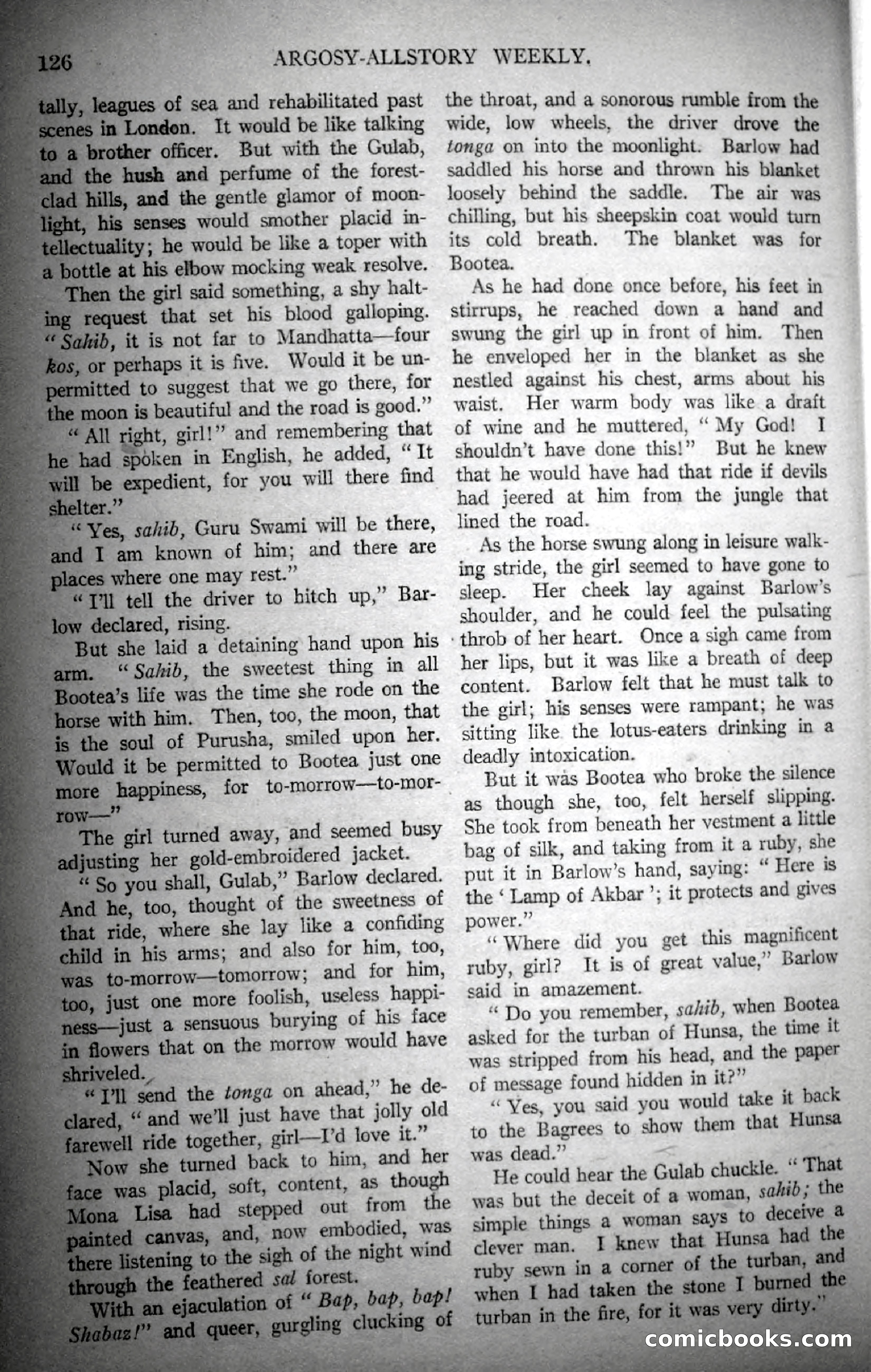
A restored page from Pulp Fiction, 1922. Page through the whole issue in the reader above.
📄 Transcribed text from this page (OCR, searchable)
Machine-transcribed from the original scan — historical spelling and the odd misread are preserved.
v ; + %. n> - \@ a > ] - 1, areas 7 ~ ir . 4 ? - am sea and rehabilitated past age n. It would be like talking x officer. But with the Gulab, and perfume of the forest- sand the gentle glamor of moon- senses would smother placid in- y; he would be like a toper with e at hi 3s elbow mocking weak resolve. he gir said something, a shy halt- | that set his blood galloping. Dy pa t is not far to Mandhatta—four arhaps it is five. Would it be un- L to suggest that we go there, for no on beautiful and the road is good.” Il ri ght » girl!” and remembering that spoken in English, he added, “ It € eXP edient, for you will there find Eis, Guru Swami will be there, it am known of him; and there are one may rest.” 4 tell the driver to hitch up,” Bar- ja ‘ . P We oy ~ “¥ . ared, rising. Su t she aid a detaining hand upon his , “Sahib, the sweetest thing in all eas s life was the time she rode on the with him. Then, too, the moon, that oul of Purusha, smiled upon her. "i _ be permitted to Bootea just one appiness, a tariéd away, and seemed busy ‘in g her gold-embroidered jacket. So y 0 ¥ u shall, Gulab,” Barlow declared. 2, 100, thought of the sweetness of where she lay like a confiding & his arms; and also for him, too, ? ae sw—tomorrow; and for him, jus ee more foolish, useless happi- syst a sensuous burying of his face mers that on the morrow would have | senc | the tonga on ahead,” he de- ARGOSY-ALLSTORY WEEKLY. for to-morrow—to-mor-_ the throat, and a sonorous rumble from the _ wide, low wheels, the driver drove the tonga on into the moonlight. Barlow had saddled his horse and thrown his blanket loosely behind the saddle. The air was chilling, but his sheepskin coat would turn its cold breath. The blanket was for Bootea. As he had done once before, his feet in stirrups, he reached down a hand and swung the girl up in front of him. Then he enveloped her in the blanket as she nestled against his chest, arms about his waist. Her warm body was like a draft of wine and he muttered, “ My God! I shouldn’t have done this!” But he knew that he would have had that ride if devils had jeered at him from the jungle that lined the road. As the horse swung along in leisure walk- ing stride, the girl seemed to have gone to sleep. Her cheek lay against Barlow’s shoulder, and he could feel the pulsating -throb of her heart. Once a sigh came from her lips, but it was like a breath of deep content. Barlow felt that he must talk to the girl; his senses were rampant, he was sitting like the lotus-eaters drinking in a deadly intoxication. But it was Bootea who broke the silence as though she, too, felt herself slipping. She took from beneath her vestment a little bag of silk, and taking from it a ruby, she put it in Barlow’s hand, say ing: “ Here is the ‘ Lamp of Akbar ’; it protects and gives power.’ “Where did you get this magnificent ruby, girl? It is of great value,” Barlow said in amazement. “ Do you remember, sahib, when Bootea asked for the turban of Hunsa, the time it was stripped from his head, and the paper of message found hidden in it?” nt we'll just have that jolly old “ Yes, you said you would take it back 1 de 1 , girl—I’d love it. % to the Bagrees to show them that Hunsa y sh 6 turned back to him, and her was dead.” as pl lacid, “soft, content, as though He could hear the Gulab chuckle. “ That isa b age out from the was but the deceit of a woman, sahib ; . s. and, now embodied, was simple things a woman say® to deceive @ igh of he net win clever man. I knew. thet, Hien eg ne Se Tuby sewn ina COE: ¢ ne pres comicbooks.com