
Pulp Fiction, 1922 · page 135 of 180
Argosy, Vol. 147, No. 1 — page 135: what you’re looking at
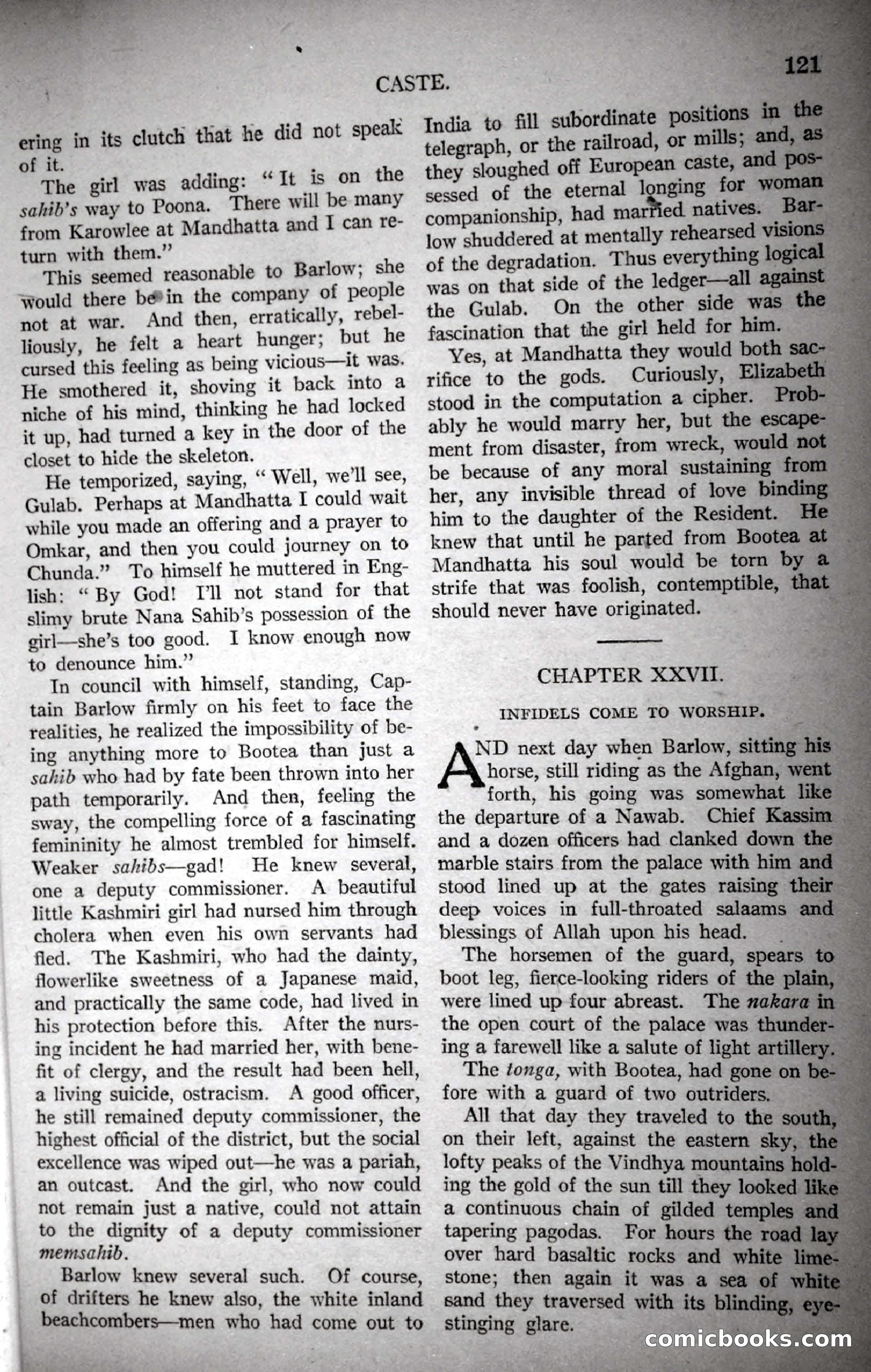
A restored page from Pulp Fiction, 1922. Page through the whole issue in the reader above.
📄 Transcribed text from this page (OCR, searchable)
Machine-transcribed from the original scan — historical spelling and the odd misread are preserved.
ering in its clutch that he did not speak of it. ? The girl was adding: “It 1s on the sahib’s way to Poona. There will be many from Karowlee at Mandhatta and I can re- turn with them.” This seemed reasonable to Barlow; she Would there be®in the company of people not at war. And then, erratically, rebel- liously, he felt a heart hunger; but he cursed this feeling as being vicious—it was. He smothered it, shoving it back into a niche of his mind, thinking he had locked it up, had turned a key in the door of the closet to hide the skeleton. He temporized, saying, “ Well, we'll see, Gulab. Perhaps at Mandhatta I could wait while you made an offering and a prayer to Omkar, and then you could journey on to Chunda.” To himself he muttered in Eng- lish: “By God! Ill not stand for that slimy brute Nana Sahib’s possession of the girl—she’s too good. I know enough now to denounce him.” In council with himself, standing, Cap- tain Barlow firmly on his feet to face the realities, he realized the impossibility of be- ing anything more to Bootea than just a sahib who had by fate been thrown into her path temporarily. And then, feeling the sway, the compelling force of a fascinating femininity he almost trembled for himself. Weaker sahibs—gad! He knew several, one a deputy commissioner. A beautiful little Kashmiri girl had nursed him through cholera when even his own servants had fled. The Kashmiri, who had the dainty, flowerlike sweetness of a Japanese maid, and practically the same code, had lived in his protection before this. After the nurs- ing incident he had married her, with bene- fit of clergy, and the result had been hell, a living suicide, ostracism. A good officer, he still remained deputy commissioner, the highest official of the district, but the social excellence was wiped out—he was a pariah, an outcast. And the girl, who now could not remain just a native, could not attain to the dignity of a deputy commissioner memsahib. : Barlow knew several such. Of course, of drifters he knew also, the white inland a ) beachcombers—men who had come out to ar ae " ed te . {4 ~, et aad E ° : Aeit Bry a India to fill subordinate positions ¥ telegraph, or they sloughed ; ae sessed of the eternal _ for 7 companionship, had m ed natives. low shuddered at mentally rehearsed Vision: of the degradation. Thus everything logic was on that side of the ledger—all agams the Gulab. On the other side was tne fascination that the girl held for him. Yes, at Mandhatta they would both sa C- rifice to the gods. Curiously, Elizabet stood in the computation a cipher. Prot ably he would marry her, but the escape ment from disaster, from wreck, would no be because of any moral sustaining fro her, any invisible thread of love bindin him to the daughter of the Resident. H knew that until he parted from Bootea a Mandhatta his soul would be torn by strife that was foolish, contemptible, should never have originated. = -— 7? eI eg” re. « 4 . — 7 Keo CHAPTER XXVI. INFIDELS COME TO WORSHIP. — ° 1 at ND next day when Barlow, sitting hi pues still riding as the Afghan, ¥ forth, his going was somewhat the departure of a Nawab. Chief K and a dozen officers had clanked doy marble stairs from the palace with hit stood lined up at the gates raising deep voices in full-throated salaams anc blessings of Allah upon his head. The horsemen of the guard, spear boot leg, fierce-looking riders of the were lined up four abreast. The # the open court of the palace was : ing a farewell like a salute of light The tonga, with Bootea, had gon fore with a guard of two outriders, All that day they traveled to the sou: on their left, against the eastern sky. t lofty peaks of the Vindhya mountains ho’ ing the gold of the sun till they looke a continuous chain of gilded | temple tapering pagodas. For hours : over hard basaltic rocks and white stone; then again it was a sea ¢ sand they traversed wit h its b ind stingi : a ee aoe ears “comicbooks.com r. - ie we §