
Pulp Fiction, 1922 · page 116 of 180
Argosy, Vol. 147, No. 1 — page 116: what you’re looking at
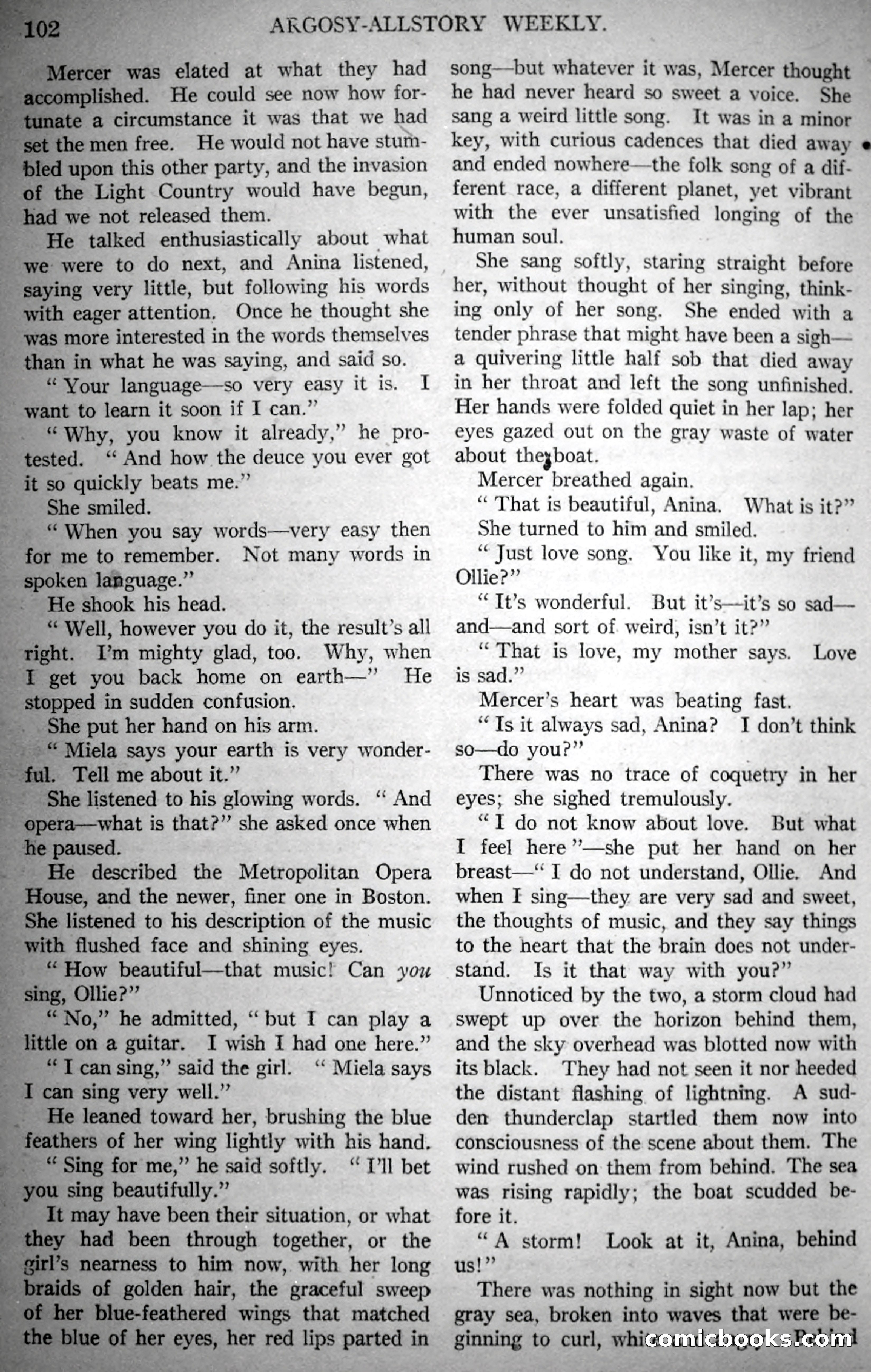
A restored page from Pulp Fiction, 1922. Page through the whole issue in the reader above.
📄 Transcribed text from this page (OCR, searchable)
Machine-transcribed from the original scan — historical spelling and the odd misread are preserved.
«a “ae Bais Y) has s elated at what they had plish hea He could see now how for- te a @ circumstance it was that we had oe men free. He would not have stutn- | or 1 this other party, and the invasion f the Light Country would have begun, ac 1 we not released them. He talked enthusiastically about what sa » to do next, and Anina listened, sé ap very little, but following his words th eager attention. Once he thought she § more interested in the words themselves than in what he was saying, and said so. 3 “ Your language—so very easy it is. I w -to learn it soon if I can.” « Why, you know it already,” he pro- * And how the’ deuce you ever got it t so quickly beats me.’ SS She smiled. Py 2 ‘When you say words—very easy then Aor 1 ne to remember. Not many words in spoken language.” Saal al fe shook his head. 7 4 “ Well, however you do it, the result’s all right. I'm mighty glad, too. Why, when te you back home on earth—” He topped in sudden confusion. e put her hand on his arm. ela says your earth is very wonder- aged me about it.” eeened to his glowing words. ‘“ And nat | is that?” she asked once when He Ristitbed the Metropolitan Opera . , and the newer, finer one in Boston. 8 3 fened to his description of the music ia F St PU. 1 flushed face and shining eyes. “How beautiful—that music! Can you sing eee” ,” he admitted, “but I can play a an a guitar. I wish I had one here.” mt Ben cing,” said the girl. “ Miela says be ‘sing very well.” Le e leaned toward her, brushing the blue a hers of her wing lightly with his hand. “ Sing for me,” he said softly. 1 sing beautifully ze oe been their situation, or what Stat through together, or the S$ nez arne oe $ op til with her long Fis na parted i in “T'll bet . a ag re -_ ARGOSY-ALLSTORY WEEKLY. a song—but whatever it was, Mercer ane’ he had never heard so sweet a voice. She sang a weird little song. It was in a minor key, with curious cadences that died away and ended nowhere—the folk song of a dif- ferent race, a different planet, yet vibrant with the ever unsatisfied longing of the human soul. She sang softly, staring straight before her, without thought of her singing, think- ing only of her song. She ended with a tender phrase that might have been a sigh— a quivering little half sob that died away in her throat and left the song unfinished. Her hands were folded quiet in her lap; her eyes gazed out on the gray waste of water about thegboat. Mercer breathed again. “ That is beautiful, Anina. What is it?” She turned to him and smiled. “Just love song. You like it, my friend Ollie?” “Tt’s wonderful. But it’s—it’s so sad— and—and sort of. weird, isn’t it?” ‘That is love, my mother says. is sad.” Mercer’s heart was beating fast. “Ts it always sad, Anina? I don’t think so—do your” ; There was no trace of coquetry in her eyes; she sighed tremulously. “T do not know about love. But what I feel here”’—she put her hand on her breast—‘ I do not understand, Ollie. And when I sing—they are very sad and sweet, the thoughts of music, and they say things to the heart that the brain does not under- Stand. Is it that way with you?” Unnoticed by the two, a storm cloud had swept up over the horizon behind them, and the sky overhead was blotted now with its black. They had not seen it nor heeded the distant flashing of lightning. A sud- den thunderclap startled them now into consciousness of the scene about them. The wind rushed on them from behind. The sea was rising rapidly; the boat scudded be- fore it. “A storm! us!” There was nothing in sight now but the gray sea, broken into waves that ¥ were Love Look at it, Anina, behind ¢