
Pulp Fiction, 1908 · page 66 of 245
The Argosy, November 1908 — page 66: what you’re looking at
A restored page from Pulp Fiction, 1908. Page through the whole issue in the reader above.
📄 Transcribed text from this page (OCR, searchable)
Machine-transcribed from the original scan — historical spelling and the odd misread are preserved.
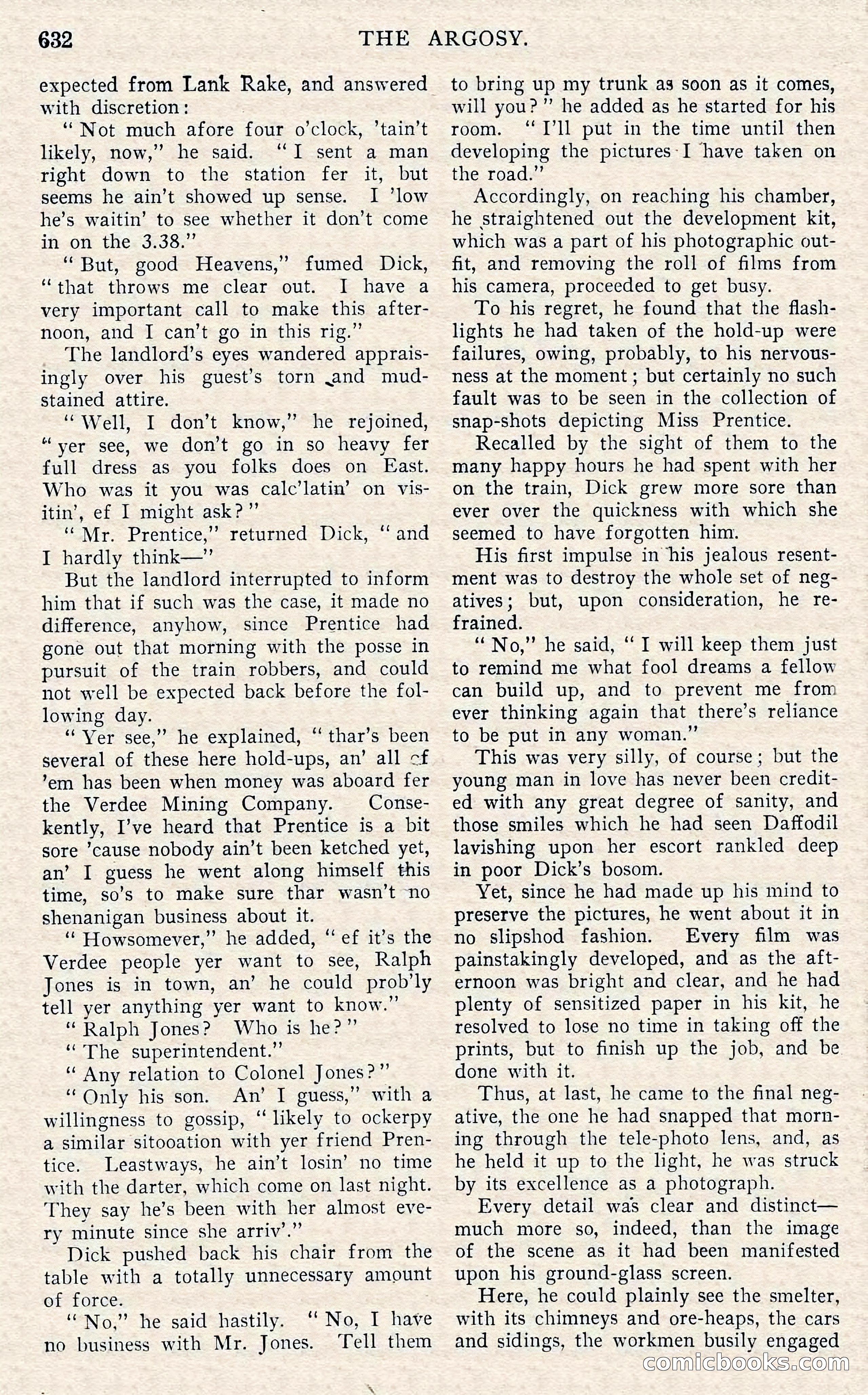
632 expected from Lank Rake, and answered with discretion : ‘“Not much afore four o'clock, ’tain’t likely, now,” he said. ‘I sent a man right down to the station fer it, but seems he ain’t showed up sense. I ’low he’s waitin’ to see whether it don’t come in on the 3.38.” ‘But, good Heavens,’ fumed Dick, “that throws me clear out. I have a very important call to make this after- noon, and I can’t go in this rig.” The landlord’s eyes wandered apprais- ingly over his guest’s torn and mud- stained attire. ‘“Well, I don’t know,” he rejoined, “ver see, we don’t go in so heavy fer full dress as you folks does on East. Who was it you was calc’latin’ on vis- itin’, ef I might ask?”’ ‘Mr. Prentice,” returned Dick, ‘ and I hardly think—’” But the landlord interrupted to inform him that if such was the case, it made no difference, anyhow, since Prentice had gone out that morning with the posse in pursuit of the train robbers, and could not well be expected back before the fol- lowing day. ‘Ver see,” he explained, ‘“ thar’s been several of these here hold-ups, an’ all cf ’em has been when money was aboard fer the Verdee Mining Company. Conse- kently, I’ve heard that Prentice is a bit sore ‘cause nobody ain’t been ketched yet, an’ I guess he went along himself this time, so’s to make sure thar wasn’t no shenanigan business about it. ‘“‘ Howsomever,” he added, “ef it’s the Verdee people yer want to see, Ralph Jones is in town, an’ he could prob’ly tell yer anything yer want to know.” “ Ralph Jones? Who is he?” ‘The superintendent.” ‘“ Any relation to Colonel Jones?”’ “Only his son. An’ I guess,” with a willingness to gossip, “likely to ockerpy a similar sitooation with yer friend Pren- tice. Leastways, he ain’t losin’ no time with the darter, which come on last night. They say he’s been with her almost eve- ry minute since she arriv’.” Dick pushed back his chair from the table with a totally unnecessary amount of force. “No,” he said hastily. no business with Mr. Jones. “No, I have Tell them THE ARGOSY. to bring up my trunk as soon as it comes, will you?” he added as he started for his room. ‘I’ll put in the time until then developing the pictures-I have taken on the road.” Accordingly, on reaching his chamber, he straightened out the development kit, which was a part of his photographic out- fit, and removing the roll of films from his camera, proceeded to get busy. To his regret, he found that the flash- lights he had taken of the hold-up were failures, owing, probably, to his nervous- ness at the moment; but certainly no such fault was to be seen in the collection of snap-shots depicting Miss Prentice. Recalled by the sight of them to the many happy hours he had spent with her on the train, Dick grew more sore than ever over the quickness with which she seemed to have forgotten him. His first impulse in his jealous resent- ment was to destroy the whole set of neg- atives; but, upon consideration, he re- frained. “No,” he said, ‘I will keep them just to remind me what fool dreams a fellow can build up, and to prevent me from ever thinking again that there’s reliance to be put in any woman.” This was very silly, of course; but the young man in love has never been credit- ed with any great degree of sanity, and those smiles which he had seen Daffodil lavishing upon her escort rankled deep in poor Dick’s bosom. Yet, since he had made up his mind to preserve the pictures, he went about it in no slipshod fashion. Every film was painstakingly developed, and as the aft- ernoon was bright and clear, and he had plenty of sensitized paper in his kit, he resolved to lose no time in taking off the prints, but to finish up the job, and be done with it. Thus, at last, he came to the final neg- ative, the one he had snapped that morn- ing through the tele-photo lens, and, as he held it up to the light, he was struck by its excellence as a photograph. Every detail was clear and distinct— much more so, indeed, than the image of the scene as it had been manifested upon his ground-glass screen. Here, he could plainly see the smelter, with its chimneys and ore-heaps, the cars and sidings, the workmen busily engaged COMICHOOKS.COM