
Pulp Fiction, 1908 · page 12 of 245
The Argosy, November 1908 — page 12: what you’re looking at
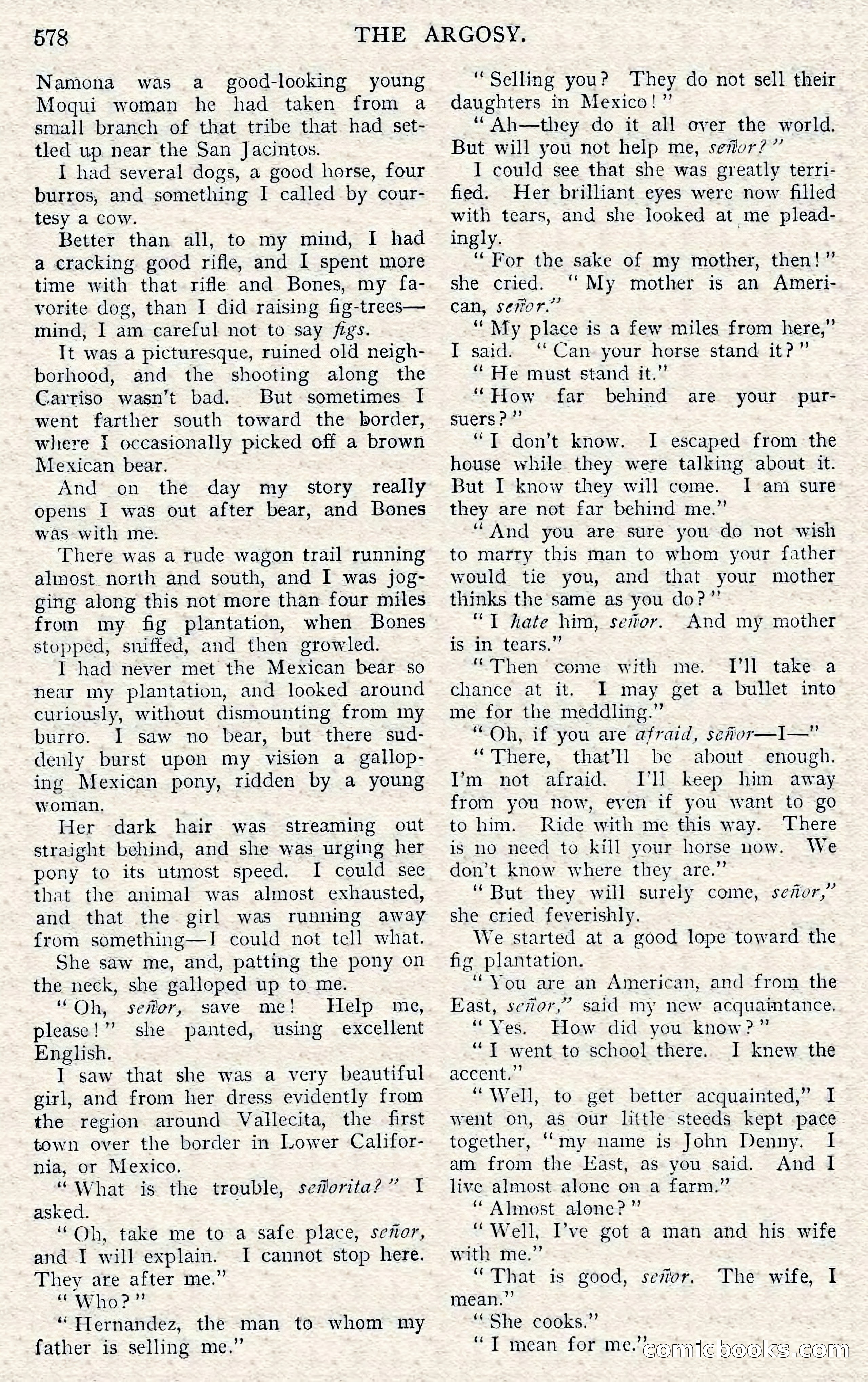
A restored page from Pulp Fiction, 1908. Page through the whole issue in the reader above.
📄 Transcribed text from this page (OCR, searchable)
Machine-transcribed from the original scan — historical spelling and the odd misread are preserved.
578 Namona was a_ good-looking young Moqui woman he had taken from a small branch of that tribe that had set- tled up near the San Jacintos. I had several dogs, a good horse, four burros, and something I called by cour- tesy a cow. Better than all, to my mind, I had a cracking good rifle, and I spent more time with that rifle and Bones, my fa- vorite dog, than I did raising fig-trees— mind, I am careful not to say figs. It was a picturesque, ruined old neigh- borhood, and the shooting along the Carriso wasn’t bad. But sometimes I went farther south toward the border, where I occasionally picked off a brown Mexican bear. And on the day my story really opens I was out after bear, and Bones was with me. There was a rude wagon trail running almost north and south, and I was jog- ging along this not more than four miles from my fig plantation, when Bones stupped, sniffed, and then growled. I had never met the Mexican bear so near my plantation, and looked around curiously, without dismounting from my burro. I saw no bear, but there sud- denly burst upon my vision a gallop- ing Mexican pony, ridden by a young woman. Her dark hair was streaming out straight behind, and she was urging her pony to its utmost speed. I could see that the animal was almost exhausted, and that the girl was running away from something—I could not tell what. She saw me, and, patting the pony on the neck, she galloped up to me. “Oh, sefor, save me! Help me, please!” she panted, using excellent English. I saw that she was a very beautiful girl, and from her dress evidently from the region around Vallecita, the first town over the border in Lower Califor- nia, or Mexico. “What is the trouble, seforita?” I asked. ‘“Oh, take me to a safe place, senor, and I will explain. I cannot stop here. They are after me.” “Who?” “Hernandez, the man to whom my father is selling me.” THE ARGOSY. They do not sell their {2 “Selling you? daughters in Mexico ““ Ah—they do it all over the world. But will you not help me, seflor?” 1 could see that she was greatly terri- fied. Her brilliant eyes were now filled with tears, and she looked at me plead- ingly. ‘For the sake of my mother, then!” she cried. ‘My mother is an Ameri- can, sefor.” “My place is a few miles from here,” I said. ‘Can your horse stand it?” “ He must stand it.” “How far behind are your pur- suers?” “T don’t know. I escaped from the house while they were talking about it. But I know they will come. I am sure they are not far behind me.” “And you are sure you do not wish to marry this man to whom your father would tie you, and that your mother thinks the same as you do?”’ “T hate him, sevor. And my mother is in tears.” “Then come with me. T’ll take a chance at it. I may get a bullet into me for the meddling.” “Oh, if you are afraid, sefor—I—” “There, that’ll be about enough. I’m not afraid. I'll keep him away from you now, even if you want to go to him. Ride with me this way. There is no need to kill your horse now. We don’t know where they are.” “ But they will surely come, sefor,” she cried feverishly. We started at a good lope toward the fig plantation. ‘You are an American, and from the East, sevor,” said my new acquaintance. “Yes. How did you know?” “IT went to school there. JI knew the accent.’ “Well, to get better acquainted,” I went on, as our little steeds kept pace together, ““my name is John Denny. I am from the East, as you said. And I live almost alone on a farm.” “Almost alone?” “Well, I’ve got a man and his wife with me.” “That is good, sevior, mean.” ‘She cooks.” “I mean for me.’ [email protected] The wife, I