
Pulp Fiction, 1907 · page 8 of 228
The Argosy, March 1907 — page 8: what you’re looking at
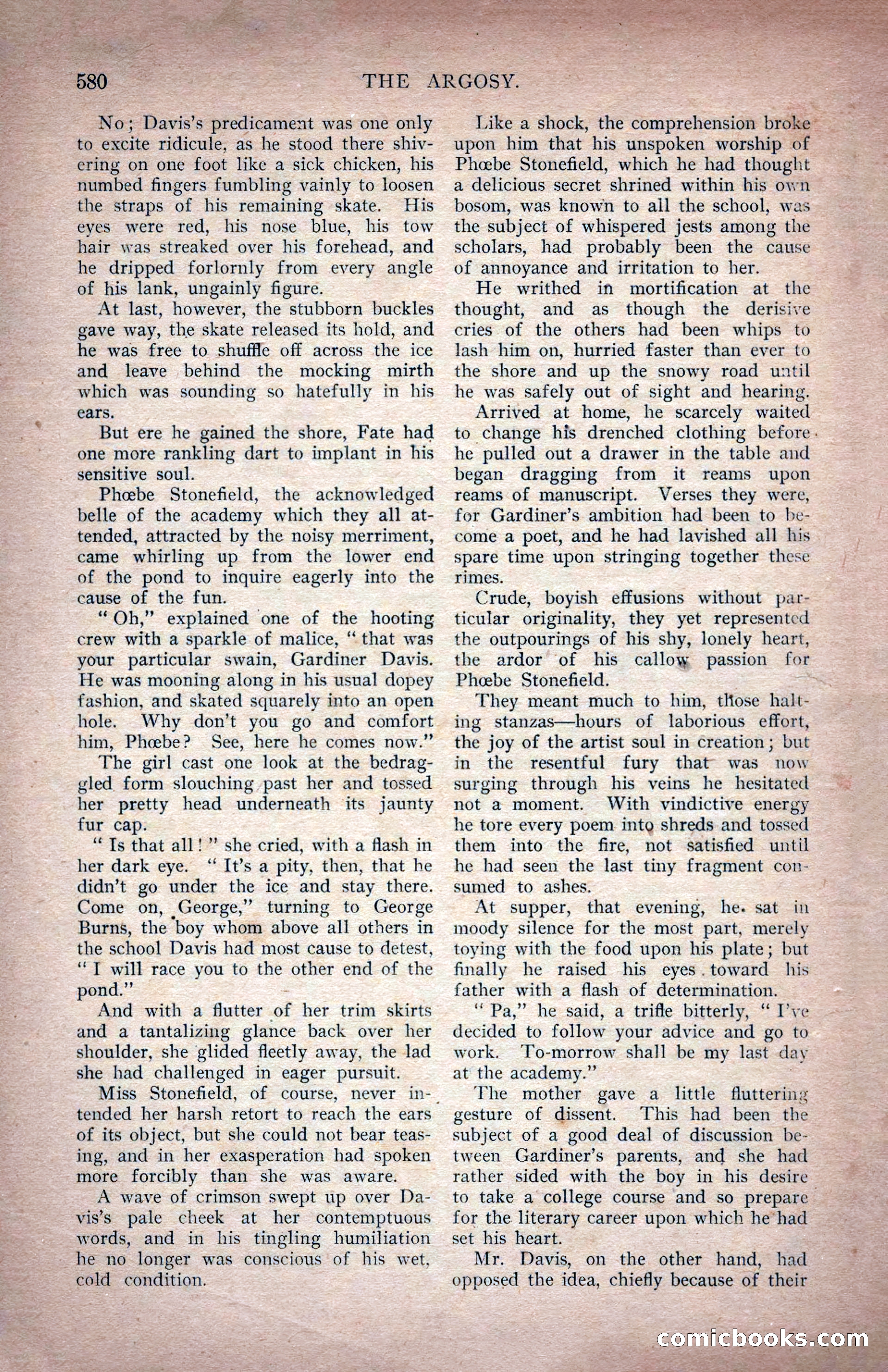
A restored page from Pulp Fiction, 1907. Page through the whole issue in the reader above.
📄 Transcribed text from this page (OCR, searchable)
Machine-transcribed from the original scan — historical spelling and the odd misread are preserved.
“S eyes were red, ~ her dark eye. a No: Davie s predicament was one only to excite ridicule, as he stood there shiv- ering on one foot like a sick chicken, his numbed fingers fumbling vainly to loosen the straps of his remaining skate. His his nose blue, his tow hair was streaked over his forehead, and he dripped forlornly from every angle of his lank, ungainly figure. At last, however, the stubborn buckles gave way, the skate released its hold, and he was free to shuffle off across the ice and leave behind the mocking mirth which was sounding so hatefully in his ears. But ere he gained the shore, Fate had one more rankling dart to implant in his sensitive soul. Phoebe Stonefield, the acknowledged belle of the academy which they all at- tended, attracted by the noisy merriment, came whirling up from the lower end of the pond to inquire eagerly into the cause of the fun. “Oh,” explained one of the hooting crew with a sparkle of malice, “that was your particular swain, Gardiner Davis. He was mooning along in his usual dopey fashion, and skated squarely into an open hole. him, Phoebe? See, here he comes now.” The girl cast one look at the bedrag- gled form slouching past her and tossed her pretty head underneath its jaunty fur cap “Ts that all!” she cried, with a flash in “It’s a pity, then, that he didn’t go under the ice and stay there. Come on, George,’ turning to George Burns, the ‘boy whom above “all others in the school Davis had most cause to detest, ‘“T will race you to the other end of the pond.” - And with a flutter of her trim skirts and a tantalizing glance back over her shoulder, she glided fleetly away, the lad she had challenged in eager pursuit. Miss Stonefield, of course, never in-_ tended her harsh retort to reach the ears of its object, but she could not bear teas- ing, and in her exasperation had spoken more forcibly than she was aware. A wave of crimson swept up over Da- vis’s pale cheek at her contemptuous words, and in his tingling humiliation he no longer was conscious of his wet, cold condition. — Soe = = | THE. “ARGOSY., Why don’t you go and comfort. Like a shock, the seibercheusidle brdiee upon him that his unspoken worship of — Phoebe Stonefield, which he had thought a delicious secret shrined within his own bosom, was known to all the school, was the subject of whispered jests among the scholars, had probably been the cause of annoyance and irritation to her. He writhed in mortification at the thought, and as though the derisive cries of the others had been whips to lash him on, hurried faster than ever to the shore and up the snowy road until he was safely out of sight and hearing. Arrived at home, he scarcely waited to change his drenched clothing before he pulled out a drawer in the table and began dragging from it reams upon reams of manuscript. Verses they were, fer Gardiner’s ambition had been to be- come a poet, and he had lavished all his spare time upon stringing together these rimes. Crude, boyish effusions without par- ticular originality, they yet represented the outpourings of his shy, lonely heart, the ardor of his callow passion Phoebe Stonefield. | They meant much to him, those halt- ing stanzas—hours of laborious effort, the joy of the artist soul in creation; but in the resentful fury that was now surging through his veins he hesitated not a moment. With vindictive energy he tore every poem intg shreds and tossed them into the fire, not satisfied until he had seen the last tiny fragment con- sumed to ashes. At supper, that evening, he. sat in moody silence for the most part, merely toying with the food upon his plate; but finally he raised his eyes.toward his father with a flash of determination. “Pa,” he said, a trifle bitterly, “ I’ve decided to follow your advice and go to work. ‘To-morrow shall be my last day at the academy.” The mother gave a little fluttering gesture of dissent. This had been the subject of a good deal of discussion be- tween Gardiner’s parents, and she had rather sided with the boy in his desire to take a college course and so prepare for the literary career upon which he had set his heart. Mr. Davis, on the Shes hand, ag opposed the idea, chiefly because of chit gies for Teas? Fae : a