
Pulp Fiction, 1907 · page 62 of 228
The Argosy, March 1907 — page 62: what you’re looking at
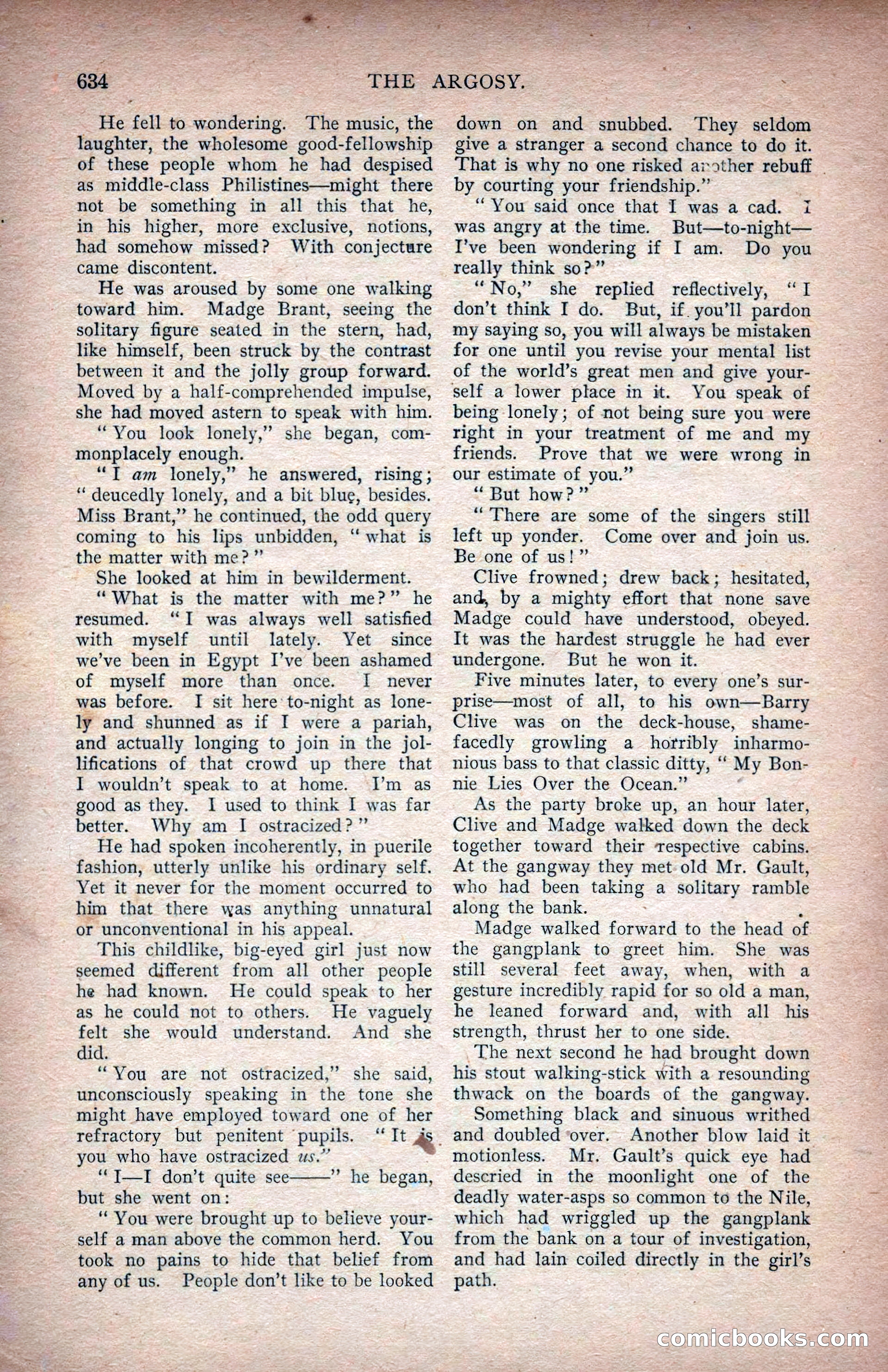
A restored page from Pulp Fiction, 1907. Page through the whole issue in the reader above.
📄 Transcribed text from this page (OCR, searchable)
Machine-transcribed from the original scan — historical spelling and the odd misread are preserved.
»- ‘ei hVe |: >, ery” A ih & 4 g-24 2 PPA ied aie” ; . :7 bt ‘ ‘I i, i. ey 7 A P - “ia — (bea Saint eee Beet ar Sin _ He fell to aponieeine. The music, ae laughter, the wholesome good-fellowship ~ of these people whom he had despised as middle-class Philistines—might there not be something in all this that he, in his higher, more exclusive, notions, had somehow missed? With conjecture came discontent. He was aroused by some one walking toward him. Madge Brant, seeing the solitary figure seated in the stern, had, like himself, been struck by the contrast between it and the jolly group forward. Moved by a half-comprehended impulse, she had moved astern to speak with him. “You look lonely,” she began, com- monplacely enough. ““T am lonely,” he answered, rising ; ‘ deucedly lonely, and a bit blue, besides. Miss Brant,” he continued, the odd query coming to his lips unbidden, “what is the matter with me?” She looked at him in bewilderment. “What is the matter with me?” he resumed. “I was always well satisfied with myself until lately. Yet since we've been in Egypt I’ve been ashamed of myself more than once. I never was before. I sit here to-night as lone- ly and shunned as if I were a pariah, and actually longing to join in the jol- lifications of that crowd up there that I wouldn’t speak to at home. I’m as good as they. I used to think I was far better. Why am I ostracized?” He had spoken incoherently, in puerile fashion, utterly unlike his ordinary self. Yet it never for the moment occurred to him that there was anything unnatural or unconventional in his appeal. This childlike, big-eyed girl just now seemed different from all other people he had known. He could speak to her as he could not to others. He vaguely felt she would understand. And she did. “You are not ostracized,” she said, unconsciously speaking in the tone she might have employed toward one of her refractory but penitent pupils. you who have ostracized ws.”’ ‘““I—I don’t quite see—— but she went on: ‘You were brought up to believe your- ” he began, _ self a man above the common herd. You took no pains to hide that belief from any of us. People don’t like to be looked self a lower place in it. ce It a. “THE, ARGOSY. pO oe eS ee down on and snubbed. They neler Ze give a stranger a second chance to do it. That is why no one risked arother rebuff - by courting your friendship.” : ‘You said once that I was a cad. i was angry at the time. But—to-night— I've been wondering if I am. Do you really think so?” “No,” she replied reflectively, “I don’t think I do. But, if. you’ll pardon my saying so, you will always be mistaken for one until you revise your mental list of the world’s great men and give your- You speak of being lonely; of not being sure you were right in your treatment of me and my friends. Prove that we were wrong in our estimate of you.” “ But how? ” “There are some of the singers still left up yonder. Come over and join us. Be one of us!” Clive frowned; drew back; hesitated, and, by a mighty effort that none save Madge could have understood, obeyed. It was the hardest struggle he had ever undergone. But he won it. Five minutes later, to every one’s sur- prise—most of all, to his own—Barry Clive was on the deck-house, shame- facedly growling a horribly inharmo- nious bass to that classic ditty, “ My Bon- nie Lies Over the Ocean.” As the party broke up, an hour later, Clive and Madge walked down the deck together toward their respective cabins. At the gangway they met old Mr. Gault, who had been pce | a solitary ramble along the bank. Madge walked forward to the head of the gangplank to greet him. She was still several feet away, when, with a gesture incredibly rapid for so old a man, he leaned forward and, with all his strength, thrust her to one side. The next second he had brought down his stout walking-stick with a resounding thwack on the boards of the gangway. Something black and sinuous writhed and doubled ‘over. motionless. Mr. Gault’s quick eye had descried in the moonlight one of the deadly water-asps so common to the Nile, which had wriggled up the gangplank from the bank on a tour of investigation, and had lain coiled directly in the girl’s path. Another blow laid it Eomichboo ‘SCO