
Pulp Fiction, 1907 · page 23 of 228
The Argosy, March 1907 — page 23: what you’re looking at
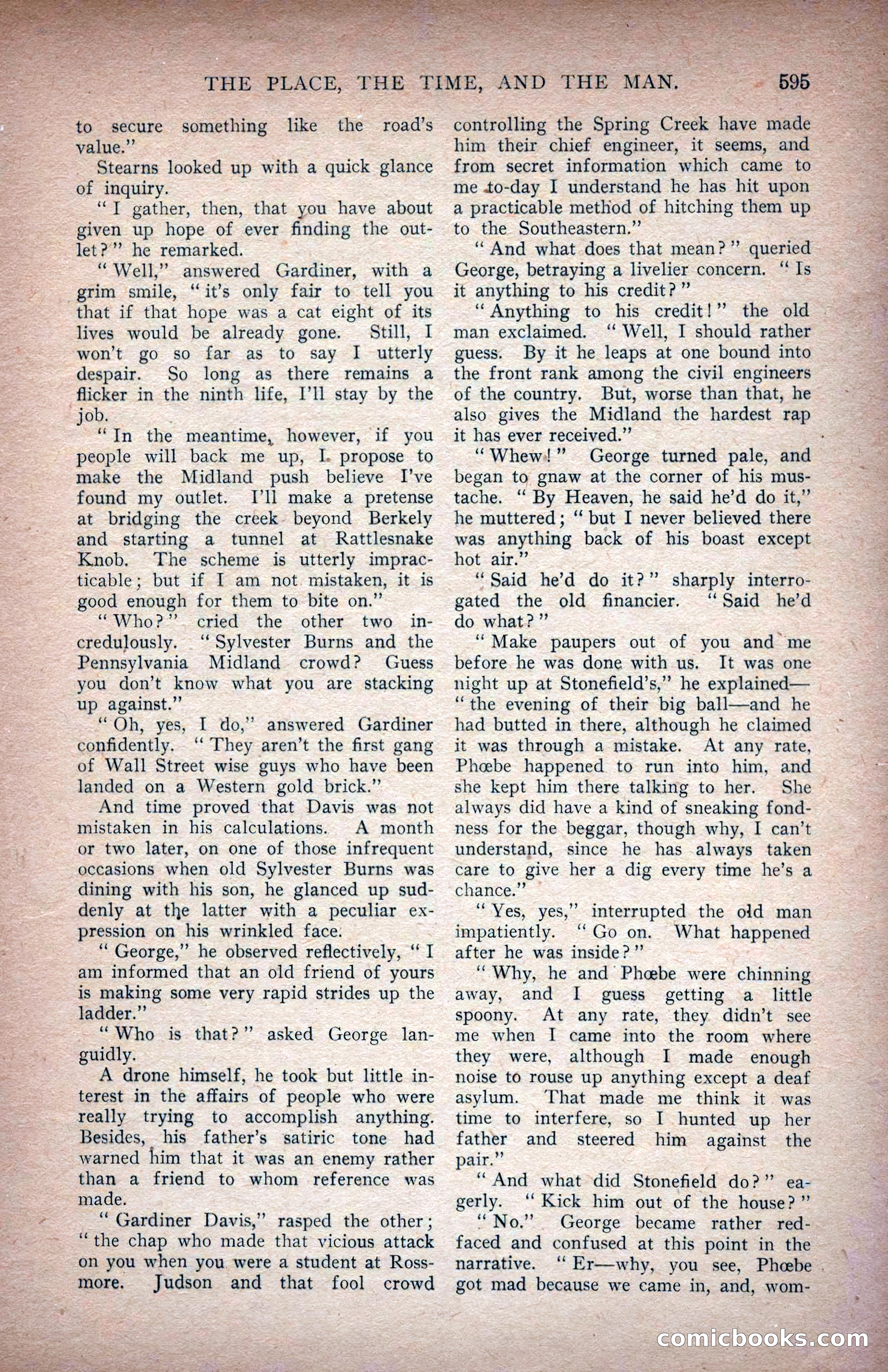
A restored page from Pulp Fiction, 1907. Page through the whole issue in the reader above.
📄 Transcribed text from this page (OCR, searchable)
Machine-transcribed from the original scan — historical spelling and the odd misread are preserved.
= THE PI PLACE, THE TIME, ED THE ‘MAN. to secure ne nine like the road’s value.” Stearns looked up with a quick glance of inquiry. ‘““T gather, then, that you have about given up hope of ever finding the out- let?’’ he remarked. “Well,” answered Gardiner, with a grim smile, “it’s only fair to tell you that if that hope was a cat eight of its lives would be already gone. Still, | won't go so far as to say | utterly despair. So long as there remains a flicker in the ninth life, 11 stay by the job. “In the meantime, however, if you people will back me up, I. propose to make the Midland push believe I’ve found my outlet. Ill make a pretense at bridging the creek. beyond Berkely and starting a tunnel at Rattlesnake Knob. The scheme is utterly imprac- ticable; but if I am not. mistaken, it is good enough for them to bite on.” ‘““Who?”’. cried the other two in- credulously. _‘“‘ Sylvester Burns and the Pennsylvania Midland crowd? Guess you don’t know what you are stacking up against.” “Oh, yes, I do,” answered Gardiner confidentiy. “ They aren’t the first gang of Wall Street wise guys who have been landed on a Western gold brick.” And time proved that Davis was not mistaken in his calculations. A month or two later, on one of those infrequent occasions when old Sylvester Burns was dining with his son, he glanced up sud- denly at the latter with a peculiar ex- pression on his wrinkled face. ‘“ George,” he observed reflectively, ‘“ I am informed that an old friend of yours is making some very rapid strides up the ladder.” _ “Who is that?” asked George lan- guidly. A drone himself, he took but little in- terest in the affairs of people who were really trying to accomplish anything. Besides, his father’s satiric tone had warned him that it was an enemy rather than a friend to whom reference was made. “Gardiner Davis,” rasped the other; “ the chap who made that vicious attack on you when you were a student at Ross- more. Judson and that fool crowd controlling the Spring Creek cae ‘Wnede se him their chief engineer, it seems, and from secret information which came to me to-day I understand he has hit upon a practicable method of hitching them up to the Southeastern.” ‘“And what does that mean?” queried George, betraying a livelier concern. “ Is it anything to his credit?” “Anything to his credit!” man exclaimed. guess. By it he leaps at one bound into the front rank among the civil engineers of the country. But, worse than that, he also gives the Midland the hardest rap it has ever received.” “Whew!” George turned pale, and began to gnaw at the corner of his mus- tache. “ By Heaven, he said he’d do it,” he muttered; ‘‘ but I never believed there was anything back of his boast except hot air.” 7 “Said he’d do it?” sharply interro- gated the old financier. ‘Said he’d do what?” ‘“Make paupers out of you and me before he was done with us. It was one night up at Stonefield’s,” he explained— “the evening of their big ball—and he had butted in there, although he claimed it was through a mistake. At any rate, Phoebe happened to run into him, and she kept him there talking to her. always did have a kind of sneaking fond- ness for the beggar, though why, I can’t understand, since he has always taken care to give her a dig every time he’s a chance.” ‘Yes, yes,’ interrupted the old man impatiently. “Go on. What happened after he was inside?” “Why, he and Phoebe were chinning away, and I guess getting a little spoony. At any rate, they didn’t see me when I came into the room where they were, although I made enough noise to rouse up anything except a deaf asylum. That made me think it was time to interfere, so I hunted up her father and steered him against the pair.” “And what did Stonefield do?” ea- gerly. ‘“‘ Kick him out of the house? ”’ “No.” George became rather red- the old faced and confused at this point in the — ‘“Er—why, you see, Pheebe . narrative. got mad because we came in, and, wom- nt ¥ . ~~ » “ Well, I should rather — | She — 7 4 " teh Few 6h ke, A Thon oh i ON We Aa) ae ei ive? ¥ i a, iY & 3 Aksoy ; \ a ree) Pay . PR 7 eee -_- g ¢ hy } Aun Se] en iat >,