
Pulp Fiction, 1907 · page 168 of 228
The Argosy, March 1907 — page 168: what you’re looking at
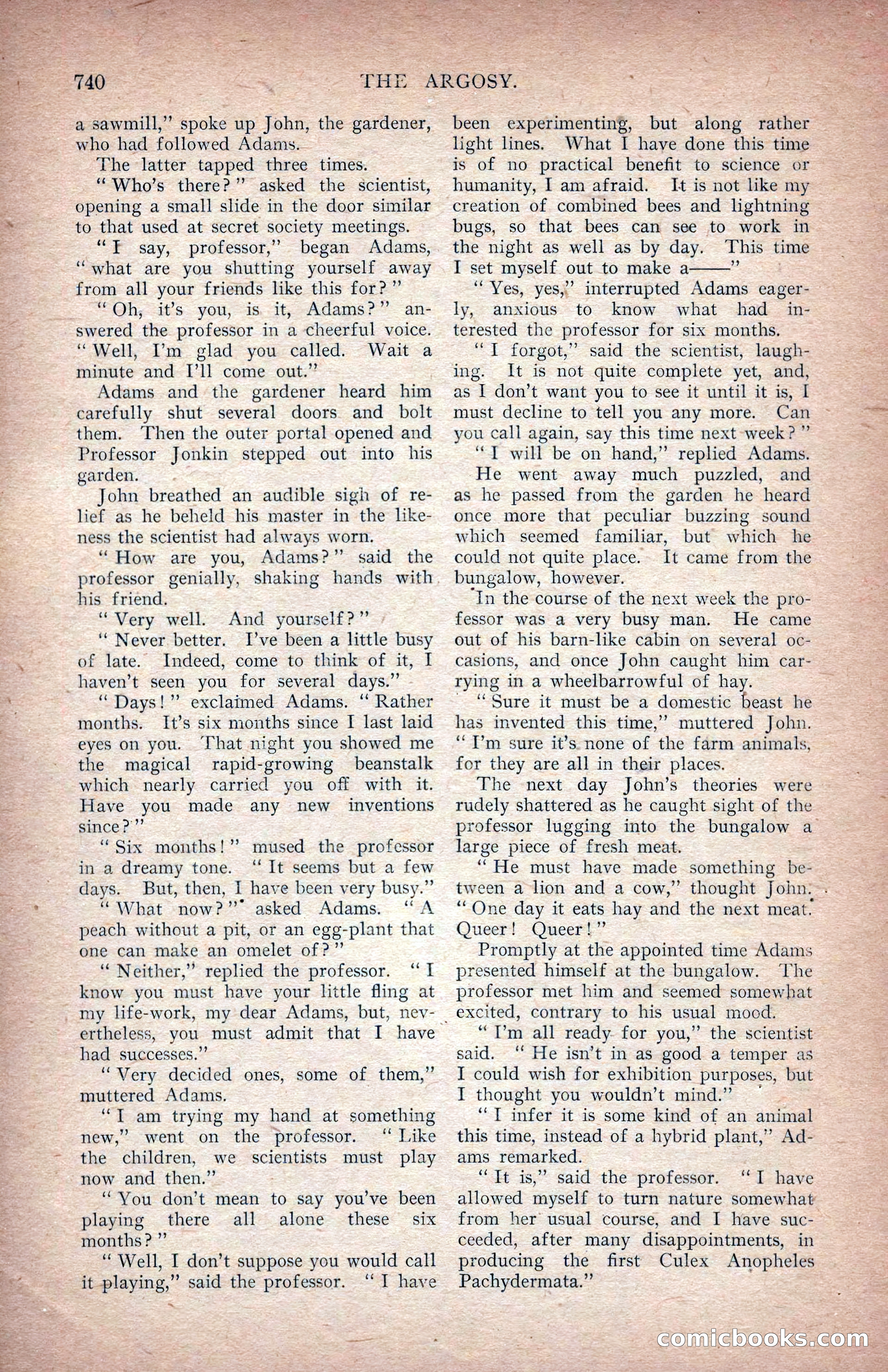
A restored page from Pulp Fiction, 1907. Page through the whole issue in the reader above.
📄 Transcribed text from this page (OCR, searchable)
Machine-transcribed from the original scan — historical spelling and the odd misread are preserved.
) “ee *] \ ‘ ‘ ; A it . : 740 a sawmill,’ spoke up John, the gardener, who had followed Adams. The latter tapped three times. ““Who’s there?” asked the scientist, opening a small slide in the door similar to that used at secret society meetings. ““F say, professor,” began Adams, “what are you shutting yourself away from all your friends like this for?” “Qh, it’s you, is. it, Adams?” an- swered the professor in a cheerful voice. “Well, I'm glad you called. Wait a minute and I'll come out.” Adams and the gardener heard him carefully shut several doors and _ bolt them. Then the outer portal opened and Professor Jonkin stepped out into his garden. John breathed an audible sigh of re- lief as he beheld his master in the like- ness the scientist had always worn. “How are you, Adams?” said the srofessor genially. shaking hands with. i s y; 5 his friend. “Very well. ‘‘ Never. better. of late. And yourself ?”’ I’ve been a little busy Indeed, come to think of it, I _haven’t seen you for several days.” “Days!” exclaimed Adams. “ Rather months. It’s six months since I last laid eyes on you. That night you showed me the magical rapid-growing beanstalk which nearly carried you off with it. Have you made any new inventions since?” “Six months!’ mused the professor in a dreamy tone. “ It seems but a few days. But, then, I have been very busy.” “What now?” asked Adams. “A peach without a pit, or an egg-plant that one can make an omelet of?” ‘““ Neither,” replied the professor. “I know you must have your little fling at _ my life-work, my dear Adams, but, nev- you must admit that I have ertheless, had successes.” ‘“Very decided ones, some of them,”’ muttered Adams. ‘“T am trying my hand at something new,’ went on the professor. ‘“ Like the children, we scientists must play now and then.”’ “You don’t mean to say you've been playing there all alone these six months ? ”’ ‘Well, I don’t suppose you would call it playing,” said the professor. “TI have THE ARGOSY. _ eee ee oe been experimenting, but along rather light lines. What I have done this time is of no practical benefit to science or humanity, | am afraid. I+ is not like my creation of combined bees and lightning bugs, so that bees can see to work in the night as well as by day. This time I set myself out to make a——”’ “Yes, yes,’ ly, anxious to know what had _ in- terested the professor for six months. “I forgot,” said the scientist, laugh- ing. It is not quite complete yet, and, as I don’t want you to see it until it is, I must decline to tell you any more. Can you call again, say this time next week? ” ‘J will be on hand,” replied Adams. He went away much puzzled, and as he passed from the garden he heard once more that peculiar buzzing sound which seemed familiar, but which he could not quite place. It came from the bungalow, however. In the course of the next week the pro- fessor was a very busy man. He came out of his barn-like cabin on several oc- ’ interrupted Adams eager- casions, and once John caught him car- rying in a wheelbarrowful of hay. ‘Sure it must be a domestic beast he has invented this time,” muttered John. “I’m sure it’s none of the farm animals, for they are all in their places. The next day John’s theories were rudely shattered as he caught sight of the professor lugging into the bungalow a_ large piece of fresh meat. “He must have made something be- tween a lion and a cow,” “One day it eats hay and the next meat. Queer! Queer!” Promptly at the appointed time Adams presented himself at the bungalow. ‘The professor met him and seemed somewhat _excited, contrary to his usual mocd. “Tm all ready. for you,” the scientist said. ‘‘ He isn’t in as good a temper as I could wish for exhibition purposes, but IT thought you wouldn’t mind.” ‘““T infer it is some kind of an animal this time, instead of a hybrid plant,” Ad- ams remarked. “Tt is,” said the professor. ‘I have allowed myself to turn nature somewhat from her usual course, and I have suc- ceeded, after many disappointments, in producing the first Culex Anopheles Pachydermata.”’ thought John: Eomicbooks.co