
Pulp Fiction, 1907 · page 164 of 228
The Argosy, March 1907 — page 164: what you’re looking at
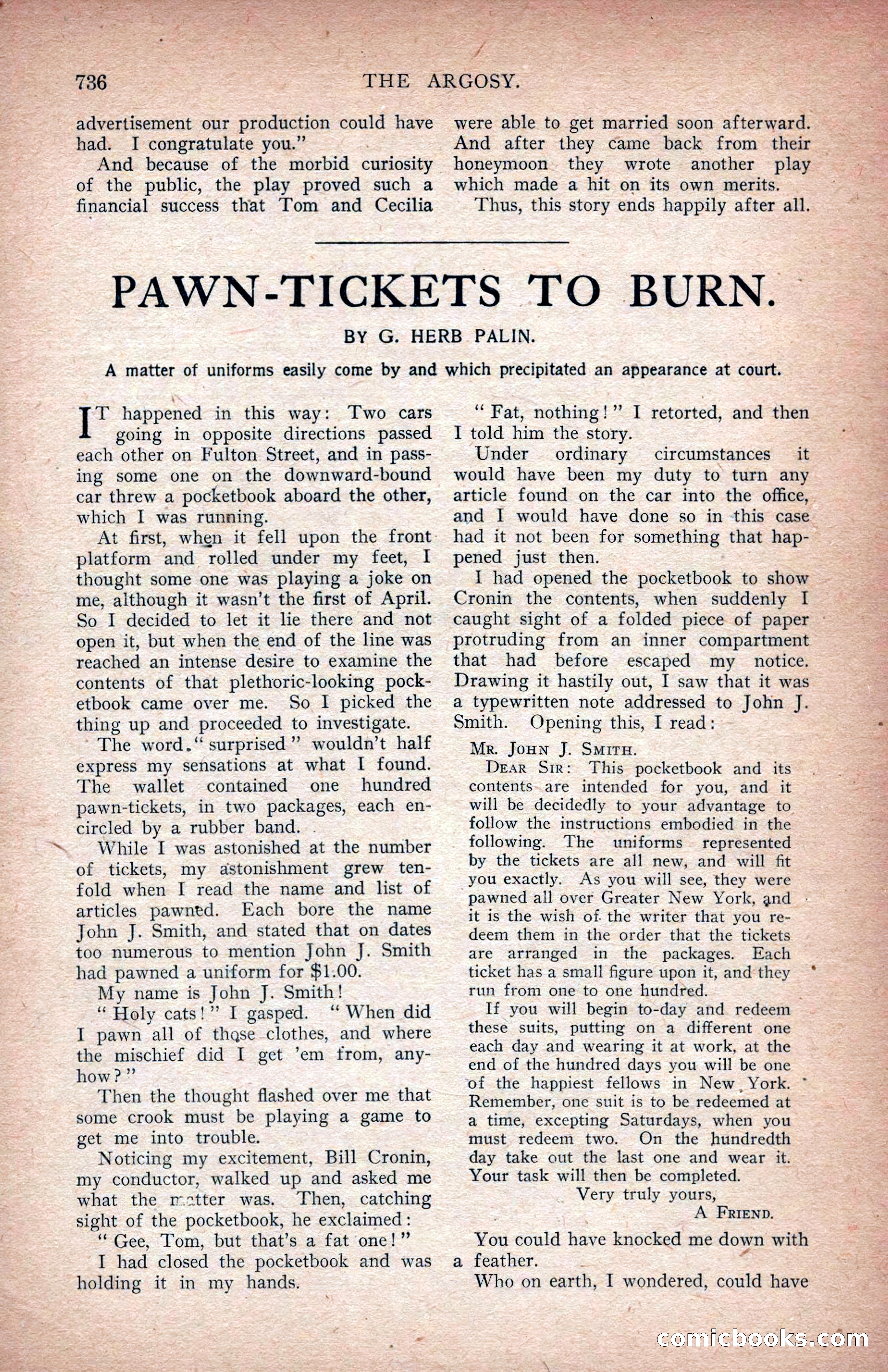
A restored page from Pulp Fiction, 1907. Page through the whole issue in the reader above.
📄 Transcribed text from this page (OCR, searchable)
Machine-transcribed from the original scan — historical spelling and the odd misread are preserved.
pm — Opel gn a a es ge ge el ST ee tg en ee nan Sa es eI en RE RR a L eS x Facer See ogni sere - ae : t 3 | aaa As 736 THE ARGOSY. advertisement our production could have had. I congratulate you.’ And because of the morbid curiosity. of the public, the play proved such a financial success that Tom and Cecilia were able to get married soon afterward. And after they came back from their another play honeymoon. they wrote which made a hit on its own merits. Thus, this story ends happily after all. PAWN-TICKETS TO BURN. BY G. HERB PALIN. A matter of uniforms easily come by and which precipitated an appearance at court. [' happened in this way: Two cars going in opposite directions passed each other on Fulton Street, and in pass- ing some one on the downward-bound car threw a pocketbook aboard the other, which I was running. At first, when it fell upon the front: platform and rolled under my feet, I thought some one was playing a joke on me, although it wasn’t the first of April. So I decided to let it lie there and not open it, but when the end of the line was reached an intense desire to examine the contents of that plethoric-looking pock- etbook came over me. So I picked the thing up and proceeded to investigate. The word.“ surprised” wouldn’t half express my sensations at what I found. The wallet contained one hundred pawn-tickets, in two packages, each en- circled by a rubber band. While I was astonished at the number of tickets, my astonishment grew ten- fold when I read the name and list of articles pawnted. Each bore the name John J. Smith, and stated that on dates too numerous to mention John J. Smith had pawned a uniform for $1.00. My name is John J. Smith! “ Holy cats!” I gasped. “ When did I pawn all of thase clothes, and where the mischief did I get ’em from, any- how?” Then the thought flashed over me that some crook must be playing a game to get me into trouble. Noticing my excitement, Bill Cronin, my conductor, walked up and asked me what the mctter was. Then, catching sight of the pocketbook, he exclaimed : ‘Gee, Tom, but that’s a fat one!” I had closed the pocketbook and was holding it in my hands. “ Fat, nothing!” I retorted, and then I told him the story. Under ordinary circumstances it would have been my duty to turn any article found on the car into the office, and I would have done so in this case had it not been for something that hap- pened just then. I had opened the pocketbook to show Cronin the contents, when suddenly I caught sight of a folded piece of paper © protruding from an inner compartment that had before escaped my _ notice. Drawing it hastily out, I saw that it was a typewritten note addressed to John J. Smith. Opening this, I read: Mr. Joun J. Smiru. Dear Sir: This pocketbook and its contents. are intended for you, and it will be decidedly to your advantage to follow the instructions embodied in the following. The uniforms represented by the tickets are all new, and will fit you exactly. As you will see, they were pawned all over Greater New York, and it is the wish of. the writer that you re- deem them in the order that the tickets are arranged in the packages. Each ticket has a small figure upon it, and they run from one to one hundred. If you will begin to-day and redeem these suits, putting on a different one each day and wearing it at work, at the end of the hundred days you will be one of the happiest fellows in New. York. * Remember, one suit is to be redeemed at a time, excepting Saturdays, when you must redeem two. On the hundredth day take out the last one and wear it. Your task will then be completed. Very truly yours, A FRIEND. Vou could have knocked me down with a feather. Who on earth, I wondered, could have Comicbooks.com-