
Pulp Fiction, 1907 · page 159 of 228
The Argosy, March 1907 — page 159: what you’re looking at
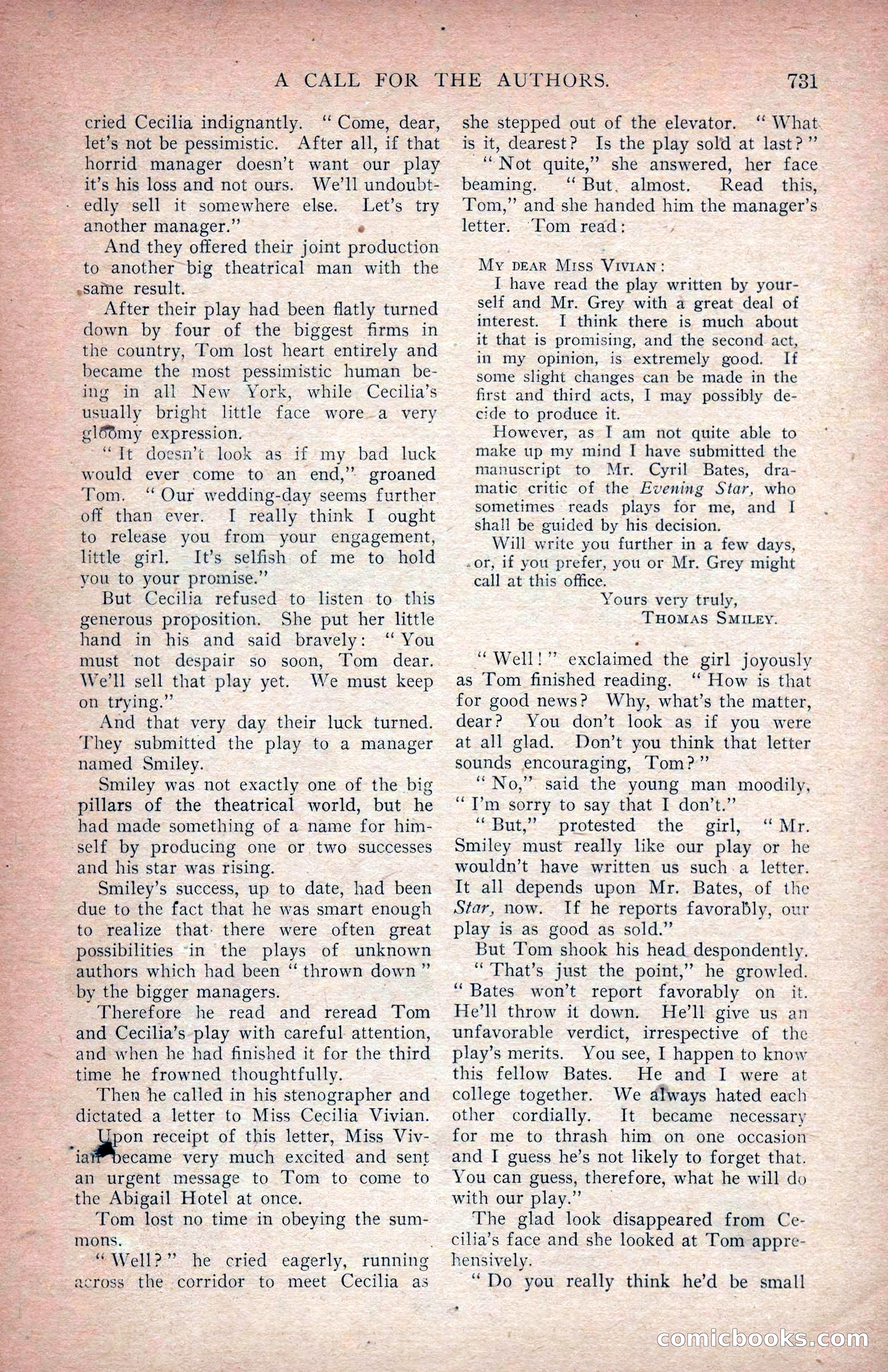
A restored page from Pulp Fiction, 1907. Page through the whole issue in the reader above.
📄 Transcribed text from this page (OCR, searchable)
Machine-transcribed from the original scan — historical spelling and the odd misread are preserved.
se. > A CALL FOR THE AUTHORS. cried Cecilia indignantly. ‘‘ Come, dear, let’s not be pessimistic. After all, if that horrid manager doesn’t want our play it’s his loss and not ours. We’ll undoubt- edly sell it somewhere else. Let’s try another manager.” “ And they offered their joint production to another big theatrical man with the same result. After their play had been flatly turned down by four of the biggest firms in the country, Tom lost heart entirely and became the most pessimistic human _ be- ing in all New York, while Cecilia’s usually bright little face wore a very ol66my expression. Tt doesn’t look as if my bad luck would ever come to an end,” groaned Tom. “ Our wedding-day seems further off than ever. I really think I ought to release you from your engagement, little girl. It’s selfish of me to hold you to your promise.” But Cecilia refused to listen to this generous proposition. She put her little hand in his and said bravely: “ You must not despair so soon, Tom dear. We'll sell that play yet. We must keep on trying.” And that very day their luck turned. They submitted the play to a manager named Smiley. Smiley was not exactly one of the big pillars of the theatrical world, but he had made something of a name for him- ‘self by producing one or two successes and his star was rising. Smiley’s success, up to date, had been due to the fact that he was smart enough to realize that: there were often great possibilities ‘in the plays of unknown authors which had been “ thrown down ” by the bigger managers. | Therefore he read and reread Tom and Cecilia’s play with careful attention, and when he had finished it for the third time he frowned thoughtfully. Then he called in his stenographer and dictated a letter to Miss Cecilia Vivian. ae receipt of this letter, Miss Viv- iaf became very much excited and sent an urgent message to Tom to come to the Abigail Hotel at once. Tom lost no time in obeying the sum- mons. across the corridor to meet Cecilia as “Well?” he cried eagerly, running 731 she stepped out of the elevator. ‘‘ What. is it, dearest? Is the play sold at last?” ~‘“Not quite,’ she answered, her face beaming. ‘‘ But. almost. Read this, Tom,” and she handed him the manager’s letter. [om read: My bDEAR Miss VIVIAN: I have read the play written by your- self and Mr. Grey with a great deal of interest. I think there is much about it that is promising, and the second act, in my opinion, is extremely good. If some slight changes can be made in the first and third acts, I may possibly de- cide to produce it. However, as I am not quite able to make up my mind I have submitted the manuscript to Mr. Cyril Bates, dra- matic critic of the Evening Star, who sometimes reads plays for me, and [| shall be guided by his decision. Will write you further in a few days, .or, if you prefer, you or Mr. Grey might call at this office. Yours very truly, THOMAS SMILEY. “Well!” exclaimed the girl joyously as Tom finished reading. ‘“‘ How is that for good news? Why, what’s the matter, dear? You don’t look as if you were at all glad. Don’t you think that letter sounds encouraging, Tom?” “No,” said the young man moodily, “Tm sorry to say that I don’t.” “Saelt,--"- protested the: -girl,--< * Mr: Smiley must really like our play or he wouldn’t have written us such.a letter. It all depends upon Mr. Bates, of the Star, now. If he reports favorably, our play is as good as sold.” But Tom shook his head despondently. ‘* That’s just the point,” he growled. ‘Bates won’t report favorably on_ it. He’ll throw it down. He’ll give us an unfavorable verdict, irrespective of the play’s merits. You see, I happen to know this fellow Bates. He and I were at college together. We always hated each other cordially. It became necessary for me to thrash him on one occasion and I guess he’s not likely to forget that. You can guess, therefore, what he will do with our play.” The glad look disappeared from Ce- cilia’s face and she looked at Tom appre- hensively. “Do you really think he’d be small Gomichooks:co -. mm,