
Pulp Fiction, 1907 · page 157 of 228
The Argosy, March 1907 — page 157: what you’re looking at
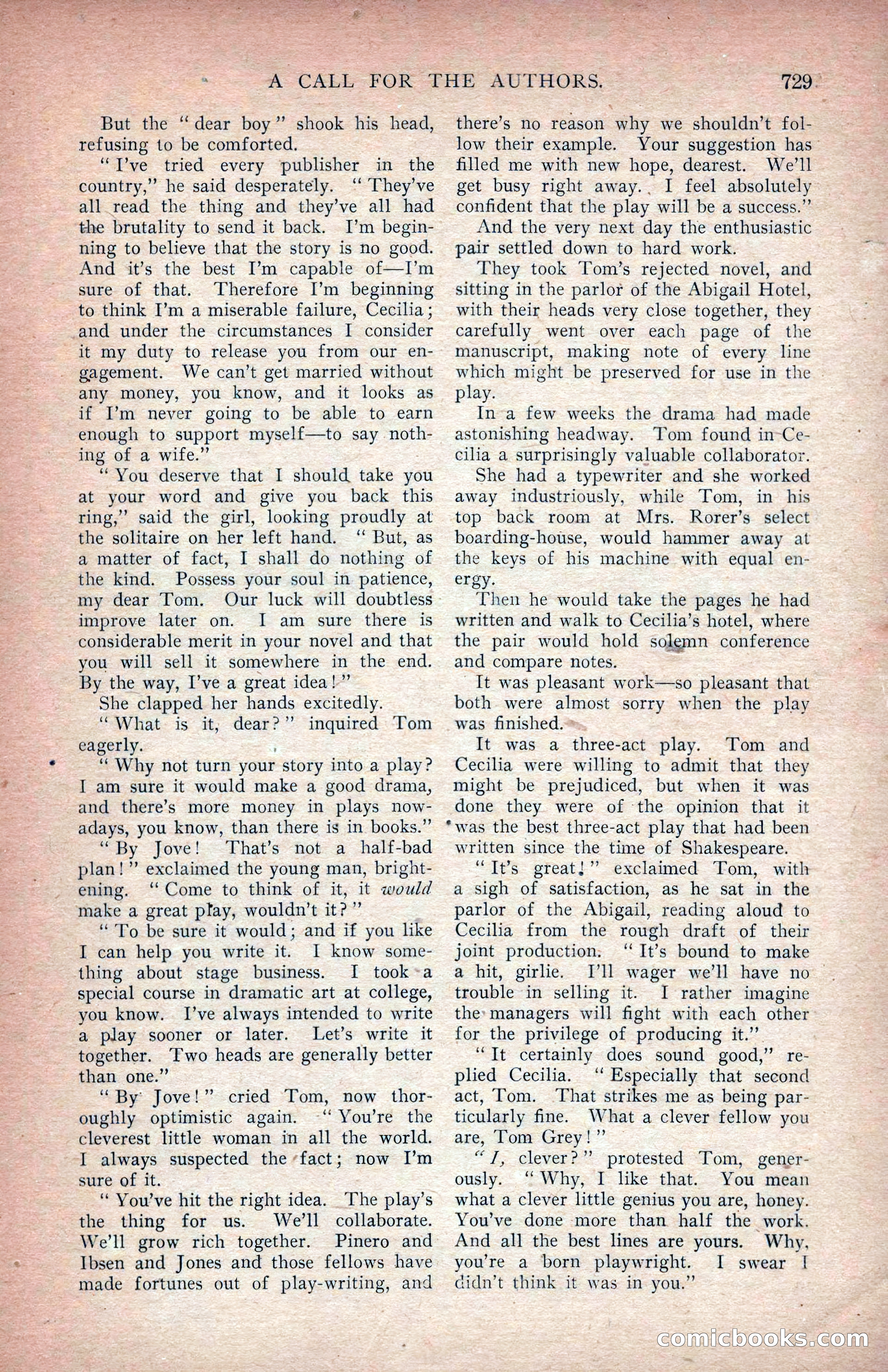
A restored page from Pulp Fiction, 1907. Page through the whole issue in the reader above.
📄 Transcribed text from this page (OCR, searchable)
Machine-transcribed from the original scan — historical spelling and the odd misread are preserved.
oN’. ae ae a ve Ft Te ome ee ag Ye ee ee Re oe, a, —s a Pa ewt il ae =a go ge i a tie ee eR a omg ~ Rs . 2 ne _ * we ~~ SF LA Ais th Sel - i Ae sea en ee ee ad s,s OR ae de Man Nn oe SS SS Fe a ae Oe ee ee = : A CALL FOR THE AUTHORS. ~ 729. But the “dear boy” shook his head, refusing to be comforted. ‘“T’ve tried every publisher in the country,’’ he said desperately. ‘ They’ve all read the thing and they’ve all had the brutality to send it back. I’m begin- ning to believe that the story is no good. And it’s the best I’m capable of—I’m sure of that. Therefore I’m beginning to think I’m a miserable failure, Cecilia ; and under the circumstances I consider it my duty to release you from our en- gagement. We can’t get married without any money, you know, and it looks as if I’m never going to be able to earn enough to support myself—to say noth- ing of a wife.” ‘You deserve that I should take you at your word and give you back this ring,”’ said the girl, looking proudly at the solitaire on her left hand. “ But, as a matter of fact, I shall do nothing of the kind. Possess your soul in patience, my dear Tom. Our luck will doubtless improve later on. I am sure there is considerable merit in your novel and that you will sell it somewhere in the end. By the way, I’ve a great idea!” She clapped her hands excitedly. “What is it; dear?” inquired Tom eagerly. ‘Why not turn your story into a play? I am sure it would make a good drama, and there’s more money in plays now- adays, you know, than there is in books.” “By Jove! That’s not a _ half-bad plan!” exclaimed the young man, bright- ening. ‘Come to think of it, it would make a great play, wouldn’t it?” ‘To be sure it would; and if you like I can help you write it. I know some- thing about stage business. [I took~a special course in dramatic art at college, you know. I’ve always intended to write a play sooner or later. Let’s write it together. Two heads are generally better than one.” “By Jove!” cried Tom, now thor- oughly optimistic again. ~“ You’re the cleverest little woman in all the world. I always suspected the fact; now I’m sure of it. ‘“You’ve hit the right idea. The play’s the thing for us. We'll collaborate. We'll grow rich together. Pinero and Ibsen and Jones and those fellows have made fortunes out of play-writing, and there’s no reason why we shouldn’t fol- low their example. Your suggestion has ™ filled me with new hope, dearest. We'll get busy right away.. I feel absolutely confident that the play will be a success.” And the very next day the enthusiastic pair settled down to hard work. They took Tom’s rejected novel, and sitting in the parlor of the Abigail Hotel, with their heads very close together, they carefully went over each page of the manuscript, making note of every line which might be preserved for use in the | play. In a few weeks the drama had made astonishing headway. Tom found in-Ce- cilia a surprisingly valuable collaborator. She had a typewriter and she worked away industriously, while Tom, in his top back room at Mrs. Rorer’s select boarding-house, would hammer away at the keys of his machine with equal en- ergy. Then he would take the pages he had written and walk to Cecilia’s hotel, where the pair would hold solemn conference and compare notes. It was pleasant work—so pleasant that both were almost sorry when the play was finished.» It was a three-act play. Tom and Cecilia were willing to admit that they might be prejudiced, but when it was done they were of the opinion that it *was the best three-act play that had been written since the time of Shakespeare. “It’s great!” exclaimed Tom, with a sigh of satisfaction, as he sat in the parlor of the Abigail, reading aloud to Cecilia from the rough draft of their joint production: ‘It’s bound to make a hit, girlie. I’ll wager we'll have no . trouble in selling it. I rather imagine the» managers will fight with each other for the privilege of producing it.’ “It certainly does sound good,’ re- plied Cecilia. ‘‘ Especially that second act, Tom. That strikes me as being par- ticularly fine. What a clever fellow you are, Tom Grey!” — “TI, clever?” protested Tom, gener- ously. “ Why, I like that. You mean what a clever little genius you are, honey. You've done more than half the work. And all the best lines are yours. Why, you're a born playwright. I swear | caidn’t think it was in you.” Gomichbooks:co Put hal fee pes a>, °.¥ debe ; im Pay