
Pulp Fiction, 1907 · page 145 of 228
The Argosy, March 1907 — page 145: what you’re looking at
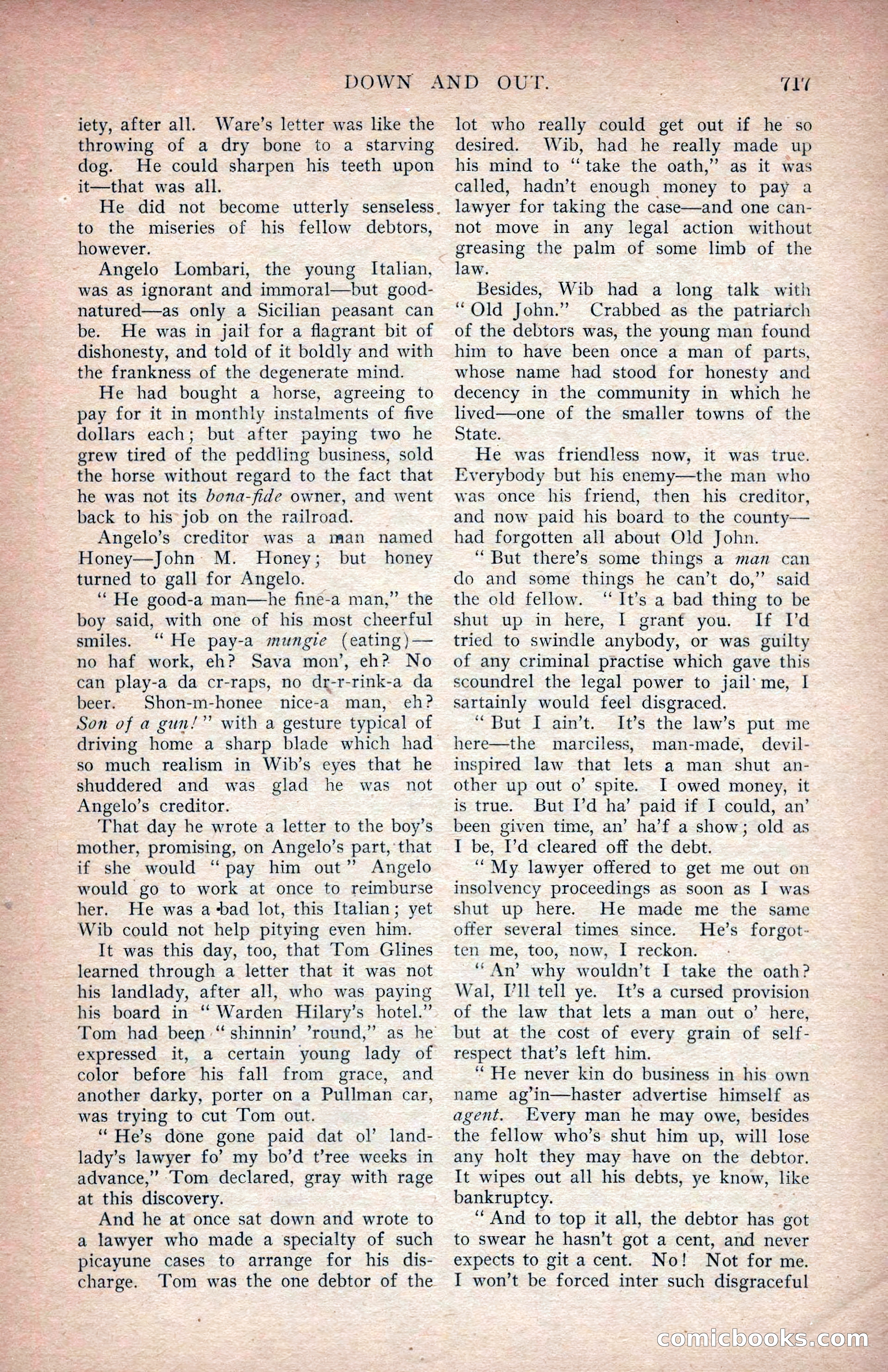
A restored page from Pulp Fiction, 1907. Page through the whole issue in the reader above.
📄 Transcribed text from this page (OCR, searchable)
Machine-transcribed from the original scan — historical spelling and the odd misread are preserved.
DOWN iety, after all. Ware’s letter was like the throwing of a dry bone to a starving dog. He could sharpen his teeth upon _it—that was all. He did not become utterly senseless. to the miseries of his fellow debtors, however. Angelo Lombari, the young Italian, was as ignorant and immoral—but good- natured—as only a Sicilian peasant can be. He was in jail for a flagrant bit of dishonesty, and told of it boldly and with the frankness of the degenerate mind. He had bought a horse, agreeing to pay for it in monthly instalments of five dollars each; but after paying two he grew tired of the peddling business, sold the horse without regard to the fact that he was not its bona-fide owner, and went back to his job on the railroad. Angelo’s creditor was a man named Honey—John M. Honey; but honey turned to gall for Angelo. “He good-a man—he fine-a man,” the boy said, with one of his most cheerful smiles. ‘‘ He pay-a mungie (eating )— no haf work, eh? Sava mon’, eh? No can play-a da cr-raps, no dr-r-rink-a da beer. Shon-m-honee nice-a man, eh? Son of a gun!” with a gesture typical of driving home a sharp blade which had so much realism in Wib’s eyes that he shuddered and was glad he was _ not Angelo’s creditor. That day he wrote a letter to the boy’s mother, promising, on Angelo’s part, that cé if she would “pay him out” Angelo would go to work at once to reimburse her. He was a-bad lot, this Italian; yet Wib could not help pitying even him. It was this day, too, that Tom Glines learned through a letter that it was not his landlady, after all, who was paying his board in ‘ Warden Hilary’s hotel.” Tom had been “ shinnin’ expressed it, a certain young lady of color before his fall from grace, and another darky, porter on a Pullman car, was trying to cut Tom out. “ He’s done gone paid dat ol’ land- lady’s lawyer fo’ my bo’d t’ree weeks in advance,” Tom declared, gray with rage at this discovery. And he at once sat down and wrote to a lawyer who made a specialty of such picayune cases to arrange for his dis- charge. Tom was the one debtor of the AND OUT. ’round,” as he (1% lot who really could get out if he so desired. Wib, had he really made up his mind to “take the oath,” as it was called, hadn’t enough money to pay a lawyer for taking the case—and one can- not move in any legal action without greasing the palm of some limb of the law. Besides, Wib had a long talk with “Old John.” Crabbed as the patriarch of the debtors was, the young man found him to have been once a man of parts, whose name had stood for honesty and decency in the community in which he lived—one of the smaller towns of the State. He was friendless now, it was true. Everybody but his enemy—the man who was once his friend, then his creditor, and now paid his board to the county— had forgotten all about Old John. ‘But there’s some things a man can do and some things he can’t do,” said the old fellow. “It’s a bad thing to be shut up in here, I grant you. If I'd tried to swindle anybody, or was guilty of any criminal practise which gave this scoundrel the legal power to jail’ me, I sartainly would feel disgraced. “But I ain’t. It’s the law’s put me here—the marciless, man-made, devil- inspired law that lets a man shut an- other up out o’ spite. I owed money, it is true. But I’d ha’ paid if I could, an’ been given time, an’ ha’f a show; old as I be, I’d cleared off the debt. “My lawyer offered to get me out on insolvency proceedings as soon as I was shut up here. He made me the same offer several times since. He’s forgot- ten me, too, now, I reckon. ‘An’ why wouldn’t I take the oath? Wal, [ll tell ye. It’s a cursed provision of the law that lets a man out o’ here, but at the cost of every grain of self- respect that’s left him. “He never kin do business in his own name ag’in—haster advertise himself as agent. Every man he may owe, besides the fellow who’s shut him up, will lose any holt they may have on the debtor. It wipes out all his debts, ye know, like bankruptcy. “ And to top it all, the debtor has got to swear he hasn’t got a cent, and never expects to git a cent. No! Not for me. I won’t be forced inter such disgraceful EOPMNIE HOC <S5(€C) in