
Pulp Fiction, 1907 · page 103 of 228
The Argosy, March 1907 — page 103: what you’re looking at
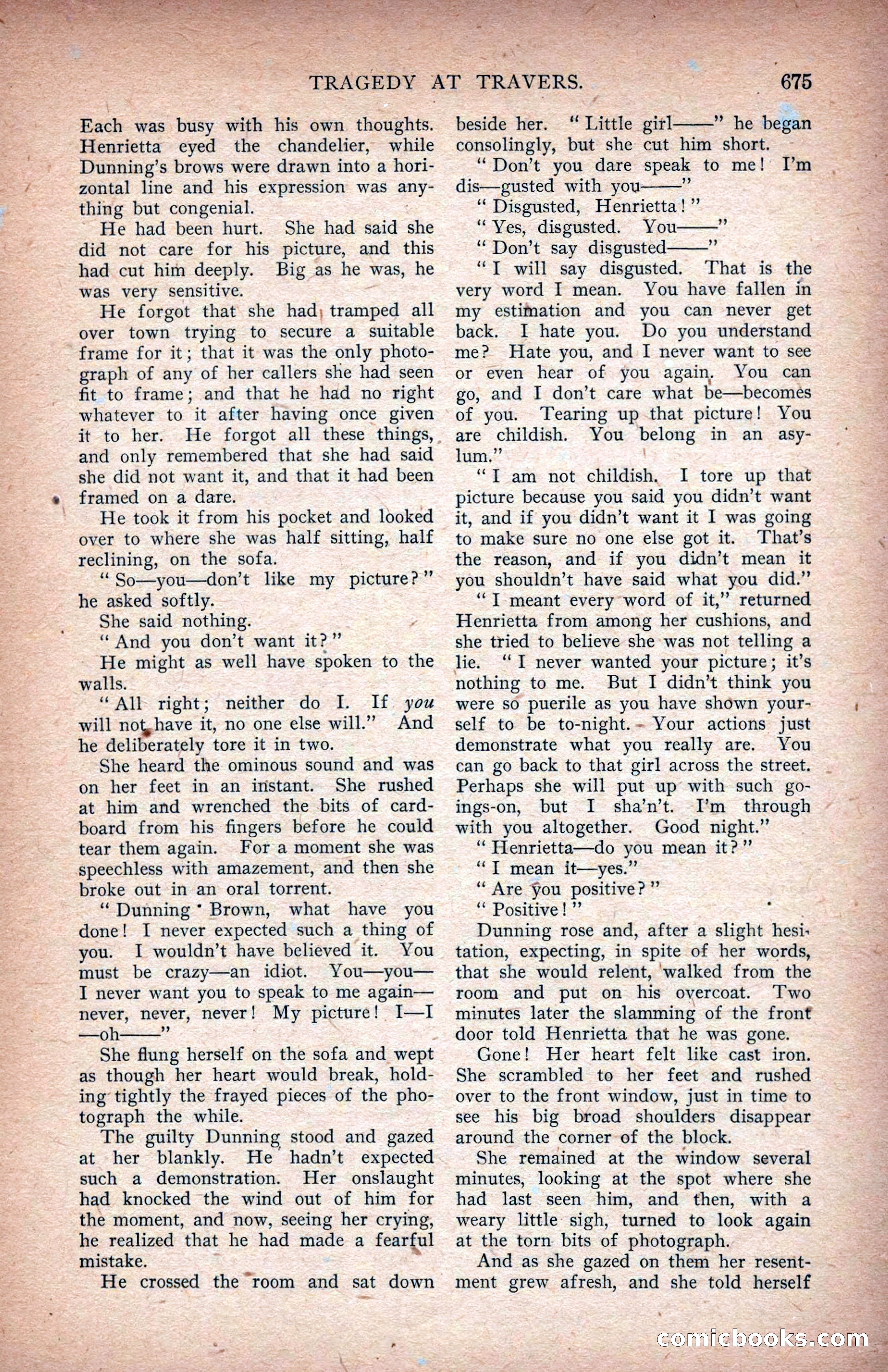
A restored page from Pulp Fiction, 1907. Page through the whole issue in the reader above.
📄 Transcribed text from this page (OCR, searchable)
Machine-transcribed from the original scan — historical spelling and the odd misread are preserved.
. "TRAGEDY AT TRAVERS. ee Bach was busy with his own thoughts. Henrietta eyed the chandelier, while Dunning’s brows were drawn into a hori- zontal line and his expression was roads thing but congenial. He had been hurt. She had said she did not care for his picture, and this had cut him deeply. Big as he was, he was very sensitive. He forgot that she had; anged all over town trying to secure a suitable - frame for it; that it was the only photo- graph of any of her callers she had seen fit to frame; and that he had no right whatever to it after having once given it to her. and only remembered that she had said she did not want it, and that it had been framed on a dare. He took it from his pocket and looked over to where she was half sitting, half reclining, on the sofa. ‘““ So—you—don’t like my picture?”’ he asked softly. She said nothing. “And you don’t want it?” He might as well have spoken to the walls. “All right; neither do I. If you will not. have it, no one else will.” And he deliberately tore it in two. She heard the ominous sound and was on her feet in an instant. She rushed at him and wrenched the bits of card- board from his fingers before he could tear them again. For a moment she was speechless with amazement, and then she broke out in an oral torrent. “Dunning * Brown, what have you done! I never expected such a thing of you. I wouldn’t have believed it. You must be crazy—an idiot. You—you— I never want you to speak to me again— never, never, never ! My picture! I—I —oh—— She flung herself on the sofa and wept as though her heart would break, hold- ing tightly the frayed pieces of the pho- tograph the while. The guilty Dunning stood and gazed at her blankly. He hadn’t expected such a demonstration. Her onslaught had knocked the wind out of him for the moment, and now, seeing her crying, he realized that he had made a fearful mistake. He crossed the room and sat down a” He forgot all these things, . beside her. “ Little girl ” he began consolingly, but she cut him short. “Don’t you dare speak to me! I’m dis—gusted with you “Disgusted, Henrietta!” ‘Yes, disgusted. You ‘Don’t say disgusted “T will say disgusted. That is the very word I mean. You have fallen in my estimation and you can never get back. I hate you. Do you understand me? Hate you, and I never want to see or even hear of you again. You can go, and I don’t care what be—becomés of you. Tearing up that picture ! You are childish. You belong in an asy- lum.” “T am not childish. I tore up that picture because you said you didn’t want it, and if you didn’t want it I was going to make sure no one else got it. That’s the reason, and if you didn’t mean it you shouldn’t have said what you did.” ‘“T meant every word of it,” returned Henrietta from among her cushions, and she tried to believe she was not telling a lie. “I never wanted your picture; it’s nothing to me. But I didn’t think you were so puerile as you have shown your- self to be to-night.- Your actions just demonstrate what you really are. You ean go back to that girl across the street. Perhaps she will put up with such go- ings-on, but I sha’n’t. I’m through with you altogether. Good night.” ‘“Henrietta—do you mean it?” ““T mean it—yes.”’ ‘Are you positive?” ‘* Positive!” Dunning rose and, after a slight hesi- tation, expecting, in spite of her words, that she would relent, walked from the room and put on his overcoat. Two minutes later the slamming of the front door told Henrietta that he was gone. Gone! Her heart felt like cast iron. She scrambled to her feet and rushed over to the front window, just in time to see his big broad shoulders disappear around the corner of the block. She remained at the window several minutes, looking at the spot where she had last seen him, and then, with a weary little sigh, turned to look again at the torn bits of photograph. And as she gazed on them her resent- ment grew afresh, and she told herself ‘ EEE Comic 900 ‘S;€O! es te Lay Aft, Ay ¥ iat : * aN er be . ve yriets 4/ te. “P. : & . oo 4 | se Se +N as 4 a