
Pulp Fiction, 1925 · page 89 of 168
Argosy All-Story Weekly, June 27, 1925 — page 89: what you’re looking at
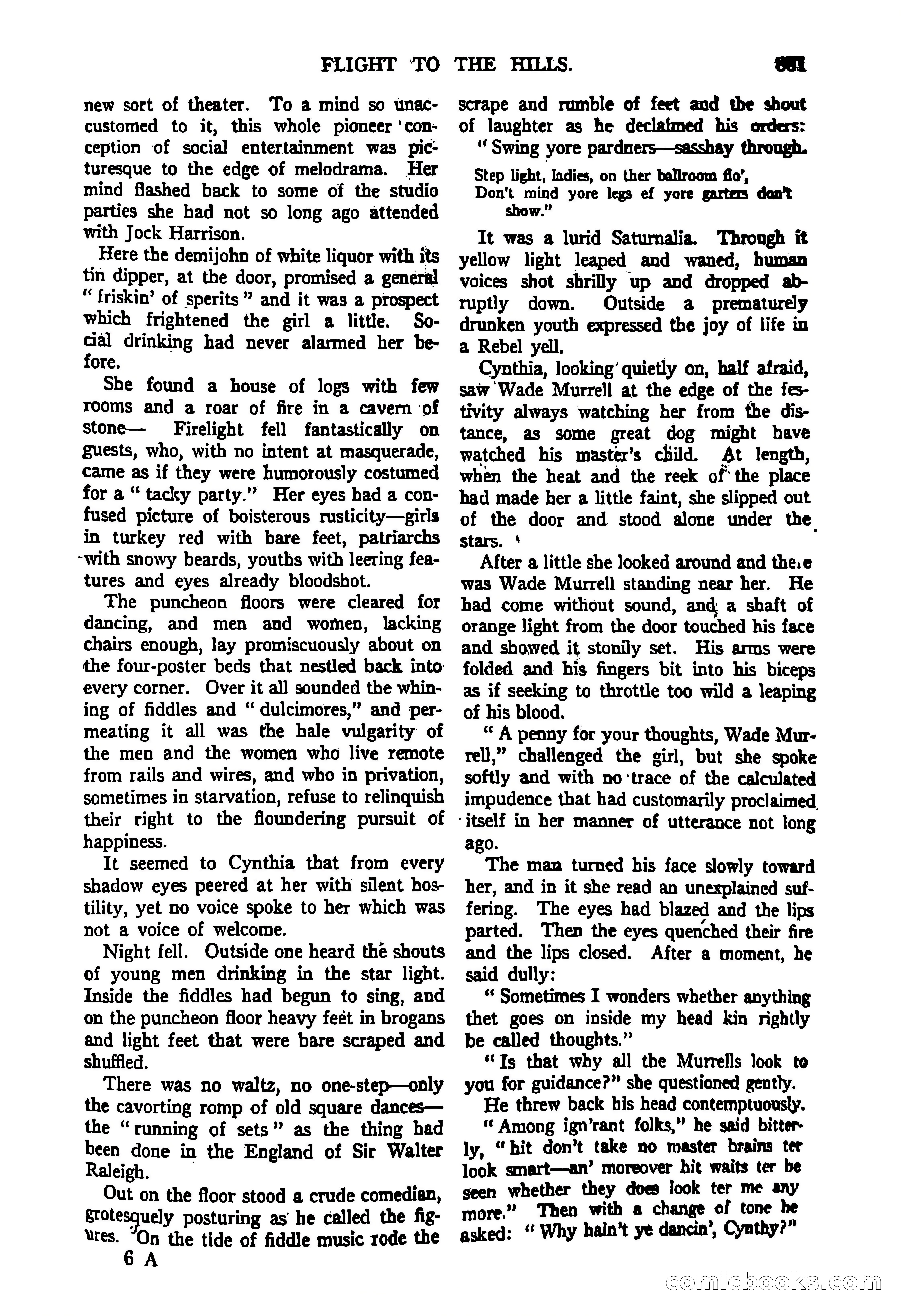
A restored page from Pulp Fiction, 1925. Page through the whole issue in the reader above.
📄 Transcribed text from this page (OCR, searchable)
Machine-transcribed from the original scan — historical spelling and the odd misread are preserved.
FLIGHT ‘TO new sort of theater. To a mind so unac- customed to it, this whole pioneer ‘con- ception of social entertainment was pic- turesque to the edge of melodrama. Her mind flashed back to some of the studio parties she had not so long ago attended with Jock Harrison. Here the demijohn of white liquor with its tin dipper, at the door, promised a general “ friskin’ of sperits? and it was a prospect which frightened the girl a little. So- cial drinking had never alarmed her be- ore. She found a house of logs with few rooms and a roar of fire in a cavern of stone— Firelight fell fantastically on guests, who, with no intent at masquerade, came as if they were humorously costumed for a “ tacky party.” Her eyes had a con- fused picture of boisterous rusticity—girls in turkey red with bare feet, patriarchs “with snowy beards, youths with leering fea- tures and eyes already bloodshot. The puncheon floors were cleared for dancing, and men and women, lacking chairs enough, lay promiscuously about on the four-poster beds that nestled back into every corner. Over it all sounded the whin- ing of fiddles and “ dulcimores,’”’ and per- meating it all was the hale vulgarity of the men and the women who live remote from rails and wires, and who in privation, sometimes in starvation, refuse to relinquish their right to the floundering pursuit of happiness. It seemed to Cynthia that from every shadow eyes peered at her with silent hos- tility, yet no voice spoke to her which was not a voice of welcome. | Night fell. Outside one heard the shouts of young men drinking in the star light. Inside the fiddles had begun to sing, and on the puncheon floor heavy feet in brogans and light feet that were bare scraped and shuffied. There was no waltz, no one-step—only the cavorting romp of old square dances— the “running of sets’’ as the thing had been done in the England of Sir Walter Raleigh. Out on the floor stood a crude comedian, grotesquely posturing as he called the fig- Ures. a the tide of fiddle music rode the A scrape and rumble of feet and the shout of laughter as he declaimed his orders: ‘Swing yore pardners—sasshay through. Step light, ladies, on ther ballroom flo’, Don't mind yore legs ef yore garters show.” It was a lurid Saturnalia. Throngh it yellow light leaped and waned, human voices shot shrilly up and dropped ab- ruptly down. Outside a prematurely drunken youth expressed the joy of life in a Rebel yell. | Cynthia, looking’ quietly on, half afraid, saw Wade Murrell at the edge of the fes- tivity always watching her from the dis- tance, as some great dog might have watched his master’s child. At length, when the heat and the reek of the place had made her a little faint, she slipped out of the door and stood alone under the Stars. | After a little she looked around and the.e was Wade Murrell standing near her. He had come without sound, and a shaft of orange light from the door touched his face and showed it stonily set. His arms were folded and his fingers bit into his biceps as if seeking to throttle too wild a leaping of his blood. “‘ A penny for your thoughts, Wade Mur- rell,” challenged the girl, but she spoke softly and with no‘trace of the calculated impudence that had customarily proclaimed. ‘itself in her manner of utterance not long ago. The man turned his face slowly toward her, and in it she read an unexplained suf- fering. The eyes had blazed and the lips parted. Then the eyes quenched their fire and the lips closed. After a moment, he said dully: “* Sometimes I wonders whether anything thet goes on inside my head kin rightly be called thoughts.” “Ts that why all the Murrells look to you for guidance?” she questioned gently. He threw back his head contemptuously. « Among ign’rant folks,” he said bitter- ly, “hit don’t take no master brains ter look smart—an’ moreover hit waits ter be seen whether they dees look ter me any more.” Then with a change of tone he asked: “Why hain't ye dancin’, Cynthy?” COnniEaoo () SS Co