
Pulp Fiction, 1925 · page 79 of 168
Argosy All-Story Weekly, June 27, 1925 — page 79: what you’re looking at
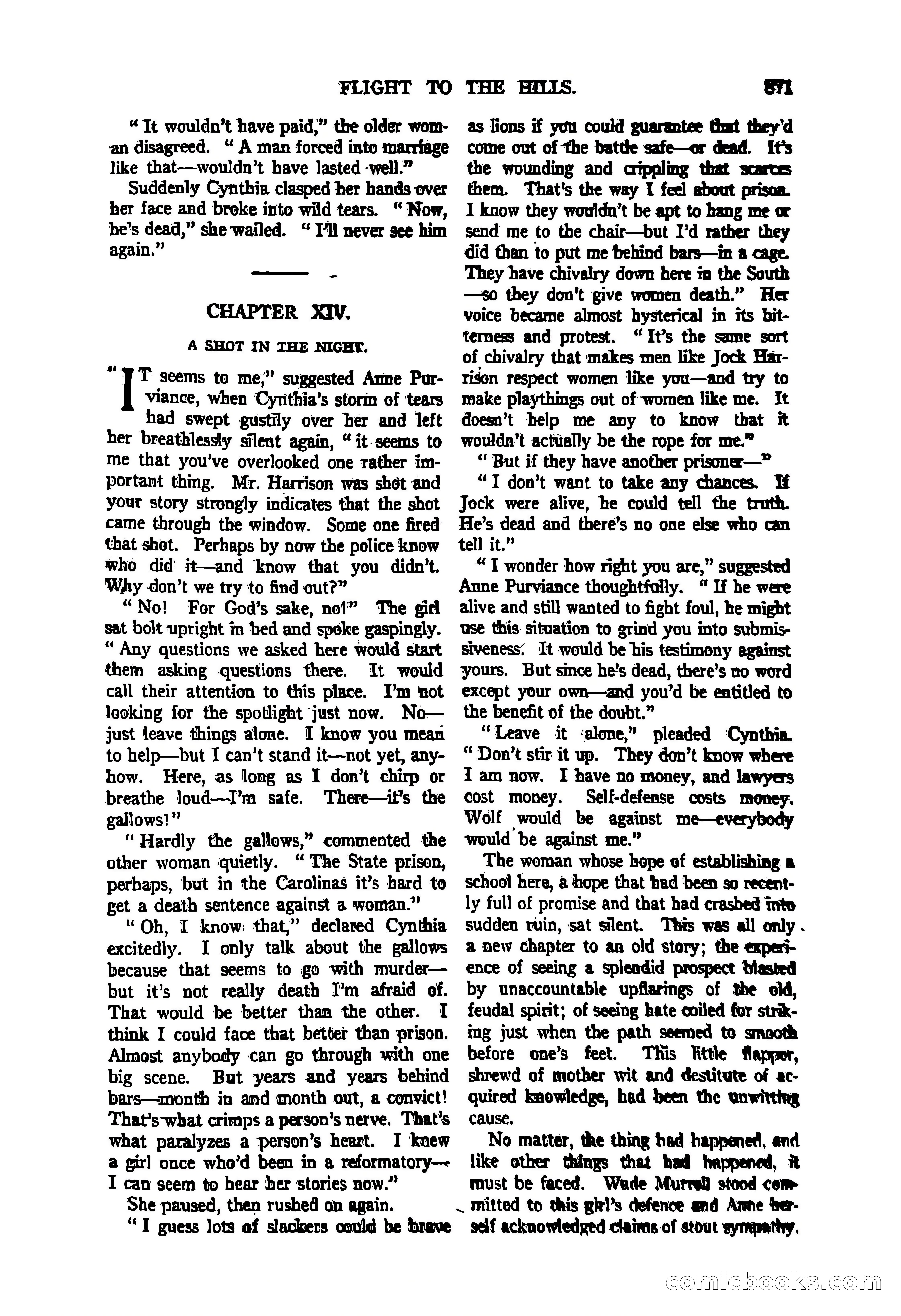
A restored page from Pulp Fiction, 1925. Page through the whole issue in the reader above.
📄 Transcribed text from this page (OCR, searchable)
Machine-transcribed from the original scan — historical spelling and the odd misread are preserved.
“Tt wouldn’t have paid;” the older wom- an disagreed. “ A man forced into marriage like that—wouldn’t have lasted -well.” Suddenly Cynthia clasped her hands over her face and broke into wild tears. ‘“ Now, he’s dead,” she wailed. “ T’li never see him again.” CHAPTER XIV. A SHOT IN THE NIGHT. “JT seems te me;” suggested Anne Par- viance, when Cytithia’s storin of tears had swept gustily over her and left her breathlessly silent again, “ it-seems to me that you’ve overlooked one rather im- portant thing. Mr. Harrison was shet and your story strongly indicates that the shot came through the window. Some one fired that shot. Perhaps by now the police know who did’ it—and know that you didn’t. Why -don’t we try to find out?” “No! For God’s sake, no!” The girl sat bolt upright in bed and spoke gaspingly. “ Any questions we asked here would start them asking questions there. It would call their attention to this place. I’m not looking for the spotlight just now. No— just leave things alone. I know you mean to help—but I can’t stand it—not yet, any- how. Here, as long as I don’t chirp or breathe loud—I’m safe. There—if’s the gallows!” “ Hardly the gallows,” commented the other woman quietly. “ The State prison, perhaps, but in the Carolinas it’s hard to get a death sentence against a woman.” “Oh, I know: that,” declared Cynthia excitedly. I only talk about the gallows because that seems to go with murder— but it’s not really death I’m afraid of. That would be better than the other. I think I could face that better than prison. Almost anybody can go through with one big scene. But years and years behind bars—month in and month out, a convict! That’s-what crimps a person's nerve. That's what paralyzes a person’s heart. I knew a gir] once who’d been in a reformatory— I can seem to hear her stories now.” She paused, then rushed on again. ‘‘T guess lots af slackers oould be brave as lions if you could guarantee that they'd come out of the battle safe—or dead. It's ‘the wounding and crippling that scarce them. That's the way I feel about prison. I know they wouldn’t be apt to hang me or send me to the chair—but I’d rather they did than to put me behind bars—in a cage. They have chivalry down here m the South —<o they don't give women death.” Her voice became almost hysterical in its bit- temness and protest. “It’s the same sart of chivalry that makes men like Jock Har- rison respect women like you—and try to make playthings out of women like me. it doesn’t help me any to know that it wouldn’t actually be the rope for me.” “ But if they have another prisoner—” “TI don’t want to take any chances. Tf Jock were alive, he could tell the truth. He’s dead and there’s no one else who can tell it.” “T wonder how right you are,” suggested Anne Purviance thoughtfully. “ If he were alive and still wanted to fight foul, he might use this situation to grind you into submis- siveness: It would be his testimony against yours. But since he's dead, there’s no word except your own—and you'd be entitled to the benefit of the doubt.” “Leave it <alone,” pleaded Cynthia. “ Don’t stir it up. They don’t know where I am now. I have no money, and lawyers cost money. Self-defense costs money. Wolf would be against me—everybedy would be against me.” The woman whose hope of establishing a school here, a ‘hope that had been so recent- ly full of promise and that had crashed into sudden ruin, sat silent. This was all only . a new chapter to an old story; the experi- ence of seeing a splendid prospect diasted by unaccountable upflarmegs of the old, feudal spirit; of seeing hate coiled for strik- ing just when the path seemed to smooth before one’s feet. This little flapper, shrewd of mother wit and destitute of ac- quired knowledge, had been the unwitting cause. No matter, the thing had happened, and like other things that had happened, it must be faced. Wade Murrell stood com ~ mitted to vkis gkl’s defence and Anne her- self acknowledged claims of stout sympathy, COnniEaoo () SS Co