
Pulp Fiction, 1925 · page 28 of 168
Argosy All-Story Weekly, June 27, 1925 — page 28: what you’re looking at
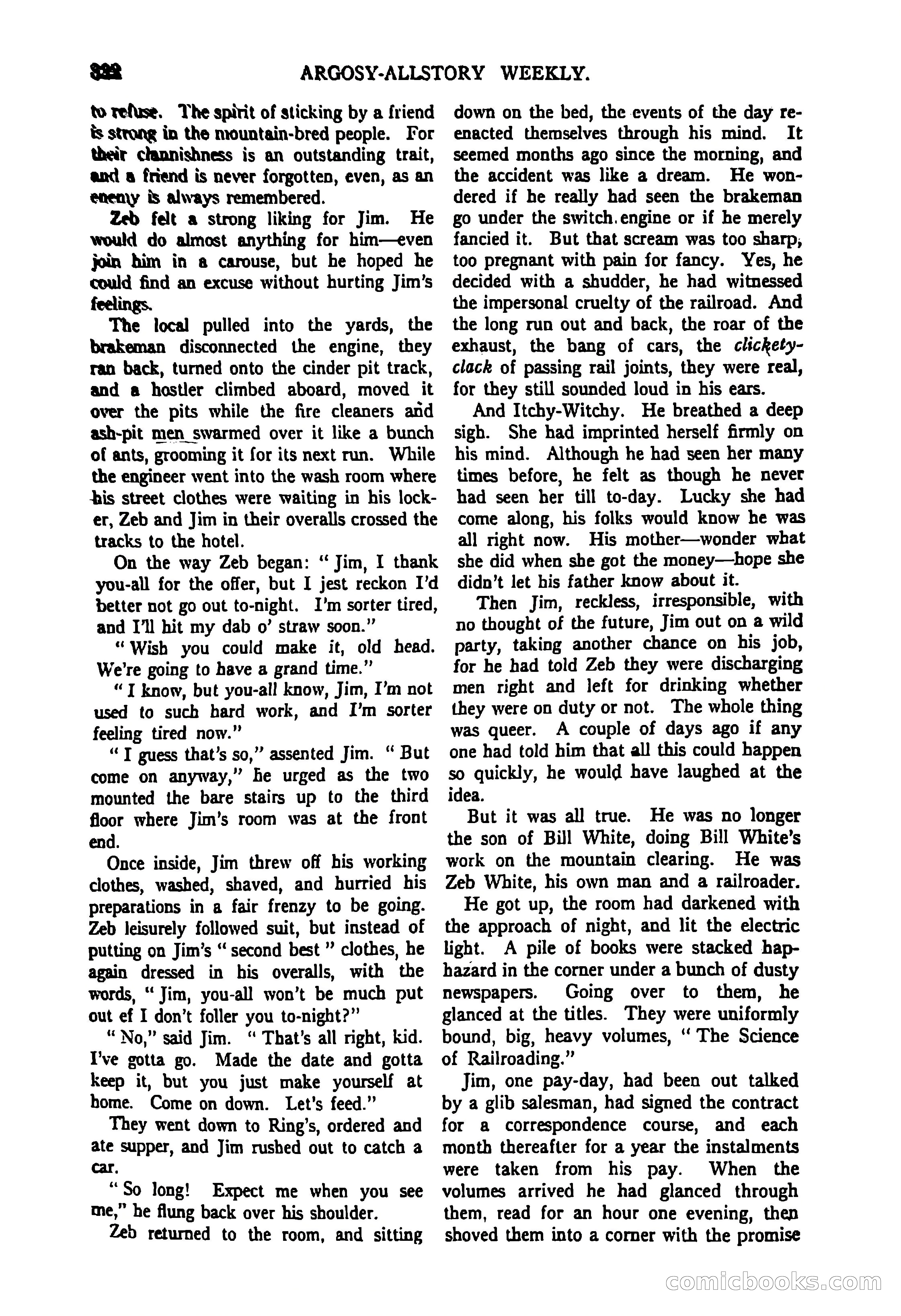
A restored page from Pulp Fiction, 1925. Page through the whole issue in the reader above.
📄 Transcribed text from this page (OCR, searchable)
Machine-transcribed from the original scan — historical spelling and the odd misread are preserved.
to refuse. The spirit of sticking by a friend ts strong in the mountain-bred people. For their clannishness is an outstanding trait, end a frend is never forgotten, even, as an eneny is always remembered. Zeb felt a strong liking for Jim. He would do almost anything for him—even join him in a carouse, but he hoped he could find an excuse without hurting Jim’s feelings. The local pulled into the yards, the brakeman disconnected the engine, they ran back, turned onto the cinder pit track, and a hostler climbed aboard, moved it over the pits while the fire cleaners and ash-pit men_swarmed over it like a bunch of ants, grooming it for its next run. While the engineer went into the wash room where his street clothes were waiting in his lock- er, Zeb and Jim in their overalls crossed the tracks to the hotel. On the way Zeb began: “ Jim, I thank you-all for the offer, but I jest reckon I’d better not go out to-night. I’m sorter tired, and Il] hit my dab o’ straw soon.” “Wish you could make it, old head. We're going to have a grand time.” “T know, but you-all know, Jim, I’m not used to such hard work, and I’m sorter feeling tired now.” “T guess that’s so,” assented Jim. “ But come on anyway,” he urged as the two mounted the bare stairs up to the third floor where Jim’s room was at the front end. Once inside, Jim threw off his working clothes, washed, shaved, and hurried his preparations in a fair frenzy to be going. Zeb leisurely followed suit, but instead of putting on Jim’s “second best ” clothes, he again dressed in his overalls, with the words, “‘ Jim, you-all won’t be much put out ef I don’t foller you to-night?” “No,” said Jim. “ That’s all right, kid. I've gotta go. Made the date and gotta keep it, but you just make yourself at home. Come on down. Let's feed.” They went down to Ring’s, ordered and ate supper, and Jim rushed out to catch a car. “So long! Expect me when you see me,” he flung back over his shoulder. Zeb returned to the room, and sitting ARGOSY-ALLSTORY WEEKLY. down on the bed, the events of the day re- enacted themselves through his mind. It seemed months ago since the morning, and the accident was like a dream. He won- dered if he really had seen the brakeman go under the switch.engine or if he merely fancied it. But that scream was too sharp, too pregnant with pain for fancy. Yes, he decided with a shudder, he had witnessed the impersonal cruelty of the railroad. And the long run out and back, the roar of the exhaust, the bang of cars, the clickety- clack of passing rail joints, they were real, for they still sounded loud in his ears. And Itchy-Witchy. He breathed a deep sigh. She had imprinted herself firmly on his mind. Although he had seen her many times before, he felt as though he never had seen her till to-day. Lucky she had come along, his folks would know he was all right now. His mother—wonder what she did when she got the money—hope she didn’t let his father know about it. Then Jim, reckless, irresponsible, with no thought of the future, Jim out on a wild party, taking another chance on his job, for he had told Zeb they were discharging men right and left for drinking whether they were on duty or not. The whole thing was queer. A couple of days ago if any one had told him that all this could happen so quickly, he would have laughed at the idea. But it was all true. He was no longer the son of Bill White, doing Bill White’s work on the mountain clearing. He was Zeb White, his own man and a railroader. He got up, the room had darkened with the approach of night, and lit the electric light. A pile of books were stacked hap- hazard in the corner under a bunch of dusty newspapers. Going over to them, he glanced at the titles. They were uniformly bound, big, heavy volumes, ‘“ The Science of Railroading.” Jim, one pay-day, had been out talked by a glib salesman, had signed the contract for a correspondence course, and each month thereafter for a year the instalments were taken from his pay. When the volumes arrived he had glanced through them, read for an hour one evening, then shoved them into a corner with the promise COMmica@oo SS Co