
Pulp Fiction, 1925 · page 24 of 168
Argosy All-Story Weekly, June 27, 1925 — page 24: what you’re looking at
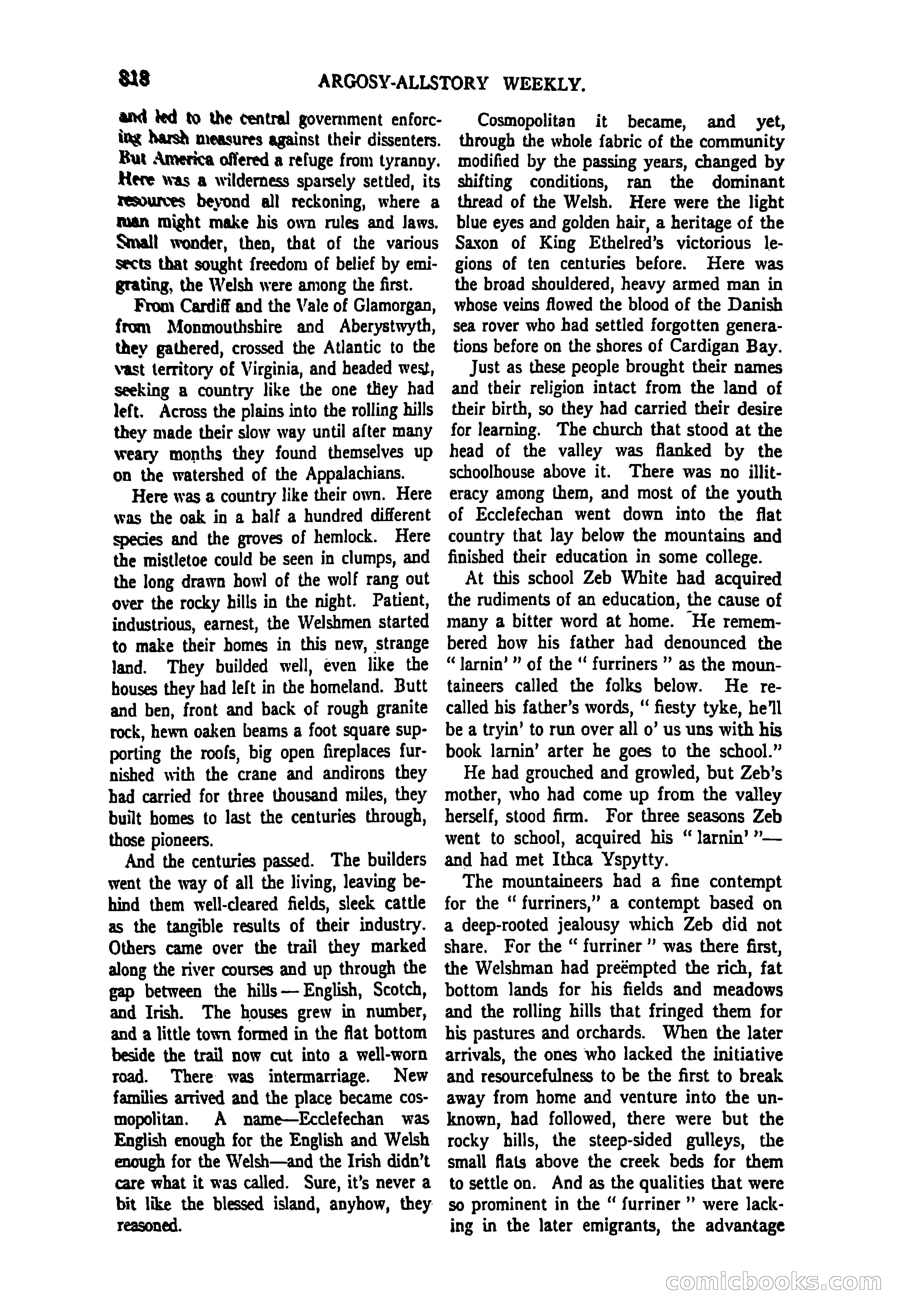
A restored page from Pulp Fiction, 1925. Page through the whole issue in the reader above.
📄 Transcribed text from this page (OCR, searchable)
Machine-transcribed from the original scan — historical spelling and the odd misread are preserved.
S18 ing harsh measures against their dissenters. But America offered a refuge from tyranny. Here was a wilderness sparsely settled, its resources beyond all reckoning, where a ruan might make his own rules and laws. Small wonder, then, that of the various sects that sought freedom of belief by emi- grating, the Welsh were among the first. From Cardiff and the Vale of Glamorgan, from Monmouthshire and Aberystwyth, they gathered, crossed the Atlantic to the vast territory of Virginia, and headed west, seeking a country like the one they had left. Across the plains into the rolling hills they made their slow way until after many weary months they found themselves up on the watershed of the Appalachians. Here was a country like their own. Here was the oak in a half a hundred different species and the groves of hemlock. Here the mistletoe could be seen in clumps, and the long drawn howl of the wolf rang out over the rocky hills in the night. Patient, industrious, earnest, the Welshmen started to make their homes in this new, strange land. They builded well, even like the houses they had left in the homeland. Butt and ben, front and back of rough granite rock, hewn oaken beams a foot square sup- porting the roofs, big open fireplaces fur- nished with the crane and andirons they had carried for three thousand miles, they built homes to last the centuries through, those pioneers. And the centuries passed. The builders went the way of all the living, leaving be- hind them well-cleared fields, sleek cattle as the tangible results of their industry. Others came over the trail they marked along the river courses and up through the gap between the hills — English, Scotch, and Irish. The houses grew in number, and a little town formed in the flat bottom beside the trail now cut into a well-worn road. There was intermarriage. New families arrived and the place became cos- mopolitan. A name—Ecclefechan was English enough for the English and Welsh enough for the Welsh—and the Irish didn’t care what it was called. Sure, it’s never a bit like the blessed island, anyhow, they reasoned. ARGOSY-ALLSTORY WEEKLY. and ted to the central government enforc- Cosmopolitan it became, and yet, through the whole fabric of the community modified by the passing years, changed by shifting conditions, ran the dominant thread of the Welsh. Here were the light blue eyes and golden hair, a heritage of the Saxon of King Ethelred’s victorious le- gions of ten centuries before. Here was the broad shouldered, heavy armed man in whose veins flowed the blood of the Danish sea rover who had settled forgotten genera- tions before on the shores of Cardigan Bay. Just as these people brought their names and their religion intact from the land of their birth, so they had carried their desire for learning. The church that stood at the head of the valley was flanked by the schoolhouse above it. There was no illit- eracy among them, and most of the youth of Ecclefechan went down into the flat country that lay below the mountains and finished their education in some college. At this school Zeb White had acquired the rudiments of an education, the cause of many a bitter word at home. He remem- bered how his father had denounced the “Jarnin’” of the “ furriners ” as the moun- taineers called the folks below. He re- called his father’s words, ‘‘ fiesty tyke, he'll be a tryin’ to run over all o’ us uns with his book lamin’ arter he goes to the school.” He had grouched and growled, but Zeb’s mother, who had come up from the valley herself, stood firm. For three seasons Zeb went to school, acquired his “ larnin’ ”— and had met Ithca Yspytty. The mountaineers had a fine contempt for the “ furriners,’’ a contempt based on a deep-rooted jealousy which Zeb did not share. For the “ furriner ’’ was there first, the Welshman had preémpted the rich, fat bottom lands for his fields and meadows and the rolling hills that fringed them for his pastures and orchards. When the later arrivals, the ones who lacked the initiative and resourcefulness to be the first to break away from home and venture into the un- known, had followed, there were but the rocky hills, the steep-sided gulleys, the small flats above the creek beds for them to settle on. And as the qualities that were so prominent in the “ furriner ’’ were lack- ing in the later emigrants, the advantage CON () 1A@OO SS Co