
Pulp Fiction, 1925 · page 154 of 168
Argosy All-Story Weekly, June 27, 1925 — page 154: what you’re looking at
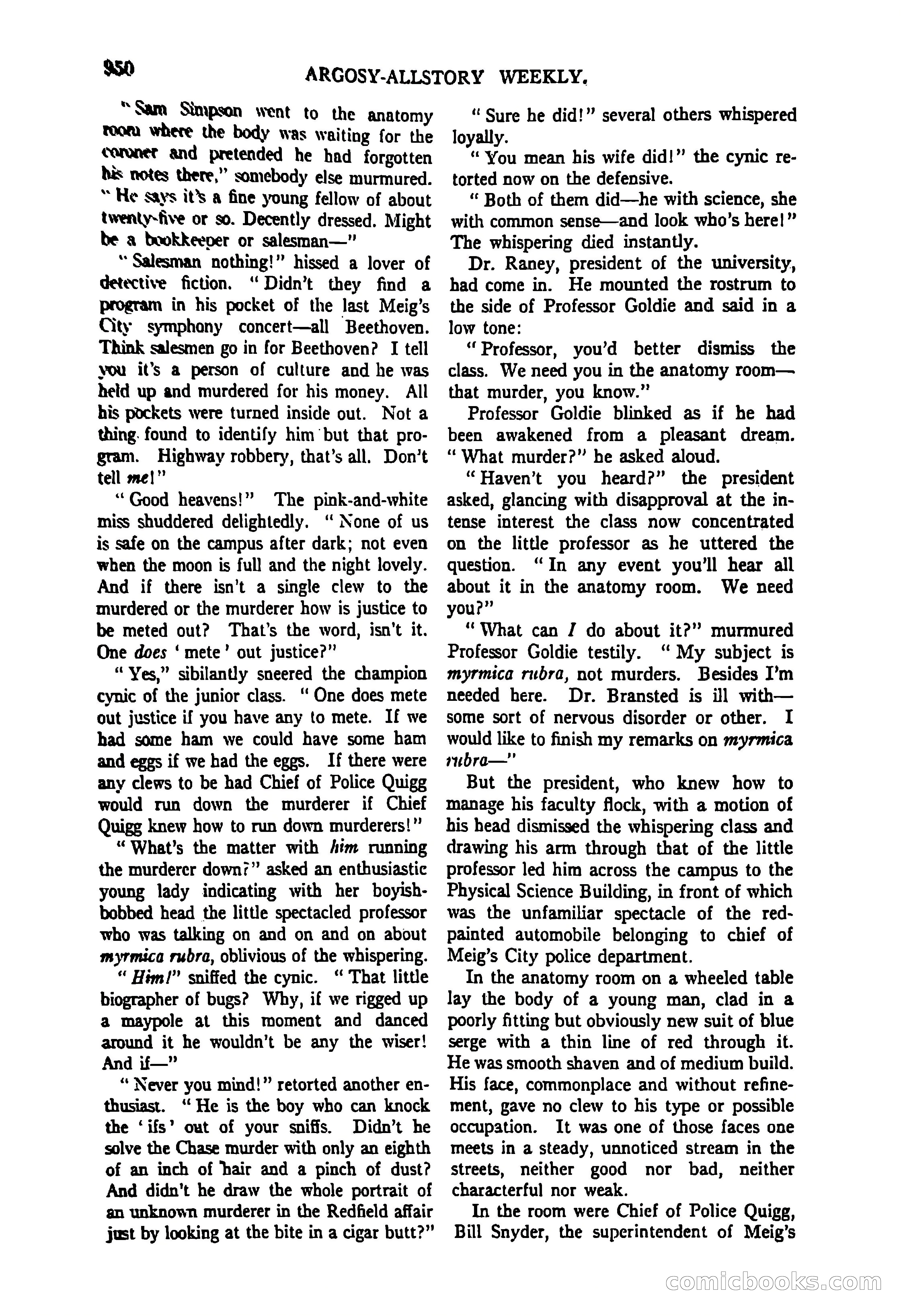
A restored page from Pulp Fiction, 1925. Page through the whole issue in the reader above.
📄 Transcribed text from this page (OCR, searchable)
Machine-transcribed from the original scan — historical spelling and the odd misread are preserved.
950 “Sam Simpson went to the anatomy room where the body was waiting for the caroner and pretended he had forgotten bas notes there,” somebody else murmured. “ He says it’s a fine young fellow of about twenty-five or so. Decently dressed. Might be a bookkeeper or salesman—” ‘“ Salesman nothing!” hissed a lover of detective fiction. ‘“ Didn’t they find a program in his pocket of the last Meig’s City symphony concert—all Beethoven. Think salesmen go in for Beethoven? I tell you it’s a person of culture and he was held up and murdered for his money. All his pockets were turned inside out. Not a thing. found to identify him but that pro- gram. Highway robbery, that’s all. Don’t tell sme!” ‘““Good heavens!” The pink-and-white miss shuddered delightedly. ‘‘ None of us is safe on the campus after dark; not even when the moon is full and the night lovely. And if there isn’t a single clew to the murdered or the murderer how is justice to be meted out? That’s the word, isn't it. One does ‘mete’ out justice?” “Yes,” sibilantly sneered the champion cynic of the junior class. ‘ One does mete out justice if you have any to mete. If we had some ham we could have some ham and eggs if we had the eggs. If there were any clews to be had Chief of Police Quigg would run down the murderer if Chief Quigg knew how to run down murderers!” “What's the matter with Atm running the murderer downr” asked an enthusiastic young lady indicating with her boyish- bobbed head the little spectacled professor who was talking on and on and on about myrmica rubra, oblivious of the whispering. “ Him!” sniffed the cynic. ‘ That little biographer of bugs? Why, if we rigged up a maypole at this moment and danced around it he wouldn’t be any the wiser! And if—” “ Never you mind!” retorted another en- thusiast. ‘He is the boy who can knock the ‘ifs’ out of your sniffs. Didn’t he solve the Chase murder with only an eighth of an inch of hair and a pinch of dust? And didn't he draw the whole portrait of an unknown murderer in the Redheld affair just by looking at the bite in a cigar butt?” ARGOSY-ALLSTORY WEEKLY. “Sure he did!’’ several others whispered loyally. “ You mean his wife did!” the cynic re- torted now on the defensive. ‘Both of them did—he with science, she with common sense—and look who’s here!” The whispering died instantly. Dr. Raney, president of the university, had come in. He mounted the rostrum to the side of Professor Goldie and said in a low tone: “Professor, you’d better dismiss the class. We need you in the anatomy room— that murder, you know.” Professor Goldie blinked as if he had been awakened from a pleasant dream. “What murder?” he asked aloud. “Haven’t you heard?” the president asked, glancing with disapproval at the in- tense interest the class now concentrated on the little professor as he uttered the question. “In any event you'll hear all about it in the anatomy room. We need your” “What can J do about it?” murmured Professor Goldie testily. ‘“ My subject is myrmica rubra, not murders. Besides I’m needed here. Dr. Bransted is ill with— some sort of nervous disorder or other. I would like to finish my remarks on myrmica mbra—” But the president, who knew how to manage his faculty flock, with a motion of his head dismissed the whispering class and drawing his arm through that of the little professor led him across the campus to the Physical Science Building, in front of which was the unfamiliar spectacle of the red- painted automobile belonging to chief of Meig’s City police department. In the anatomy room on a wheeled table lay the body of a young man, clad in a poorly fitting but obviously new suit of blue serge with a thin line of red through it. He was smooth shaven and of medium build. His face, commonplace and without refine- ment, gave no clew to his type or possible occupation. It was one of those faces one meets in a steady, unnoticed stream in the Streets, neither good nor bad, neither characterful nor weak. In the room were Chief of Police Quigg, Bill Snyder, the superintendent of Meig’s COnniEaoo () SS Co