
Pulp Fiction, 1925 · page 148 of 168
Argosy All-Story Weekly, June 27, 1925 — page 148: what you’re looking at
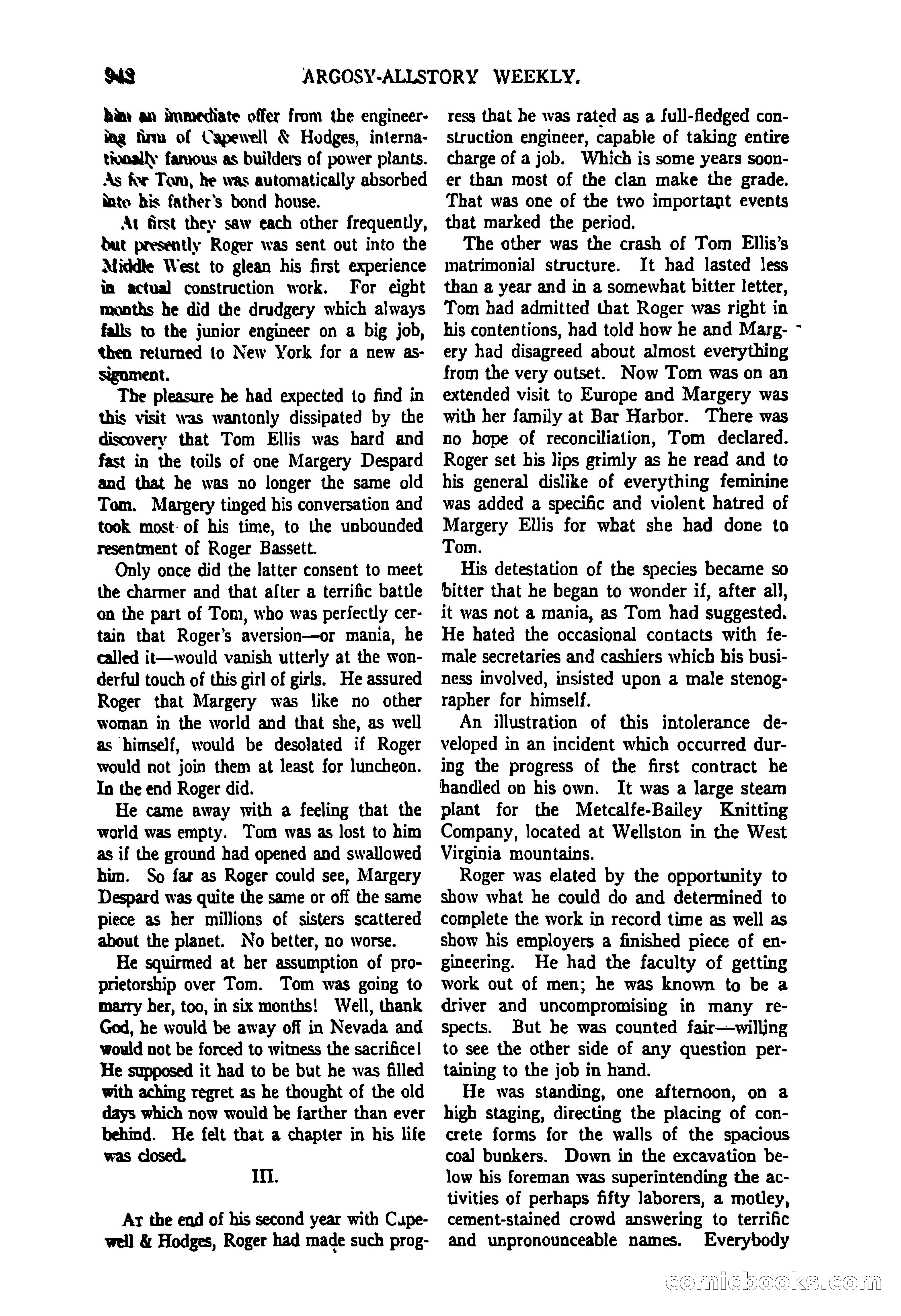
A restored page from Pulp Fiction, 1925. Page through the whole issue in the reader above.
📄 Transcribed text from this page (OCR, searchable)
Machine-transcribed from the original scan — historical spelling and the odd misread are preserved.
NS hime an immediate offer from the engineer- tag fim of Capewell & Hodges, interna- trooally famous as builders of power plants. As for Tam, he was automatically absorbed into his father’s bond house. At first they saw each other frequently, but presently Roger was sent out into the Middle West to glean his first experience in actual construction work. For eight months he did the drudgery which always falls to the junior engineer on a big job, then returned to New York for a new as- signment. The pleasure he had expected to find in this visit was wantonly dissipated by the discovery that Tom Ellis was hard and fast in the toils of one Margery Despard and that he was no longer the same old Tom. Margery tinged his conversation and took most of his time, to the unbounded resentment of Roger Bassett. Only once did the latter consent to meet the charmer and that alter a terrific battle on the part of Tom, who was perfectly cer- tain that Roger’s aversion—or mania, he called it—would vanish utterly at the won- derful touch of this girl of girls. He assured Roger that Margery was like no other woman in the world and that she, as well as himself, would be desolated if Roger would not join them at least for luncheon. In the end Roger did. He came away with a feeling that the world was empty. Tom was as lost to him as if the ground had opened and swallowed him. So far as Roger could see, Margery Despard was quite the same or off the same piece as her millions of sisters scattered about the planet. No better, no worse. He squirmed at her assumption of pro- pnietorship over Tom. Tom was going to marry her, too, in six months! Well, thank God, he would be away off in Nevada and would not be forced to witness the sacrifice! He supposed it had to be but he was filled with aching regret as he thought of the old days which now would be farther than ever behind. He felt that a chapter in his life was closed. Il. Ar the end of his second year with Cupe- well & Hodges, Roger had made such prog- ARGOSY-ALLSTORY WEEKLY. ress that he was rated as a full-fledged con- struction engineer, capable of taking entire charge of a job. Which is some years soon- er than most of the clan make the grade. That was one of the two important events that marked the period. The other was the crash of Tom FEllis’s matrimonial structure. It had lasted less than a year and in a somewhat bitter letter, Tom had admitted that Roger was right in his contentions, had told how he and Marg- ery had disagreed about almost everything from the very outset. Now Tom was on an extended visit to Europe and Margery was with her family at Bar Harbor. There was no hope of reconciliation, Tom declared. Roger set his lips grimly as he read and to his gencral dislike of everything feminine was added a specific and violent hatred of Margery Ellis for what she had done ta Tom. His detestation of the species became so bitter that he began to wonder if, after all, it was not a mania, as Tom had suggested. He hated the occasional contacts with fe- male secretaries and cashiers which his busi- ness involved, insisted upon a male stenog- rapher for himself. An illustration of this intolerance de- veloped in an incident which occurred dur- ing the progress of the first contract he handled on his own. It was a large steam plant for the Metcalfe-Bailey Knitting Company, located at Wellston in the West Virginia mountains. Roger was elated by the opportunity to show what he could do and determined to complete the work in record time as well as show his employers a finished piece of en- gineering. He had the faculty of getting work out of men; he was known to be a driver and uncompromising in many re- spects. But be was counted fair—willing to see the other side of any question per- taining to the job in hand. He was standing, one afternoon, on a high staging, directing the placing of con- crete forms for the walls of the spacious coal bunkers. Down in the excavation be- low his foreman was superintending the ac- tivities of perhaps fifty Jaborers, a motley, cement-stained crowd answering to terrific and unpronounceable names. Everybody GOMIGDOOo C SS Co