
Pulp Fiction, 1925 · page 143 of 168
Argosy All-Story Weekly, June 27, 1925 — page 143: what you’re looking at
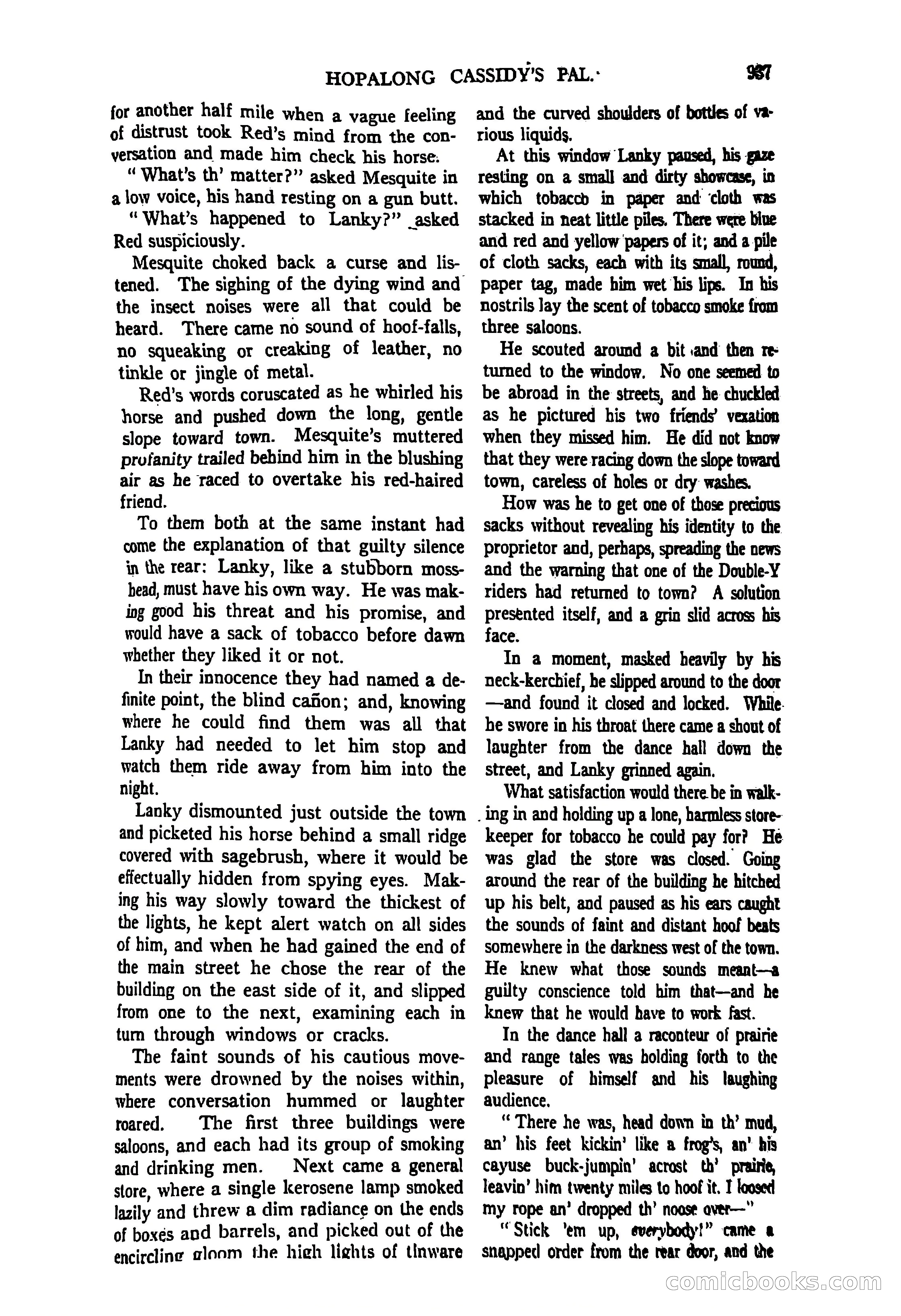
A restored page from Pulp Fiction, 1925. Page through the whole issue in the reader above.
📄 Transcribed text from this page (OCR, searchable)
Machine-transcribed from the original scan — historical spelling and the odd misread are preserved.
HOPALONG CASSIDY’S PAL.: for another half mile when a vague feeling of distrust took Red’s mind from the con- yersation and made him check his horse: “What's th’ matter?” asked Mesquite in a low voice, his hand resting on a gun butt. “What’s happened to Lanky?” asked Red suspiciously. Mesquite choked back a curse and lis- tened. The sighing of the dying wind and the insect noises were all that could be heard. There came no sound of hoof-falls, no squeaking or creaking of leather, no tinkle or jingle of metal. Red’s words coruscated as he whirled his horse and pushed down the long, gentle slope toward town. Mesquite’s muttered profanity trailed behind him in the blushing air as he raced to overtake his red-haired friend. To them both at the same instant had come the explanation of that guilty silence in the rear: Lanky, like a stubborn moss- head, must have his own way. He was mak- ing good his threat and his promise, and would have a sack of tobacco before dawn whether they liked it or not. In their innocence they had named a de- finite point, the blind cafion; and, knowing where he could find them was all that Lanky had needed to let him stop and watch them ride away from him into the night. Lanky dismounted just outside the town and picketed his horse behind a small ridge covered with sagebrush, where it would be effectually hidden from spying eyes. Mak- ing his way slowly toward the thickest of the lights, he kept alert watch on all sides of him, and when he had gained the end of the main street he chose the rear of the building on the east side of it, and slipped from one to the next, examining each in tum through windows or cracks. The faint sounds of his cautious move- ments were drowned by the noises within, where conversation hummed or laughter roared. The first three buildings were saloons, and each had its group of smoking and drinking men. Next came a general store, where a Single kerosene lamp smoked lazily and threw a dim radiance on the ends of boxes and barrels, and picked out of the encircling gloom the hieh lights of tinware 937 and the curved shoulders of bottles of va- rious liquids. At this window Lanky paused, his gaze resting on a small and dirty showcase, io which tobaccb in paper and ‘cloth was stacked in neat little piles. There were bive and red and yellow ‘papers of it, and a pile of cloth sacks, each with its small, round, paper tag, made him wet his lips. In his nostrils Jay the scent of tobacco smoke from three saloons. He scouted around a bit :and then re- turned to the window. No one seemed to be abroad in the streets, and he chuckled as he pictured his two friends’ vexation when they missed him. He did not know that they were racing down the slope toward town, careless of holes or dry: washes. How was he to get one of those precious sacks without revealing his identity to the proprietor and, perhaps, spreading the news and the warning that one of the Double-Y riders had retumed to town? A solution presented itself, and a grin slid across his face. In a moment, masked heavily by his neck-kerchief, he slipped around to the door —and found it closed and locked. While. he swore in his throat there came a shout of laughter from the dance hall down the street, and Lanky grinned again. What satisfaction would there be in walk- _ Ing in and holding up a lone, harmless store- keeper for tobacco he could pay for? He was glad the store was closed. Going around the rear of the building he hitched up his belt, and paused as his ears caught the sounds of faint and distant hoof beats somewhere in the darkness west of the town. He knew what those sounds meant—a guilty conscience told him that—and he knew that he would have to work fast. In the dance hall a raconteur of prairie and range tales was holding forth to the pleasure of himself and his laughing auclience, “There he was, head down in th’ mud, an’ his feet kickin’ like a frog’s, an’ his cayuse buck-jumpin’ acrost th’ prairie, leavin’ him twenty miles to hoof it. I loosed my rope an’ dropped th’ noose over—" Stick ‘em up, everybody!” came a snapped order from the rear door, and the COMmica@oo SS Co