
Pulp Fiction, 1925 · page 84 of 170
Argosy All-Story Weekly, June 13, 1925 — page 84: what you’re looking at
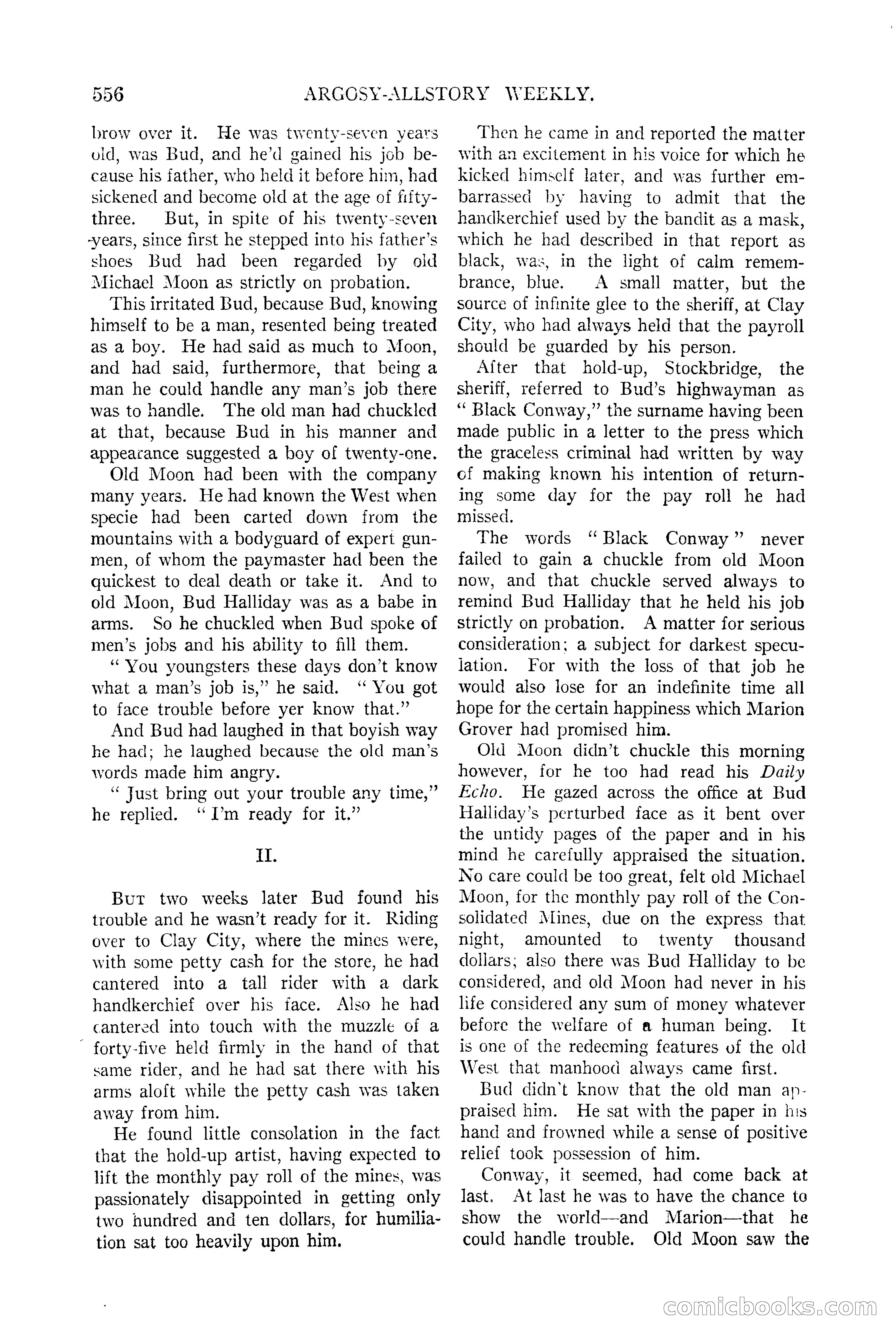
A restored page from Pulp Fiction, 1925. Page through the whole issue in the reader above.
📄 Transcribed text from this page (OCR, searchable)
Machine-transcribed from the original scan — historical spelling and the odd misread are preserved.
506 brow over it. He was twenty-seven years vid, was Bud, and he’d gained his job be- cause his father, who held it before him, had sickened and become old at the age of fifty- three. But, in spite of his twenty-seven -years, since first he stepped into his father’s shoes Bud had been regarded by old Michael Moon as strictly on probation. This irritated Bud, because Bud, knowing himself to be a man, resented being treated as a boy. He had said as much to Moon, and had said, furthermore, that being a man he could handle any man’s job there was to handle. The old man had chuckled at that, because Bud in his manner and appearance suggested a boy of twenty-one. Old Moon had been with the company many years. He had known the West when specie had been carted down from the mountains with a bodyguard of expert gun- men, of whom the paymaster had been the quickest to deal death or take it. And to old Moon, Bud Halliday was as a babe in arms. So he chuckled when Bud spoke of men’s jobs and his ability to fill them. “You youngsters these days don’t know what a man’s job is,” he said. ‘‘ You got to face trouble before yer know that.” And Bud had laughed in that boyish way he had; he laughed because the old man’s words made him angry. “ Just bring out your trouble any time,” he replied. ‘I’m ready for it.” IT. But two weeks later Bud found his trouble and he wasn’t ready for it. Riding over to Clay City, where the mines were, with some petty cash for the store, he had cantered into a tall rider with a dark handkerchief over his face. Also he had cantered into touch with the muzzle of a ' forty-five held firmly in the hand of that same rider, and he had sat there with his arms aloft while the petty cash was taken away from him. He found little consolation in the fact that the hold-up artist, having expected to lift the monthly pay roll of the mines, was passionately disappointed in getting only two hundred and ten dollars, for humilia- tion sat too heavily upon him. ARGOSY-ALLSTORY WEEKLY. Then he came in and reported the matter with an excitement in his voice for which he kicked himself later, and was further em- barrassed by having to admit that the handkerchief used by the bandit as a mask, which he had described in that report as black, was, in the light of calm remem- brance, blue. A small matter, but the source of infinite glee to the sheriff, at Clay City, who had always held that the payroll should be guarded by his person. After that hold-up, Stockbridge, the sheriff, referred to Bud’s highwayman as “Black Conway,” the surname having been made public in a letter to the press which the graceless criminal had written by way of making known his intention of return- ing some day for the pay roll he had missed. The words ‘ Black Conway” never failed to gain a chuckle from old Moon now, and that chuckle served always to remind Bud Halliday that he held his job strictly on probation. A matter for serious consideration; a subject for darkest specu- lation. For with the loss of that job he would also lose for an indefinite time all hope for the certain happiness which Marion Grover had promised him. Old Moon didn’t chuckle this morning however, for he too had read his Daily Echo. He gazed across the office at Bud Halliday’s perturbed face as it bent over the untidy pages of the paper and in his mind he carefully appraised the situation. No care could be too great, felt old Michael Moon, for the monthly pay roll of the Con- solidated Mines, due on the express that night, amounted to twenty thousand dollars; also there was Bud Halliday to be considered, and old Moon had never in his life considered any sum of money whatever before the welfare of a human being. It is one of the redeeming features of the old West that manhood always came first. Bud didn’t know that the old man ap- praised him. He sat with the paper in his hand and frowned while a sense of positive relief took possession of him. Conway, it seemed, had come back at last. At last he was to have the chance te show the world—and Marion—that he could handle trouble. Old Moon saw the comiclboolk CO