
Pulp Fiction, 1925 · page 39 of 170
Argosy All-Story Weekly, June 13, 1925 — page 39: what you’re looking at
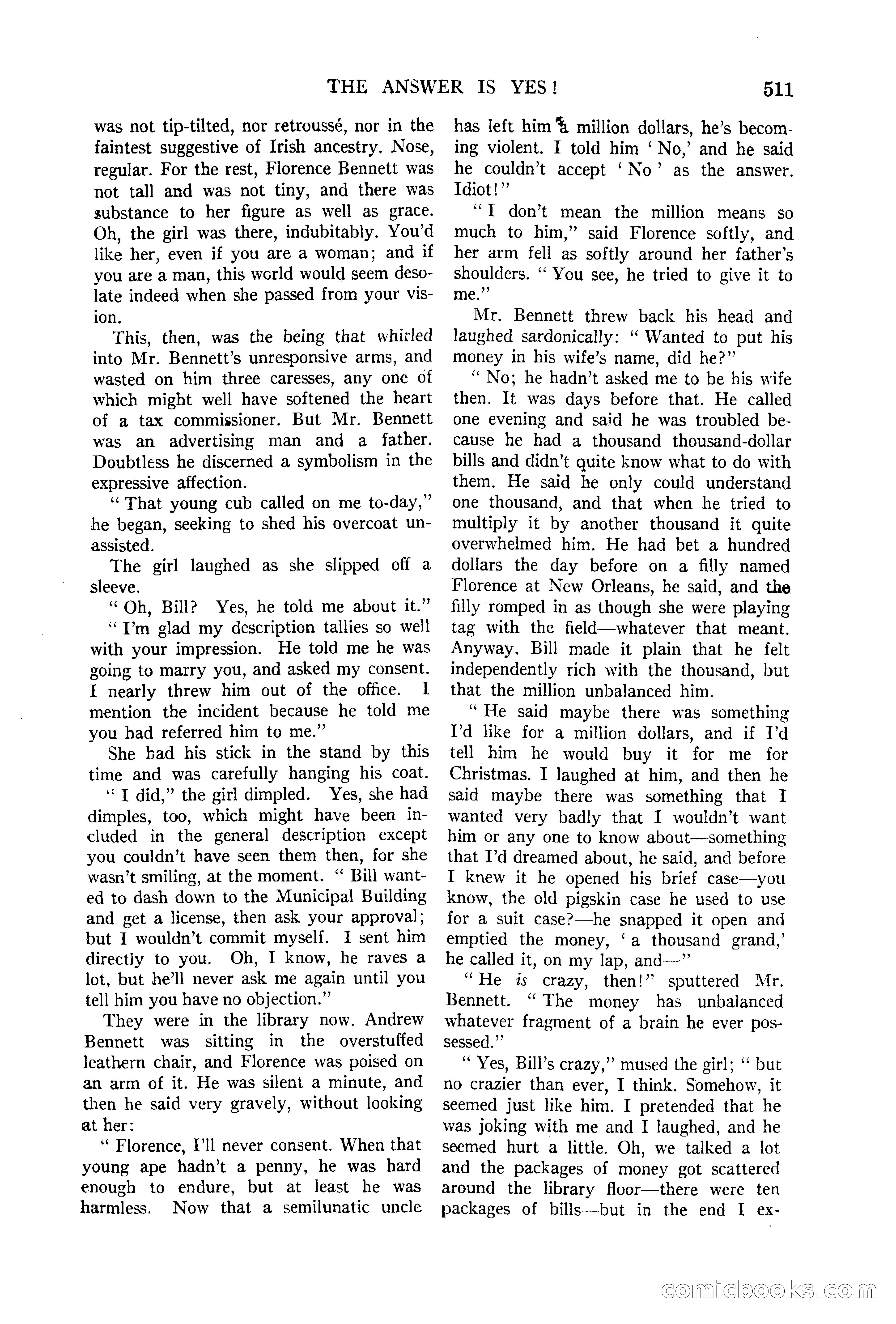
A restored page from Pulp Fiction, 1925. Page through the whole issue in the reader above.
📄 Transcribed text from this page (OCR, searchable)
Machine-transcribed from the original scan — historical spelling and the odd misread are preserved.
THE ANSWER IS was not tip-tilted, nor retroussé, nor in the faintest suggestive of Irish ancestry. Nose, regular. For the rest, Florence Bennett was not tall and was not tiny, and there was substance to her figure as well as grace. Oh, the girl was there, indubitably. You'd like her, even if you are a woman; and if you are a man, this world would seem deso- late indeed when she passed from your vis- ion. This, then, was the being that whirled into Mr. Bennett’s unresponsive arms, and wasted on him three caresses, any one of which might well have softened the heart of a tax commissioner. But Mr. Bennett was an advertising man and a father. Doubtless he discerned a symbolism in the expressive affection. ‘That young cub called on me to-day,” he began, seeking to shed his overcoat un- assisted. The girl laughed as she slipped off a sleeve. “Oh, Bill? Yes, he told me about it.” ‘I’m glad my description tallies so well with your impression. He told me he was going to marry you, and asked my consent. I nearly threw him out of the office. I mention the incident because he told me you had referred him to me.” She had his stick in the stand by this time and was carefully hanging his coat. ‘TI did,” the girl dimpled. Yes, she had dimples, too, which might have been in- cluded in the general description except you couldn’t have seen them then, for she wasn’t smiling, at the moment. ‘‘ Bill want- ed to dash down to the Municipal Building and get a license, then ask your approval; but I wouldn’t commit myself. I sent him directly to you. Oh, I know, he raves a lot, but he’ll never ask me again until you tell him you have no objection.” They were in the library now. Andrew Bennett was sitting in the overstuffed leathern chair, and Florence was poised on an arm of it. He was silent a minute, and then he said very gravely, without looking at her: “Florence, I'll never consent. When that young ape hadn’t a penny, he was hard enough to endure, but at least he was harmless. Now that a semilunatic uncle YES! oli has left him ‘4 million dollars, he’s becom- ing violent. I told him ‘ No,’ and he said he couldn’t accept ‘No’ as the answer. Idiot!” “I don’t mean the million means so much to him,” said Florence softly, and her arm fell as softly around her father’s shoulders. ‘‘ You see, he tried to give it to me.”’ Mr. Bennett threw back his head and laughed sardonically: ‘‘ Wanted to put his money in his wife’s name, did he?” “No; he hadn’t asked me to be his wife then. It was days before that. He called one evening and said he was troubled be- cause he had a thousand thousand-dollar bills and didn’t quite know what to do with them. He said he only could understand one thousand, and that when he tried to multiply it by another thousand it quite overwhelmed him. He had bet a hundred dollars the day before on a filly named Florence at New Orleans, he said, and the filly romped in as though she were playing tag with the field—whatever that meant. Anyway. Bill made it plain that he felt independently rich with the thousand, but that the million unbalanced him. ‘He said maybe there was something I'd like for a million dollars, and if I’d tell him he would buy it for me for Christmas. I laughed at him, and then he said maybe there was something that I wanted very badly that I wouldn’t want him or any one to know about—somethineg that I’d dreamed about, he said, and before I knew it he opened his brief case—you know, the old pigskin case he used to use for a suit case?—he snapped it open and emptied the money, ‘a thousand grand,’ he called it, on my lap, and—”’ “He is crazy, then!” sputtered Mr. Bennett. “The money has unbalanced whatever fragment of a brain he ever pos- sessed.”’ “Yes, Bill’s crazy,” mused the girl; “ but no crazier than ever, I think. Somehow, it seemed just like him. I pretended that he was joking with me and I laughed, and he seemed hurt a little. Oh, we talked a lot and the packages of money got scattered around the library floor—there were ten packages of bills—but in the end I ex- Conn clooo“lkks.com