
Pulp Fiction, 1925 · page 37 of 170
Argosy All-Story Weekly, June 13, 1925 — page 37: what you’re looking at
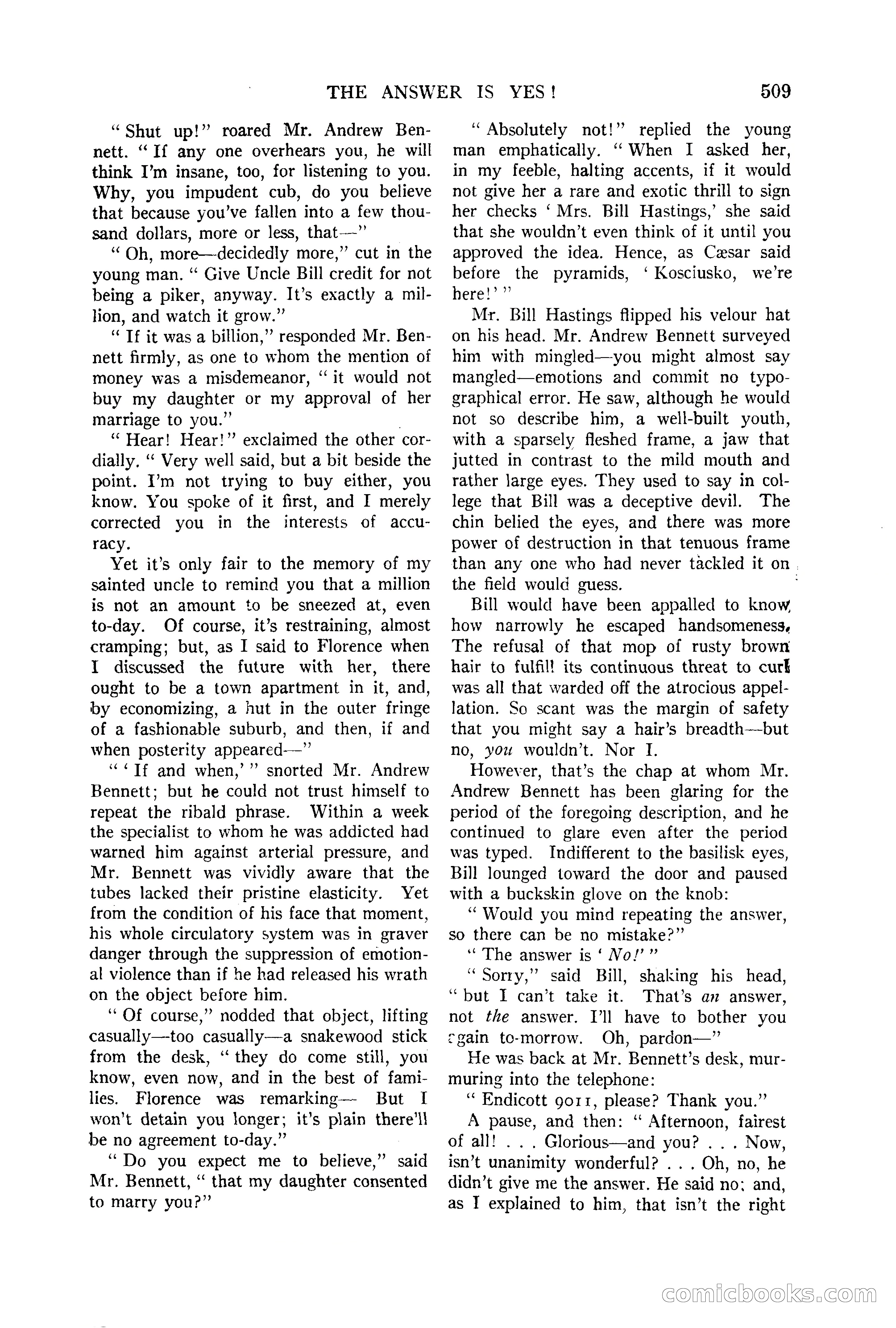
A restored page from Pulp Fiction, 1925. Page through the whole issue in the reader above.
📄 Transcribed text from this page (OCR, searchable)
Machine-transcribed from the original scan — historical spelling and the odd misread are preserved.
THE ANSWER IS YES! “Shut up!” roared Mr. Andrew Ben- nett. “If any one overhears you, he will think I’m insane, too, for listening to you. Why, you impudent cub, do you believe that because you’ve fallen into a few thou- sand dollars, more or less, that-—-” ‘Oh, more—decidedly more,” cut in the young man. “‘ Give Uncle Bill credit for not being a piker, anyway. It’s exactly a mil- lion, and watch it grow.” ‘Tf it was a billion,” responded Mr. Ben- nett firmly, as one to whom the mention of money was a misdemeanor, “it would not buy my daughter or my approval of her Marriage to you.” | ‘“‘ Hear! Hear!” exclaimed the other cor- dially. “‘ Very well said, but a bit beside the point. I’m not trying to buy either, you know. You spoke of it first, and I merely corrected you in the interests of accu- racy. Yet it’s only fair to the memory of my sainted uncle to remind you that a million is not an amount to be sneezed at, even to-day. Of course, it’s restraining, almost cramping; but, as I said to Florence when I discussed the future with her, there ought to be a town apartment in it, and, by economizing, a hut in the outer fringe of a fashionable suburb, and then, if and when posterity appeared” ‘Tf and when,’”’ snorted Mr. Andrew Bennett; but he could not trust himself to repeat the ribald phrase. Within a week the specialist to whom he was addicted had warned him against arterial pressure, and Mr. Bennett was vividly aware that the tubes lacked their pristine elasticity. Yet from the condition of his face that moment, his whole circulatory system was in graver danger through the suppression of emotion- al violence than if he had released his wrath on the object before him. ‘Of course,” nodded that object, lifting casually—too casually—a snakewood stick from the desk, ‘“ they do come still, you know, even now, and in the best of fami- lies. Florence was remarking— But I won't detain you longer; it’s plain there'll be no agreement to-day.” . “Do you expect me to believe,” said Mr. Bennett, “ that my daughter consented to marry youP”’ 509 ‘“ Absolutely not!” replied the young man emphatically. “‘ When I asked her, in my feeble, halting accents, if it would not give her a rare and exotic thrill to sign her checks ‘ Mrs. Bill Hastings,’ she said that she wouldn’t even think of it until you approved the idea. Hence, as Cesar said before the pyramids, ‘ Kosciusko, we’re here!’ ”’ Mr. Bill Hastings flipped his velour hat on his head. Mr. Andrew Bennett surveyed him with mingled—you might almost say mangled—emotions and commit no typo- graphical error. He saw, although he would not so describe him, a well-built youth, with a sparsely fleshed frame, a jaw that jutted in contrast to the mild mouth and rather large eyes. They used to say in col- lege that Bill was a deceptive devil. The chin belied the eyes, and there was more power of destruction in that tenuous frame than any one who had never tackled it on. the field would guess. Bill would have been appalled to know how narrowly he escaped handsomeness, The refusal of that mop of rusty brown hair to fulfill its continuous threat to curk was all that warded off the atrocious appel- lation. So scant was the margin of safety that you might say a hair’s breadth—-but no, you wouldn’t. Nor I. However, that’s the chap at whom Mr. Andrew Bennett has been glaring for the period of the foregoing description, and he continued to glare even after the period was typed. Indifferent to the basilisk eyes, Bill lounged toward the door and paused with a buckskin glove on the knob: ‘Would you mind repeating the answer, so there can be no mistake?” ‘The answer is ‘ No!’ ” “Sorry,” said Bill, shaking his head, “but I can’t take it. That’s az answer, not the answer. I'll have to bother you ¢gain to-morrow. Oh, pardon—”’ He was back at Mr. Bennett’s desk, mur- muring into the telephone: “Endicott gor1, please? Thank you.” A pause, and then: ‘ Afternoon, fairest of all! . . . Glorious—and you? .. . Now, isn’t unanimity wonderful? ... Oh, no, he didn’t give me the answer. He said no; and, as I explained to him, that isn’t the right cCoOmiclbook