
Pulp Fiction, 1925 · page 160 of 170
Argosy All-Story Weekly, June 13, 1925 — page 160: what you’re looking at
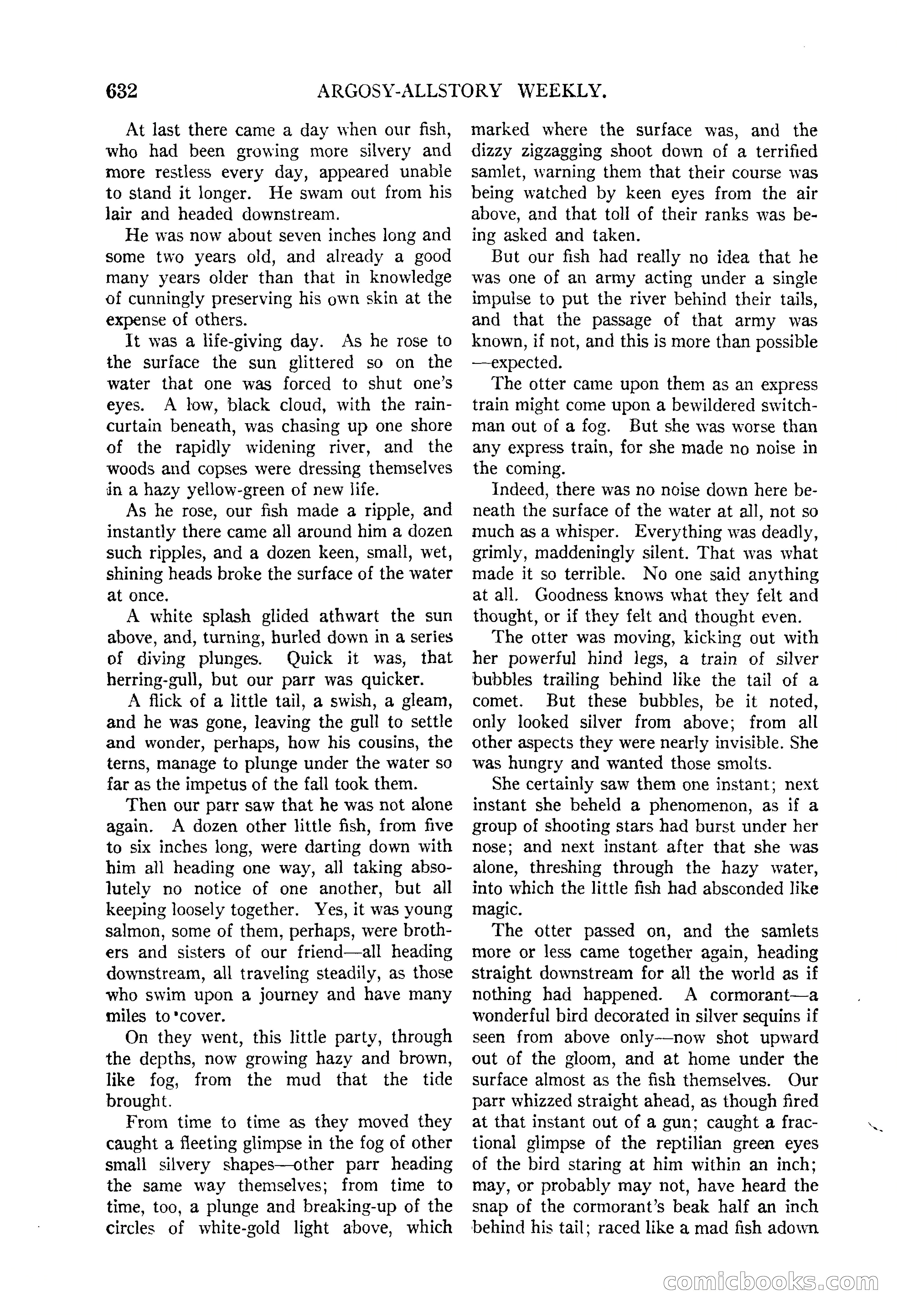
A restored page from Pulp Fiction, 1925. Page through the whole issue in the reader above.
📄 Transcribed text from this page (OCR, searchable)
Machine-transcribed from the original scan — historical spelling and the odd misread are preserved.
632 At last there came a day when our fish, who had been growing more silvery and more restless every day, appeared unable to stand it longer. He swam out from his Jair and headed downstream. He was now about seven inches long and some two years old, and already a good many years older than that in knowledge of cunningly preserving his own skin at the expense of others. It was a life-giving day. As he rose to the surface the sun glittered so on the water that one was forced to shut one’s eyes. A low, black cloud, with the rain- curtain beneath, was chasing up one shore of the rapidly widening river, and the woods and copses were dressing themselves in a hazy yellow-green of new life. As he rose, our fish made a ripple, and instantly there came all around him a dozen such ripples, and a dozen keen, small, wet, shining heads broke the surface of the water at once. A white splash glided athwart the sun above, and, turning, hurled down in a series of diving plunges. Quick it was, that herring-gull, but our parr was quicker. A flick of a little tail, a swish, a gleam, and he was gone, leaving the gull to settle and wonder, perhaps, how his cousins, the terns, manage to plunge under the water so far as the impetus of the fall took them. Then our parr saw that he was not alone again. A dozen other little fish, from five to six inches long, were darting down with him all heading one way, all taking abso- lutely no notice of one another, but all keeping loosely together. Yes, it was young salmon, some of them, perhaps, were broth- ers and sisters of our friend—all heading downstream, all traveling steadily, as those who swim upon a journey and have many miles to *cover. On they went, this little party, through the depths, now growing hazy and brown, like fog, from the mud that the tide brought. From time to time as they moved they caught a fleeting glimpse in the fog of other small silvery shapes—other parr heading the same way themselves; from time to time, too, a plunge and breaking-up of the circles of white-gold light above, which ARGOSY-ALLSTORY WEEKLY, marked where the surface was, and the dizzy zigzagging shoot down of a terrified samlet, warning them that their course was being watched by keen eyes from the air above, and that toll of their ranks was be- ing asked and taken. But our fish had really no idea that he was one of an army acting under a single impulse to put the river behind their tails, and that the passage of that army was known, if not, and this is more than possible —expected. The otter came upon them as an express train might come upon a bewildered switch- man out of a fog. But she was worse than any express train, for she made no noise in the coming. Indeed, there was no noise down here be- neath the surface of the water at all, not so much as a whisper. Everything was deadly, grimly, maddeningly silent. That was what made it so terrible. No one said anything at all. Goodness knows what they felt and thought, or if they felt and thought even. The otter was moving, kicking out with her powerful hind legs, a train of silver bubbles trailing behind like the tail of a comet. But these bubbles, be it noted, only looked silver from above; from all other aspects they were nearly invisible. She was hungry and wanted those smolts. She certainly saw them one instant; next instant she beheld a phenomenon, as if a group of shooting stars had burst under her nose; and next instant after that she was alone, threshing through the hazy water, into which the little fish had absconded like magic. The otter passed on, and the samlets more or less came together again, heading Straight downstream for all the world as if nothing had happened. A cormorant—a wonderful bird decorated in silver sequins if seen from above only--now shot upward out of the gloom, and at home under the surface almost as the fish themselves. Our parr whizzed straight ahead, as though fired at that instant out of a gun; caught a frac- tional glimpse of the reptilian green eyes of the bird staring at him within an inch; may, or probably may not, have heard the snap of the cormorant’s beak half an inch behind his tail; raced like a mad fish adown COMmiclboo (Cc S