
Pulp Fiction, 1925 · page 148 of 170
Argosy All-Story Weekly, June 13, 1925 — page 148: what you’re looking at
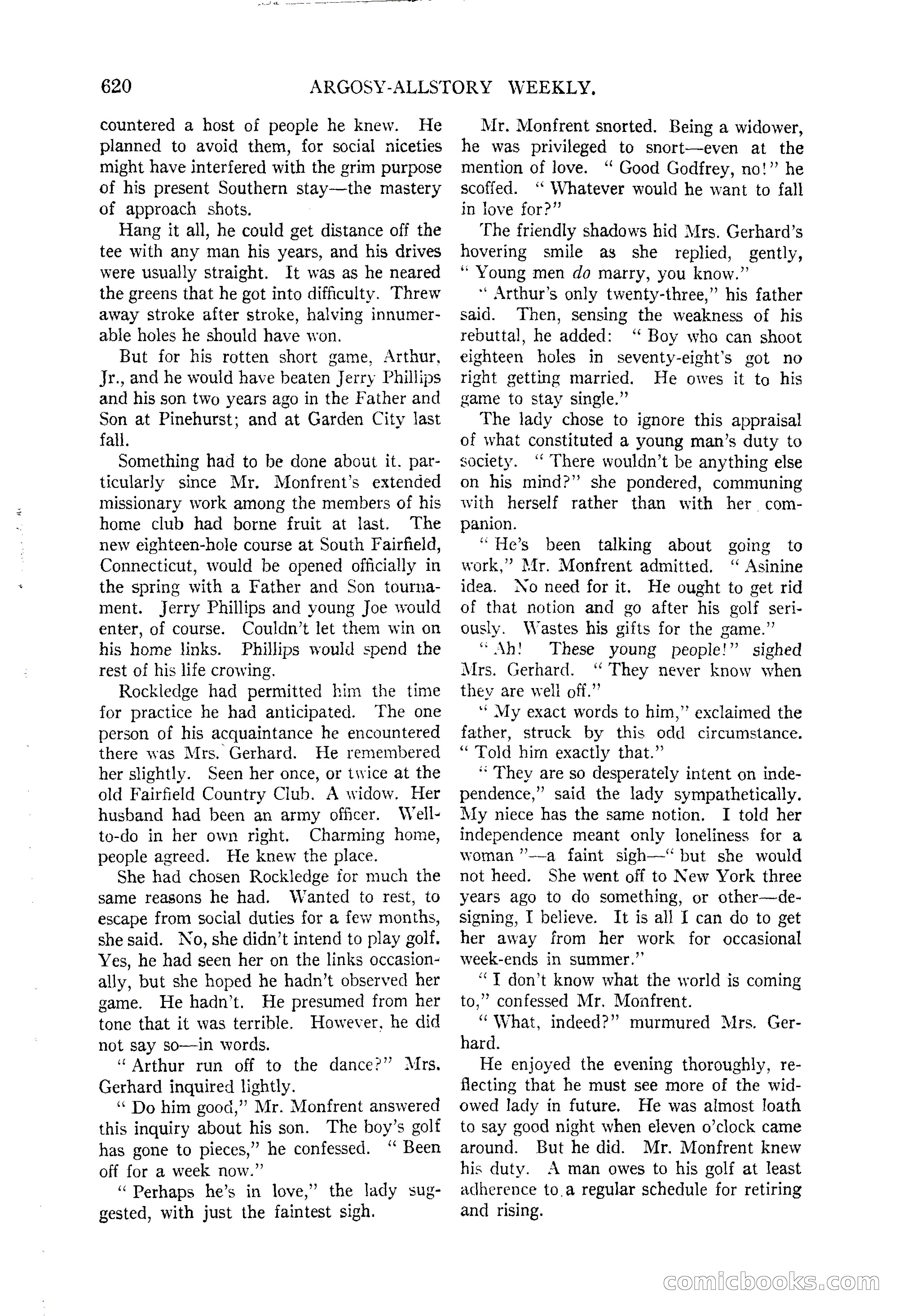
A restored page from Pulp Fiction, 1925. Page through the whole issue in the reader above.
📄 Transcribed text from this page (OCR, searchable)
Machine-transcribed from the original scan — historical spelling and the odd misread are preserved.
620 countered a host of people he knew. He planned to avoid them, for social niceties might have interfered with the grim purpose of his present Southern stay—the mastery of approach shots. Hang it all, he could get distance off the tee with any man his years, and his drives were usually straight. It was as he neared the greens that he got into difficulty. Threw away stroke after stroke, halving innumer- able holes he should have won. But for his rotten short game, Arthur, Jr., and he would have beaten Jerry Phillips and his son two years ago in the Father and Son at Pinehurst; and at Garden City last fall. Something had to be done about it. par- ticularly since Mr. Monfrent’s extended missionary work among the members of his home club had borne fruit at last. The new eighteen-hole course at South Fairfield, Connecticut, would be opened officially in the spring with a Father and Son tourna- ment. Jerry Phillips and young Joe would enter, of course. Couldn’t let them win on his home links. Phillips would spend the rest of his life crowing. Rockledge had permitted him the time for practice he had anticipated. The one person of his acquaintance he encountered there was Mrs. Gerhard. He remembered her slightly. Seen her once, or twice at the old Fairfield Country Club. A widow. Her husband had been an army officer. Well- to-do in her own right. Charming home, people agreed. He knew the place. She had chosen Rockledge for much the same reasons he had. Wanted to rest, to escape from social duties for a few months, she said. No, she didn’t intend to play golf. Yes, he had seen her on the links occasion- ally, but she hoped he hadn’t observed her game. He hadn’t. He presumed from her tone that it was terrible. However, he did not say so—in words. “Arthur run off to the dance?” Mrs. Gerhard inquired lightly. ‘Do him good,” Mr. Monfrent answered this inquiry about his son. The boy’s golf has gone to pieces,” he confessed. “ Been off for a week now.” “Perhaps he’s in love,” the lady sug- gested, with just the faintest sigh. ARGOSY-ALLSTORY WEEKLY, Mr. Monfrent snorted. Being a widower, he was privileged to snort—even at the mention of love. “ Good Godfrey, no!” he scoffed. ‘‘ Whatever would he want to fall in love for?” The friendly shadows hid Mrs. Gerhard’s hovering smile as she replied, gently, * Young men do marry, you know.”’ * Arthur’s only twenty-three,” his father said. Then, sensing the weakness of his rebuttal, he added: ‘ Boy who can shoot eighteen holes in seventy-eight’s got no right getting married. He owes it to his game to stay single.” The lady chose to ignore this appraisal of what constituted a young man’s duty to society. “‘ There wouldn’t be anything else on his mind?” she pondered, communing with herself rather than with her com- panion. ‘“ He’s been talking about work,” Mr. Monfrent admitted. ‘ Asinine idea. No need for it. He ought to get rid of that notion and go after his golf seri- ously. Wastes his gifts for the game.” “Ah! These young people!” sighed Mrs. Gerhard. ‘ They never know when thev are well off.” ‘* My exact words to him,” exclaimed the father, struck by this odd circumstance. “Told hirn exactly that.” ‘‘ Thev are so desperately intent on inde- pendence,” said the lady sympathetically. My niece has the same notion. I told her independence meant only loneliness for a woman ”—a faint sigh—-“ but she would not heed. She went off to New York three years ago to do something, or other—de- signing, I believe. It is all I can do to get her away from her work for occasional week-ends in summer.”’ ‘“T don’t know what the world is coming to,” confessed Mr. Monfrent. “What, indeed?” murmured Mrs. Ger- hard. He enjoyed the evening thoroughly, re- flecting that he must see more of the wid- owed lady in future. He was almost loath to say good night when eleven o’clock came around. But he did. Mr. Monfrent knew his duty. A man owes to his golf at least adherence to.a regular schedule for retiring and rising. going to GOMIIGIOO S CO