
Pulp Fiction, 1925 · page 141 of 170
Argosy All-Story Weekly, June 13, 1925 — page 141: what you’re looking at
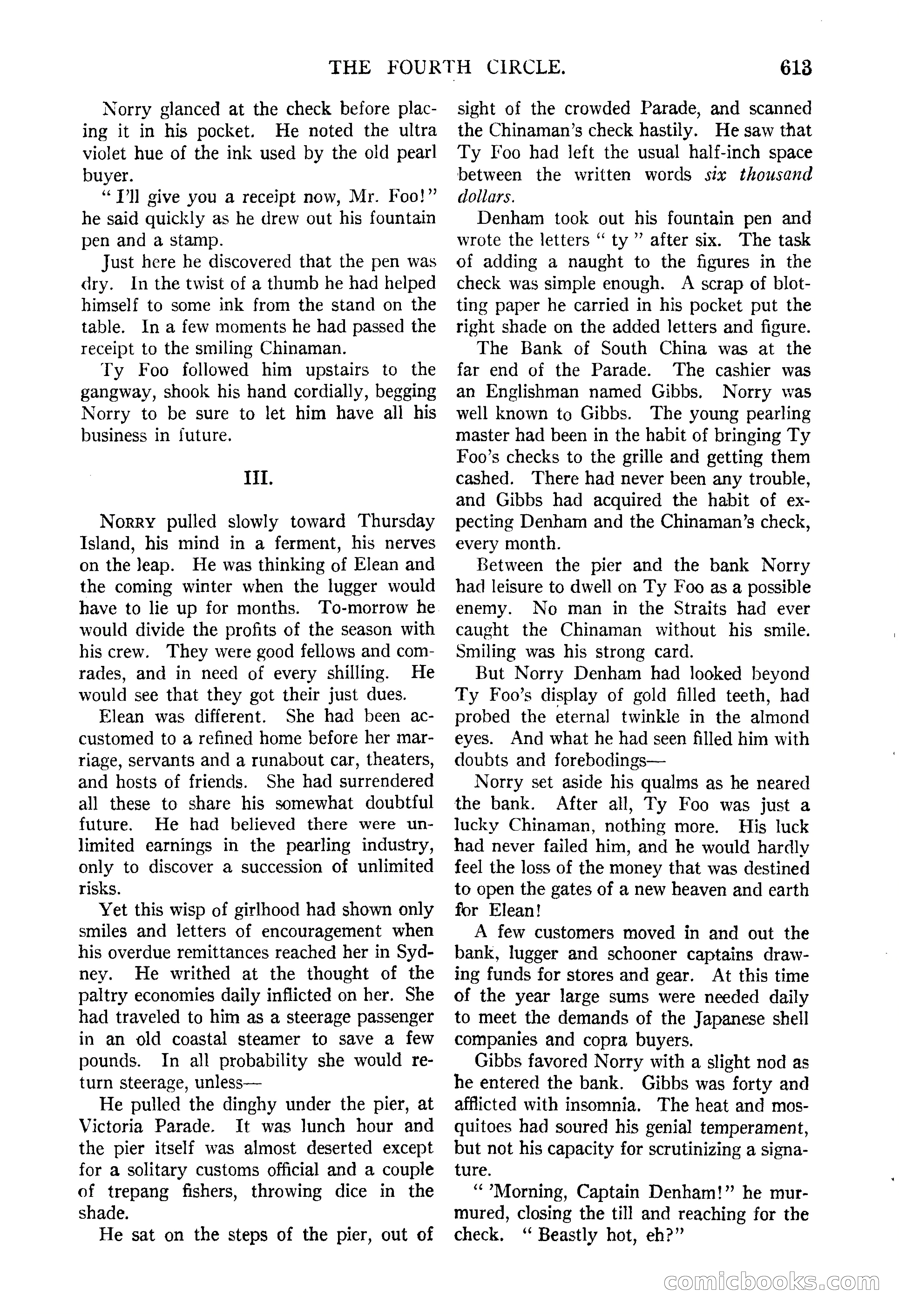
A restored page from Pulp Fiction, 1925. Page through the whole issue in the reader above.
📄 Transcribed text from this page (OCR, searchable)
Machine-transcribed from the original scan — historical spelling and the odd misread are preserved.
THE FOURTH CIRCLE. Norry glanced at the check before plac- ing it in his pocket. He noted the ultra violet hue of the ink used by the old pearl buyer. “J’ll give you a receipt now, Mr. Foo!”’ he said quickly as he drew out his fountain pen and a stamp. Just here he discovered that the pen was dry. In the twist of a thumb he had helped himself to some ink from the stand on the table. In a few moments he had passed the receipt to the smiling Chinaman. Ty Foo followed him upstairs to the gangway, shook his hand cordially, begging Norry to be sure to let him have all his business in future. Til. Norry pulled slowly toward Thursday Island, his mind in a ferment, his nerves on the Jeap. He was thinking of Elean and the coming winter when the lugger would have to lie up for months. would divide the profits of the season with his crew. They were good fellows and com- rades, and in need of every shilling. He would see that they got their just dues. Elean was different. She had been ac- customed to a refined home before her mar- riage, servants and a runabout car, theaters, and hosts of friends. She had surrendered all these to share his somewhat doubtful future. He had believed there were un- limited earnings in the pearling industry, only to discover a succession of unlimited risks. Yet this wisp of girlhood had shown only smiles and letters of encouragement when his overdue remittances reached her in Syd- ney. He writhed at the thought of the paltry economies daily inflicted on her. She had traveled to him as a steerage passenger in an old coastal steamer to save a few pounds. In all probability she would re- turn steerage, unless— He pulled the dinghy under the pier, at Victoria Parade. It was Junch hour and the pier itself was almost deserted except for a solitary customs official and a couple of trepang fishers, throwing dice in the shade. He sat on the steps of the pier, out of To-morrow he. 613 sight of the crowded Parade, and scanned the Chinaman’s check hastily. He saw that Ty Foo had left the usual half-inch space between the written words six thousand dollars. Denham took out his fountain pen and wrote the letters “ ty ” after six. The task of adding a naught to the figures in the check was simple enough. A scrap of blot- ting paper he carried in his pocket put the right shade on the added letters and figure. The Bank of South China was at the far end of the Parade. The cashier was an Englishman named Gibbs. Norry was well known to Gibbs. The young pearling master had been in the habit of bringing Ty Foo’s checks to the grille and getting them cashed. There had never been any trouble, and Gibbs had acquired the habit of ex- pecting Denham and the Chinaman’s check, every month. Between the pier and the bank Norry had leisure to dwell on Ty Foo as a possible enemy. No man in the Straits had ever caught the Chinaman without his smile. Smiling was his strong card. But Norry Denham had looked beyond Ty Foo’s display of gold filled teeth, had probed the eternal twinkle in the almond eyes. And what he had seen filled him with doubts and forebodings— Norry set aside his qualms as he neared the bank. After all, Ty Foo was just a lucky Chinaman, nothing more. His luck had never failed him, and he would hardly feel the loss of the money that was destined to open the gates of a new heaven and earth for Elean! A few customers moved in and out the bank, lugger and schooner captains draw- ing funds for stores and gear. At this time of the year large sums were needed daily to meet the demands of the Japanese shell companies and copra buyers. Gibbs favored Norry with a slight nod as he entered the bank. Gibbs was forty and afflicted with insomnia. The heat and mos- quitoes had soured his genial temperament, but not his capacity for scrutinizing a signa- ture. “Morning, Captain Denham!” he mur- mured, closing the till and reaching for the check. ‘“* Beastly hot, eh?” COMmicloo S CO