
Pulp Fiction, 1925 · page 136 of 170
Argosy All-Story Weekly, June 13, 1925 — page 136: what you’re looking at
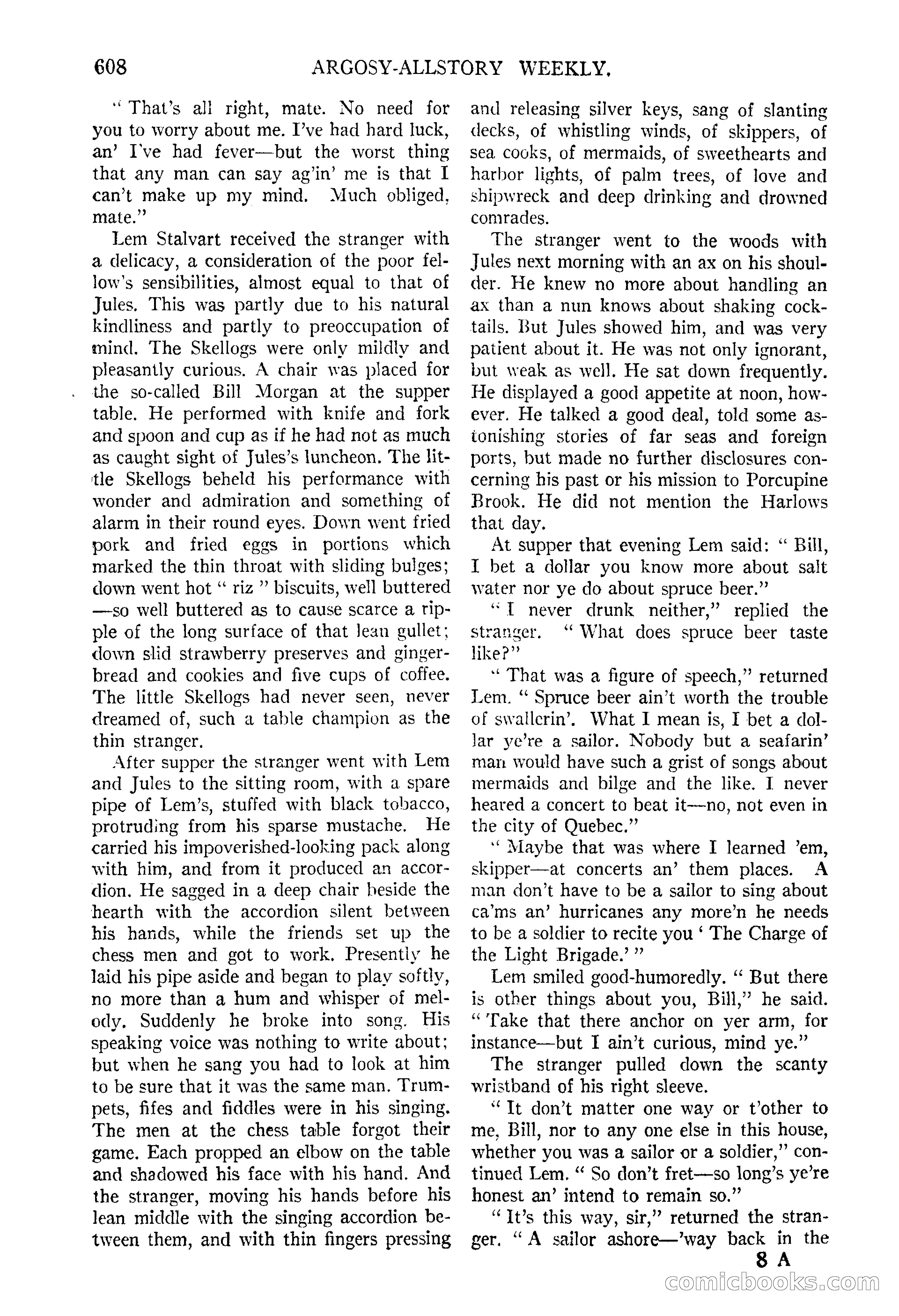
A restored page from Pulp Fiction, 1925. Page through the whole issue in the reader above.
📄 Transcribed text from this page (OCR, searchable)
Machine-transcribed from the original scan — historical spelling and the odd misread are preserved.
608 ‘ That’s ali right, mate. No need for you to worry about me. I’ve had hard luck, an’ I’ve had fever—but the worst thing that any man can say ag’in’ me is that I can’t make up my mind. Much obliged, mate.” Lem Stalvart received the stranger with a delicacy, a consideration of the poor fel- low’s sensibilities, almost equal to that of Jules. This was partly due to his natural kindliness and partly to preoccupation of mind, The Skellogs were only mildly and pleasantly curious. A chair was placed for the so-called Bill Morgan at the supper table. He performed with knife and fork and spoon and cup as if he had not as much as caught sight of Jules’s luncheon. The lit- tle Skellogs beheld his performance with wonder and admiration and something of alarm in their round eyes. Down went fried pork and fried eggs in portions which marked the thin throat with sliding bulges; down went hot “ riz ” biscuits, well buttered —so well buttered as to cause scarce a tip- ple of the long surface of that Jean gullet; down slid strawberry preserves and ginger- bread and cookies and five cups of coffee. The little Skellogs had never seen, never dreamed of, such a table champion as the thin stranger. After supper the stranger went with Lem and Jules to the sitting room, with a spare pipe of Lem’s, stuffed with black tobacco, protruding from his sparse mustache. He carried his impoverished-looking pack along with him, and from it produced an accor- dion. He sagged in a deep chair heside the hearth with the accordion silent between his hands, while the friends set up the chess men and got to work. Presentiy he laid his pipe aside and began to play softly, no more than a hum and whisper of mel- ody. Suddenly he broke into song. His speaking voice was nothing to write about; but when he sang you had to look at him to be sure that it was the same man. Trum- pets, fifes and fiddles were in his singing. The men at the chess table forgot their game. Each propped an elbow on the table and shadowed his face with his hand. And the stranger, moving his hands before his lean middle with the singing accordion be- tween them, and with thin fingers pressing ARGOSY-ALLSTORY WEEKLY, and releasing silver keys, sang of slanting decks, of whistling winds, of skippers, of sea cooks, of mermaids, of sweethearts and harbor lights, of palm trees, of love and shipwreck and deep drinking and drowned comrades. The stranger went to the woods with Jules next morning with an ax on his shoul- der. He knew no more about handling an ax than a nun knows about shaking cock- tails. But Jules showed him, and was very patient about it. He was not only ignorant, but weak as well. He sat down frequently. He displayed a good appetite at noon, how- ever. He talked a good deal, told some as- ionishing stories of far seas and foreign ports, but made no further disclosures con- cerning his past or his mission to Porcupine Brook. He did not mention the Harlows that day. At supper that evening Lem said: “‘ Bill, { bet a dollar you know more about salt water nor ye do about spruce beer.” “{ never drunk neither,” replied the Stranger. ‘‘ What does spruce beer taste like?” “That was a figure of speech,” returned Lem. “ Spruce beer ain’t worth the trouble of swallcrin’. What I mean is, I bet a dol- Jar ye’re a sailor. Nobody but a seafarin’ man would have such a grist of songs about mermaids and bilge and the like. I never heared a concert to beat it-——no, not even in the city of Quebec.” ‘“ Maybe that was where I learned ’em, skipper—at concerts an’ them places. A man don’t have to be a sailor to sing about ca’ms an’ hurricanes any more’n he needs to be a soldier to recite you ‘ The Charge of the Light Brigade.’ ” Lem smiled good-humoredly. “‘ But there is other things about you, Bill,” he said. “Take that there anchor on yer arm, for instance—but I ain’t curious, mind ye.” The stranger pulled down the scanty wristband of his right sleeve. “Tt don’t matter one way or t’other to me, Bill, nor to any one else in this house, whether you was a sailor or a soldier,” con- tinued Lem. “ So don’t fret—so long’s ye’re honest an’ intend to remain so.” “It’s this way, sir,” returned the stran- ger. “A sailor ashore—’way back in the SA COMiCLOOOkKKS. CGO