
Pulp Fiction, 1925 · page 133 of 170
Argosy All-Story Weekly, June 13, 1925 — page 133: what you’re looking at
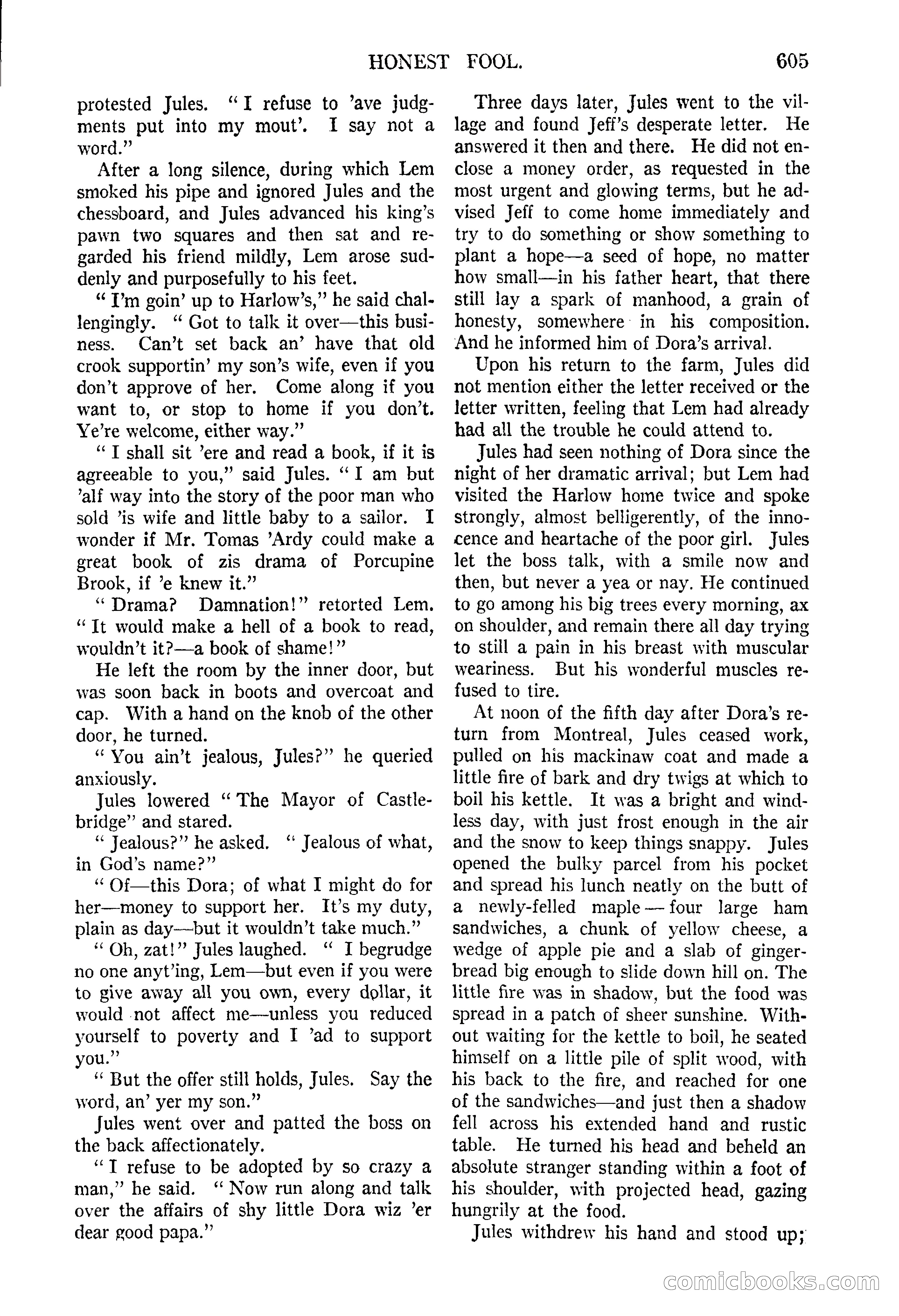
A restored page from Pulp Fiction, 1925. Page through the whole issue in the reader above.
📄 Transcribed text from this page (OCR, searchable)
Machine-transcribed from the original scan — historical spelling and the odd misread are preserved.
HONEST FOOL. “T refuse to ’ave judg- I say not a protested Jules. ments put into my mout’. word.” After a long silence, during which Lem smoked his pipe and ignored Jules and the chessboard, and Jules advanced his king’s pawn two squares and then sat and re- garded his friend mildly, Lem arose sud- denly and purposefully to his feet. “ T’m goin’ up to Harlow’s,”’ he said chal- lengingly. “ Got to talk it over—this busi- ness. Can’t set back an’ have that old crook supportin’ my son’s wife, even if you don’t approve of her. Come along if you want to, or stop to home if you don’t. Ye’re welcome, either way.” ‘“T shall sit ’ere and read a book, if it is agreeable to you,” said Jules. “I am but ‘alf way into the story of the poor man who sold ’is wife and little baby to a sailor. I wonder if Mr. Tomas ’Ardy could make a great book of zis drama of Porcupine Brook, if ’e knew it.” “Drama? Damnation!” retorted Lem. “It would make a hell of a book to read, wouldn’t it?—a book of shame!” He left the room by the inner door, but was soon back in boots and overcoat and cap. With a hand on the knob of the other door, he turned. “Vou ain’t jealous, Jules?” he queried anxiously. Jules lowered ‘‘ The Mayor of Castle- bridge” and stared. “ Jealous?” he asked. “ Jealous of what, in God’s name?” “ Of-this Dora; of what I might do for her—money to support her. It’s my duty, plain as day——but it wouldn’t take much.” ‘‘ Oh, zat!” Jules laughed. ‘“ I begrudge no one anyt’ing, Lem—but even if you were to give away all you own, every dollar, it would not affect me—unless you reduced yourself to poverty and I ’ad to support you.” ‘‘ But the offer still holds, Jules. Say the word, an’ yer my son.” Jules went over and patted the boss on the back affectionately. ‘“‘T refuse to be adopted by so crazy a man,” he said. ‘‘ Now run along and talk over the affairs of shy little Dora wiz ’er dear good papa.” 605 Three days later, Jules went to the vil- lage and found Jeff’s desperate letter. He answered it then and there. He did not en- close a money order, as requested in the most urgent and glowing terms, but he ad- vised Jeff to come home immediately and try to do something or show something to plant a hope—a seed of hope, no matter how small—in his father heart, that there still lay a spark of manhood, a grain of honesty, somewhere in his composition. And he informed him of Dora’s arrival. Upon his return to the farm, Jules did not mention either the letter received or the letter written, feeling that Lem had already had all the trouble he could attend to. Jules had seen nothing of Dora since the night of her dramatic arrival; but Lem had visited the Harlow home twice and spoke strongly, almost belligerently, of the inno- cence and heartache of the poor girl. Jules let the boss talk, with a smile now and then, but never a yea or nay. He continued to go among his big trees every morning, ax on shoulder, and remain there all day trying to still a pain in his breast with muscular weariness. But his wonderful muscles re- fused to tire. At noon of the fifth day after Dora’s re- turn from Montreal, Jules ceased work, pulled on his mackinaw coat and made a little fire of bark and dry twigs at which to boil his kettle. It was a bright and wind- less day, with just frost enough in the air and the snow to keep things snappy. Jules opened the bulky parcel from his pocket and spread his lunch neatly on the butt of a newly-felled maple~-four large ham sandwiches, a chunk of yellow cheese, a wedge of apple pie and a slab of ginger- bread big enough to slide down hill on. The little fire was in shadow, but the food was spread in a patch of sheer sunshine. With- out waiting for the kettle to boil, he seated himself on a little pile of split wood, with his back to the fire, and reached for one of the sandwiches—and just then a shadow fell across his extended hand and rustic table. He turned his head and beheld an absolute stranger standing within a foot of his shoulder, with projected head, gazing hungrily at the food. Jules withdrew his hand and stood up; COMmiclhoo S CO S|