
Pulp Fiction, 1925 · page 109 of 170
Argosy All-Story Weekly, June 13, 1925 — page 109: what you’re looking at
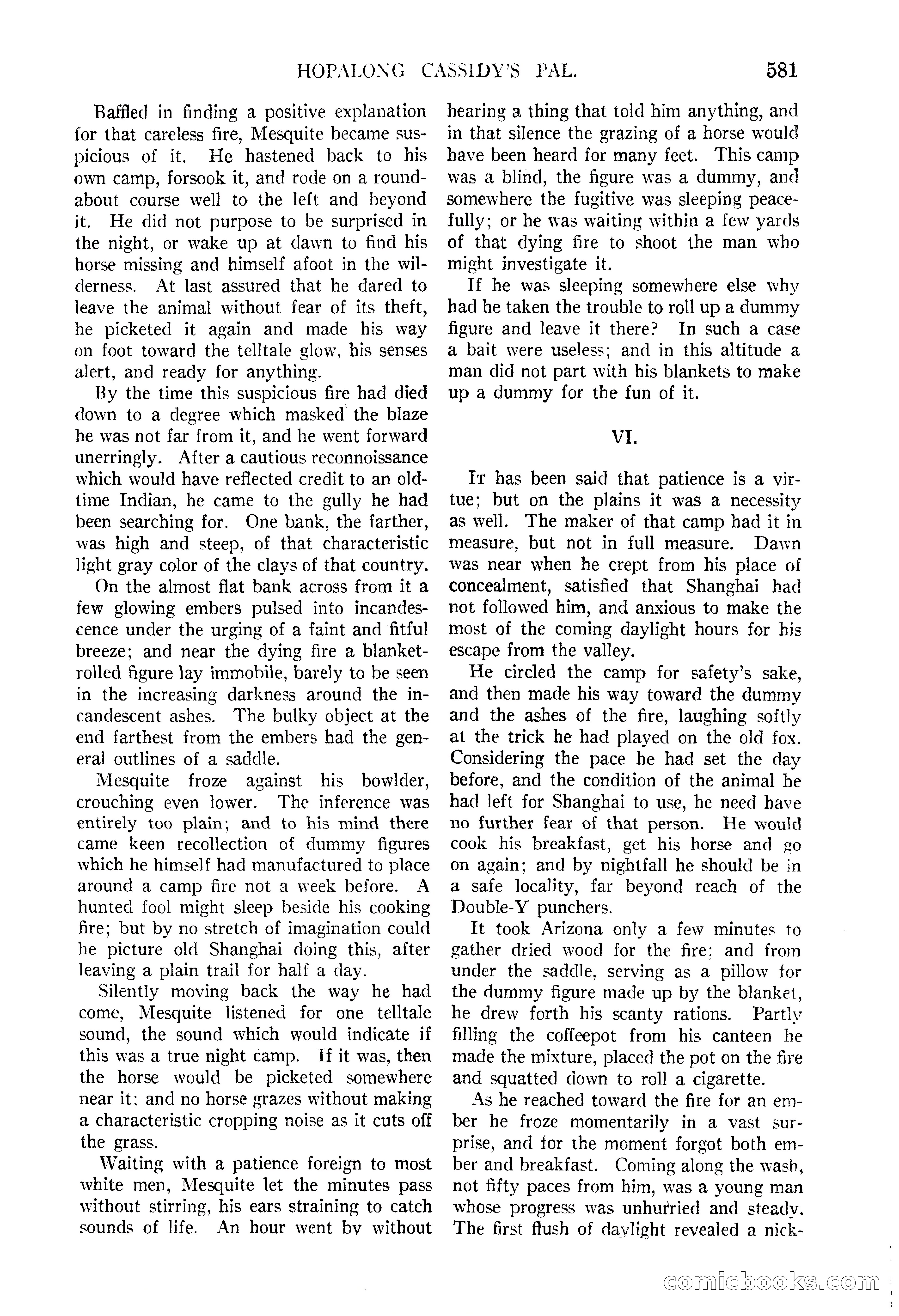
A restored page from Pulp Fiction, 1925. Page through the whole issue in the reader above.
📄 Transcribed text from this page (OCR, searchable)
Machine-transcribed from the original scan — historical spelling and the odd misread are preserved.
HOPALONG Baffled in finding a positive explanation for that careless fire, Mesquite became sus- picious of it. He hastened back to his own camp, forsook it, and rode on a round- about course well to the left and beyond it. He did not purpose to be surprised in the night, or wake up at dawn to find his horse missing and himself afoot in the wil- derness. At last assured that he dared to leave the animal without fear of its theft, he picketed it again and made his way on foot toward the telltale glow, his senses alert, and ready for anything. By the time this suspicious fire had died down to a degree which masked the blaze he was not far from it, and he went forward unerringly. After a cautious reconnoissance which would have reflected credit to an old- time Indian, he came to the gully he had been searching for. One bank, the farther, was high and steep, of that characteristic light gray color of the clays of that country. On the almost flat bank across from it a few glowing embers pulsed into incandes- cence under the urging of a faint and fitful breeze; and near the dying fire a blanket- rolled figure lay immobile, barely to be seen in the increasing darkness around the in- candescent ashes. The bulky object at the end farthest from the embers had the gen- eral outlines of a saddle. Mesquite froze against his bowlder, crouching even lower. The inference was entirely too plain; and to his mind there came keen recollection of dummy figures which he himself had manufactured to place around a camp fire not a week before. A hunted fool might sleep beside his cooking fre; but by no stretch of imagination could he picture old Shanghai doing this, after leaving a plain trail for half a day. Silently moving back the way he had come, Mesquite listened for one telltale sound, the sound which would indicate if this was a true night camp. If it was, then the horse would be picketed somewhere near it; and no horse grazes without making a characteristic cropping noise as it cuts off the grass. Waiting with a patience foreign to most white men, Mesquite let the minutes pass without stirring, his ears straining to catch sounds of life. An hour went by without CASSIDY’S PAL. 581 hearing a thing that told him anything, and in that silence the grazing of a horse would have been heard for many feet. This camp was a blind, the figure was a dummy, and somewhere the fugitive was sleeping peace- fully; or he was waiting within a few yards of that dying fire to shoot the man who might investigate it. If he was sleeping somewhere else why had he taken the trouble to roll up a dummy figure and leave it there? In such a case a bait were useless; and in this altitude a man did not part with his blankets to make up a dummy for the fun of it. VI. Ir has been said that patience is a vir- tue; but on the plains it was a necessity as well. The maker of that camp had it in measure, but not in full measure. Dawn was near when he crept from his place of concealment, satisfied that Shanghai had not followed him, and anxious to make the most of the coming daylight hours for his escape from the valley. He circled the camp for safety’s sake, and then made his way toward the dummy and the ashes of the fire, laughing softly at the trick he had played on the old fox. Considering the pace he had set the day before, and the condition of the animal he had left for Shanghai to use, he need have no further fear of that person. He would cook his breakfast, get his horse and go on again; and by nightfall he should be in a safe locality, far beyond reach of the Double-Y punchers. It took Arizona only a few minutes to gather dried wood for the fire; and from under the saddle, serving as a pillow for the dummy figure made up by the blanket, he drew forth his scanty rations. Partly filling the coffeepot from his canteen he made the mixture, placed the pot on the fire and squatted down to roll a cigarette. As he reached toward the fire for an em- ber he froze momentarily in a vast sur- prise, and tor the moment forgot both em- ber and breakfast. Coming along the wash, not fifty paces from him, was a young man whose progress was unhurried and steady. The first flush of daylight revealed a nick- cCOmiclbooks CO