
Pulp Fiction, 1925 · page 10 of 170
Argosy All-Story Weekly, June 13, 1925 — page 10: what you’re looking at
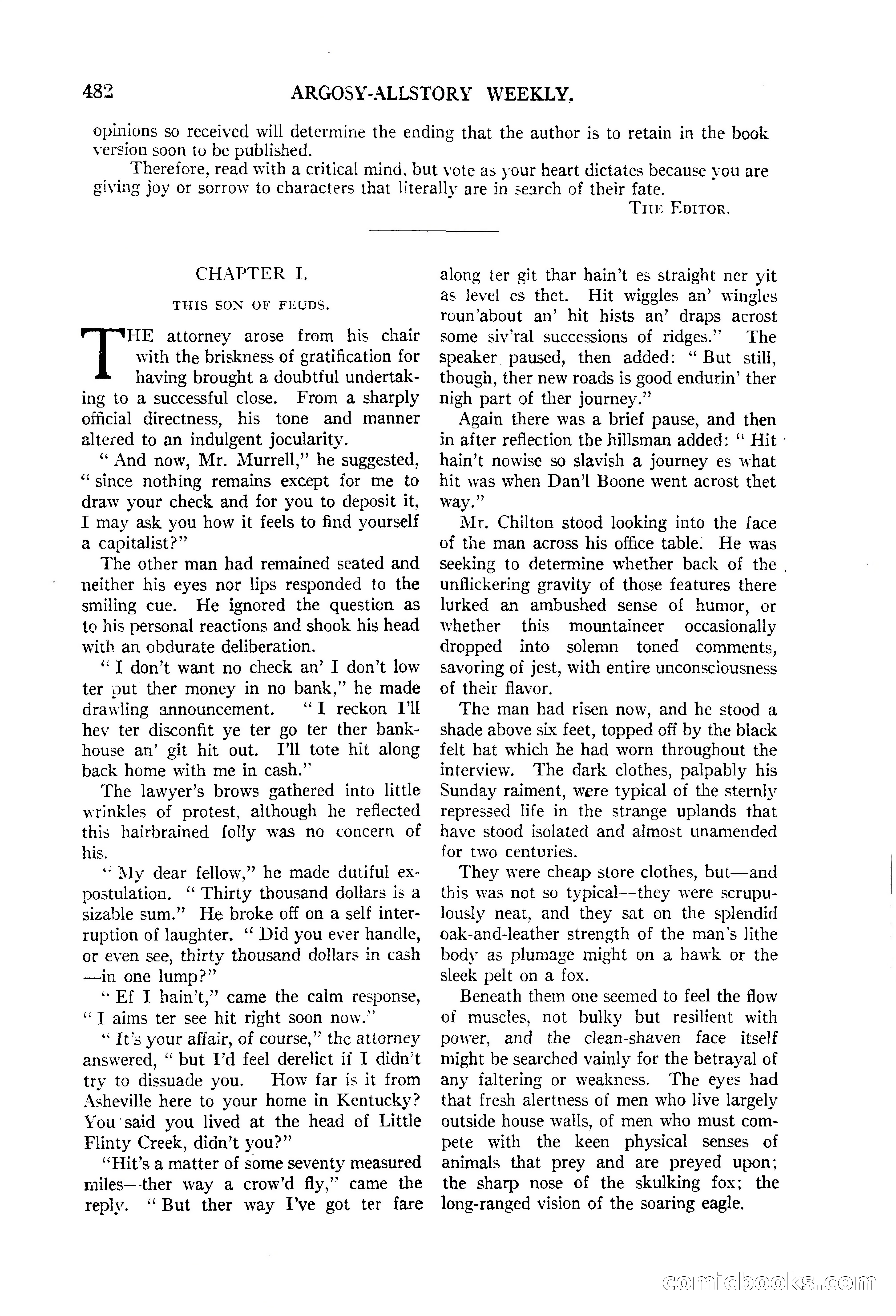
A restored page from Pulp Fiction, 1925. Page through the whole issue in the reader above.
📄 Transcribed text from this page (OCR, searchable)
Machine-transcribed from the original scan — historical spelling and the odd misread are preserved.
43% ARGOSY-ALLSTORY WEEKLY. opinions so received will determine the ending that the author is to retain in the book version soon to be published. Therefore, read with a critical mind, but vote as your heart dictates because you are giving Joy or sorrow to characters that literally are in search of their fate. CHAPTER f. THIS SON OF FEUDS. v YHE attorney arose from his chair with the briskness of gratification for having brought a doubtful undertak- ing to a successful close. From a sharply official directness, his tone and manner altered to an indulgent jocularity. “And now, Mr. Murrell,” he suggested, ‘since nothing remains except for me to draw your check and for you to deposit it, I may ask you how it feels to find yourself a capitalist?” The other man had remained seated and neither his eyes nor lips responded to the smiling cue. He ignored the question as to his personal reactions and shook his head with an obdurate deliberation. ‘“T don’t want no check an’ I don’t low ter put ther money in no bank,” he made drawling announcement. ‘I reckon I'll hey ter disconfit ye ter go ter ther bank- house an’ git hit out. Jl tote hit along back home with me in cash.” The lawyer’s brows gathered into little wrinkles of protest, although he reflected this hairbrained folly was no concern of his. ‘My dear fellow,” he made dutiful ex- postulation. “‘ Thirty thousand dollars is a sizable sum.” He broke off on a self inter- ruption of laughter. ‘¢ Did you ever handle, or even see, thirty thousand dollars in cash —in one lump?” “ Ef I hain’t,” came the calm response, ‘“T aims ter see hit right soon now.” “ It’s your affair, of course,” the attorney answered, “ but I’d feel derelict if 1 didn’t try to dissuade you. How far is it from Asheville here to your home in Kentucky? You said you lived at the head of Little Flinty Creek, didn’t you?” ‘“Hit’s a matter of some seventy measured miles—-ther way a crow’d fly,” came the reply. “But ther way I’ve got ter fare THE EDITOR, along ter git thar hain’t es straight ner yit as level es thet. Hit wiggles an’ wingles roun’about an’ hit hists an’ draps acrost some siv’ral successions of ridges.’’ The speaker paused, then added: ‘“ But still, though, ther new roads is good endurin’ ther nigh part of ther journey.” Again there was a brief pause, and then in after reflection the hillsman added: “ Hit - hain’t nowise so slavish a journey es what hit was when Dan’l Boone went acrost thet way.” Mr. Chilton stood looking into the face of the man across his office table. He was Seeking to determine whether back of the . unflickering gravity of those features there lurked an ambushed sense of humor, or whether this mountaineer occasionally dropped into solemn toned comments, savoring of jest, with entire unconsciousness of their flavor. The man had risen now, and he stood a shade above six feet, topped off by the black felt hat which he had worn throughout the Interview. The dark clothes, palpably his Sunday raiment, were typical of the sternly repressed life in the strange uplands that have stood isolated and almost unamended for two centuries. They were cheap store clothes, but-—and this was not so typical—they were scrupu- lously neat, and they sat on the splendid oak-and-leather strength of the man’s lithe body as plumage might on a hawk or the sleek pelt on a fox. Beneath them one seemed to feel the flow of muscles, not bulky but resilient with power, and the clean-shaven face itself might be searched vainly for the betrayal of any faltering or weakness. The eyes had that fresh alertness of men who live largely outside house walls, of men who must com- pete with the keen physical senses of animals that prey and are preyed upon; the sharp nose of the skulking fox; the long-ranged vision of the soaring eagle. cConnicloool. CO