
Pulp Fiction, 1925 · page 59 of 172
Argosy All-Story Weekly, April 18, 1925 — page 59: what you’re looking at
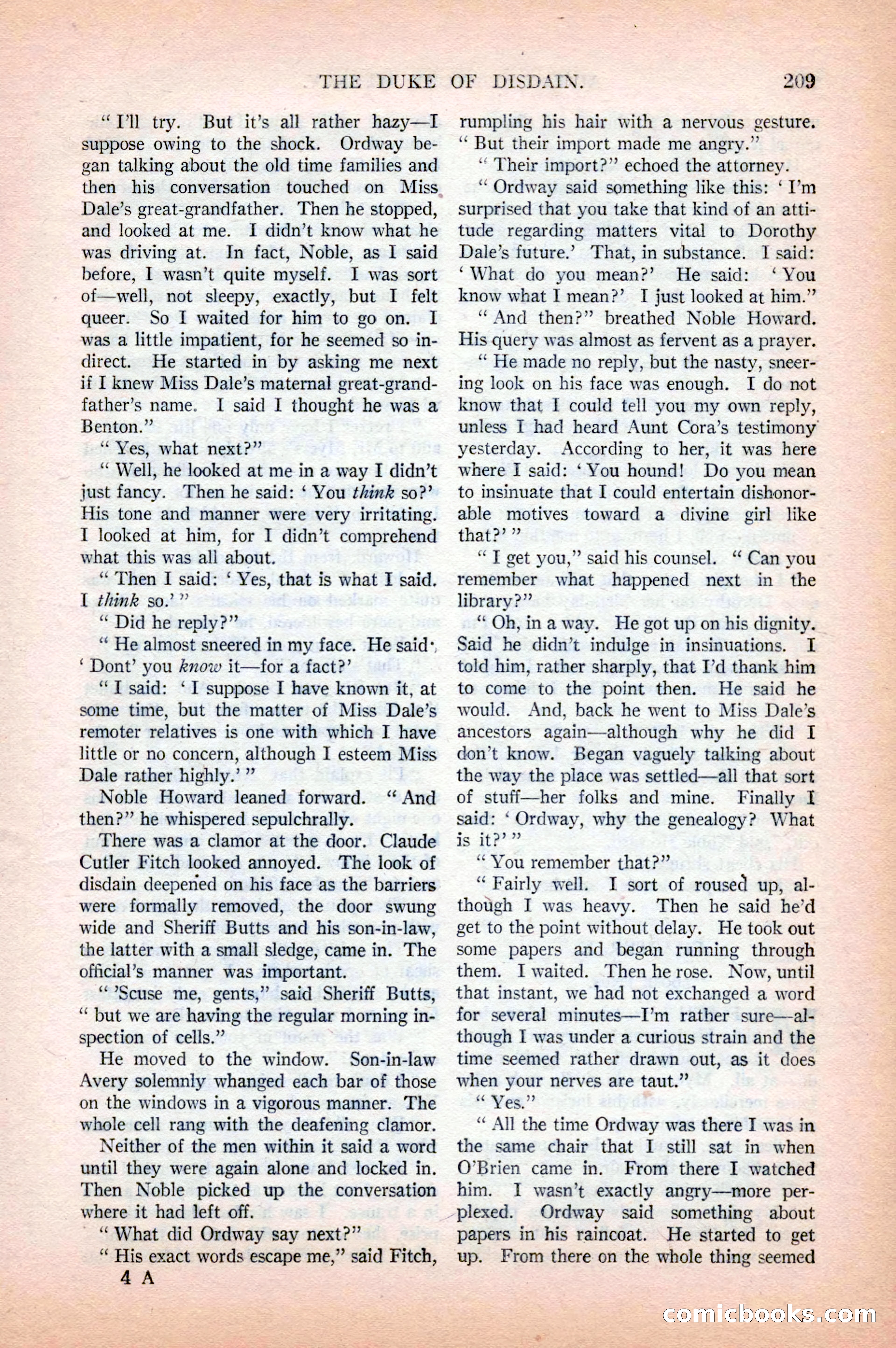
A restored page from Pulp Fiction, 1925. Page through the whole issue in the reader above.
📄 Transcribed text from this page (OCR, searchable)
Machine-transcribed from the original scan — historical spelling and the odd misread are preserved.
THE “Tl try. But it’s all rather hazy—I suppose owing to the shock. Ordway be- gan talking about the old time families and then his conversation touched on Miss Dale’s great-grandfather. Then he stopped, and looked at me. I didn’t know what he was driving at. In fact, Noble, as I said before, I wasn’t quite myself. I was sort of—well, not sleepy, exactly, but I felt queer. So I waited for him to go on. I was a little impatient, for he seemed so in- direct. He started in by asking me next if I knew Miss Dale’s maternal great-grand- father’s name. I said I thought he was a Benton.” “Yes, what next?” ‘“ Well, he looked at me in a way I didn’t just fancy. Then he said: ‘ You think so?’ His tone and manner were very irritating. I looked at him, for I didn’t comprehend what this was all about. “Then I said: ‘ Yes, that is what I said. [ think so.” ‘“ Did he reply?” ‘* He almost sneered in my face. He said’, ‘ Dont’ you know it—for a fact?’ “TT said: ‘I suppose I have known it, at some time, but the matter of Miss Dale’s remoter relatives is one with which I have little or no concern, although I esteem Miss Dale rather highly.’ ” Noble Howard leaned forward. then?” he whispered sepulchrally. There was a clamor at the door. Claude Cutler Fitch looked annoyed. The look of disdain deepened on his face as the barriers were formally removed, the door swung wide and Sheriff Butts and his son-in-law, the latter with a small sledge, came in. The official’s manner was important. “*Scuse me, gents,” said Sheriff Butts, ‘but we are having the regular morning in- spection of cells.” He moved to the window. Son-in-law Avery solemniy whanged each bar of those on the windows in a vigorous manner. The whole cell rang with the deafening clamor. Neither of the men within it said a word until they were again alone and locked in. Then Noble picked up the conversation where it had left off. _ “What did Ordway say next?” “ His exact words escape me,” said Fitch, 4A “ And DUBE OF DISDAIN. 209 rumpling his hair with a nervous gesture. ‘“ But their import made me angry.” ‘‘ Their import?” echoed the attorney. “ Ordway said something like this: ‘ I’m surprised that you take that kind of an atti- tude regarding matters vital to Dorothy Dale’s future.’ That, in substance. I said: ‘What do you mean?’ He said: ‘You know what I mean?’ I just looked at him.” ‘“And then?” breathed Noble Howard. His query was almost as fervent as a prayer. “ He made no reply, but the nasty, sneer- Ing look on his face was enough. I do not know that I could tell you my own reply, unless I had heard Aunt Cora’s testimony yesterday. According to her, it was here where I said: ‘You hound! Do you mean to insinuate that I could entertain dishonor- able motives toward a divine girl like that?’ ” “TI get you,” said his counsel. “ Can you remember what happened next in the library?” “ Oh, ina way. He got up on his dignity. Said he didn’t indulge in insinuations. I told him, rather sharply, that I’d thank him to come to the point then. He said he would. And, back he went to Miss Dale’s ancestors again—although why he did I don’t know. Began vaguely talking about the way the place was settled—all that sort of stuff—her folks and mine. Finally I said: ‘ Ordway, why the genealogy? What a (9 aoe “You remember that?” “Fairly well. I sort of roused up, al- though I was heavy. Then he said he’d get to the point without delay. He took out some papers and began running through them. I waited. Then he rose. Now, until that instant, we had not exchanged a word for several minutes—I’m rather sure—al- though I was under a curious strain and the time seemed rather drawn out, as it does when your nerves are taut.” “< Ves.” ‘“ All the time Ordway was there I was in the same chair that I still sat in when O’Brien came in. From there I watched him. I wasn’t exactly angry—more per- plexed. Ordway said something about papers in his raincoat. He started to get up. From there on the whole thing seemed .OOKS (EOL AMUE