
Pulp Fiction, 1925 · page 50 of 172
Argosy All-Story Weekly, April 18, 1925 — page 50: what you’re looking at
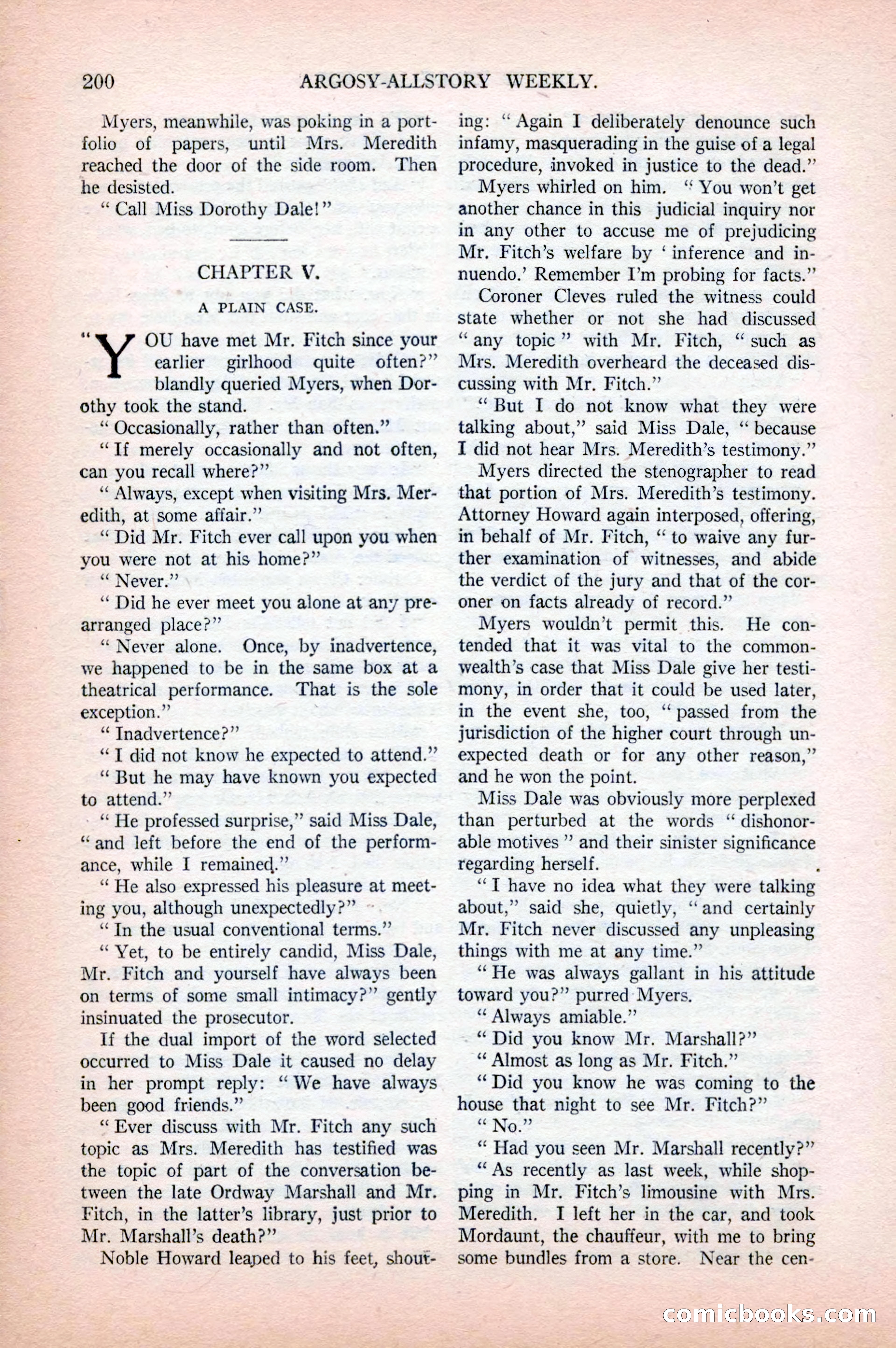
A restored page from Pulp Fiction, 1925. Page through the whole issue in the reader above.
📄 Transcribed text from this page (OCR, searchable)
Machine-transcribed from the original scan — historical spelling and the odd misread are preserved.
200 Myers, meanwhile, was poking in a port- folio of papers, until Mrs. Meredith reached the door of the side room. Then he desisted. “Call Miss Dorothy Dale!” CHAPTER V. A PLAIN CASE. = OU have met Mr. Fitch since your earlier girlhood quite often?” blandly queried Myers, when Dor- othy took the stand. “ Occasionally, rather than often.” “Tf merely occasionally and not often, can you recall where?” ‘“‘ Always, except when visiting Mrs. Mer- edith, at some affair.”’ “Did Mr. Fitch ever call upon you when you were not at his home?” ** Never.”’ ‘“‘ Did he ever meet you alone at any pre- arranged place?” “ Never alone. Once, by inadvertence, we happened to be in the same box at a theatrical performance. That is the sole exception.” “* Inadvertence?”’ “T did not know he expected to attend.” ‘But he may have known you expected to attend.” _ “ He professed surprise,” said Miss Dale, “and left before the end of the perform- ance, while I remained.”’ ‘“* He also expressed his pleasure at meet- ing you, although unexpectedly?” ‘In the usual conventional terms.” “ Yet, to be entirely candid, Miss Dale, Mr. Fitch and yourself have always been on terms of some small intimacy?” gently insinuated the prosecutor. If the dual import of the word selected occurred to Miss Dale it caused no delay in her prompt reply: ‘“ We have always been good friends.” “ Ever discuss with Mr. Fitch any such topic as Mrs. Meredith has testified was the topic of part of the conversation be- tween the late Ordway Marshall and Mr. Fitch, in the latter’s library, just prior to Mr. Marshall’s death?” Noble Howard leaped to his feet, shout- ARGOSY-ALLSTORY WEEKLY. ing: ‘“ Again I deliberately denounce such infamy, masquerading in the guise of a legal procedure, invoked in justice to the dead.”’ Myers whirled on him. ‘‘ You won’t get another chance in this judicial inquiry nor in any other to accuse me of prejudicing Mr. Fitch’s welfare by ‘ inference and in- nuendo.’ Remember I’m probing for facts.”’ Coroner Cleves ruled the witness could state whether or not she had discussed “any topic” with Mr. Fitch, “such as Mrs. Meredith overheard the deceased dis- cussing with Mr. Fitch.” “But I do not know what they were talking about,” said Miss Dale, ‘‘ because I did not hear Mrs. Meredith’s testimony.” Myers directed the stenographer to read that portion of Mrs. Meredith’s testimony. Attorney Howard again interposed, offering, in behalf of Mr. Fitch, “ to waive any fur- ther examination of witnesses, and abide the verdict of the jury and that of the cor- oner on facts already of record.” Myers wouldn’t permit this. He con- tended that it was vital to the common- wealth’s case that Miss Dale give her testi- mony, in order that it could be used later, in the event she, too, “ passed from the jurisdiction of the higher court through un- expected death or for any other reason,” and he won the point. Miss Dale was obviously more perplexed than perturbed at the words “ dishonor- able motives ” and their sinister significance regarding herself. ‘“‘T have no idea what they were talking about,” said she, quietly, “and certainly Mr. Fitch never discussed any unpleasing things with me at any time.” “He was always gallant in his attitude toward you?” purred Myers. “ Always amiable.” * Did you know Mr. Marshall?” ‘“* Almost as long as Mr. Fitch.” “Did you know he was coming to the house that night to see Mr. Fitch?” ce Ne.” ** Had you seen Mr. Marshall recently?” “As recently as last week, while shop- ping in Mr. Fitch’s limousine with Mrs. Meredith. I left her in the car, and took Mordaunt, the chauffeur, with me to bring some bundles from a store. Near the cen- EOPMIG OOO KS (E@)