
Pulp Fiction, 1925 · page 41 of 172
Argosy All-Story Weekly, April 18, 1925 — page 41: what you’re looking at
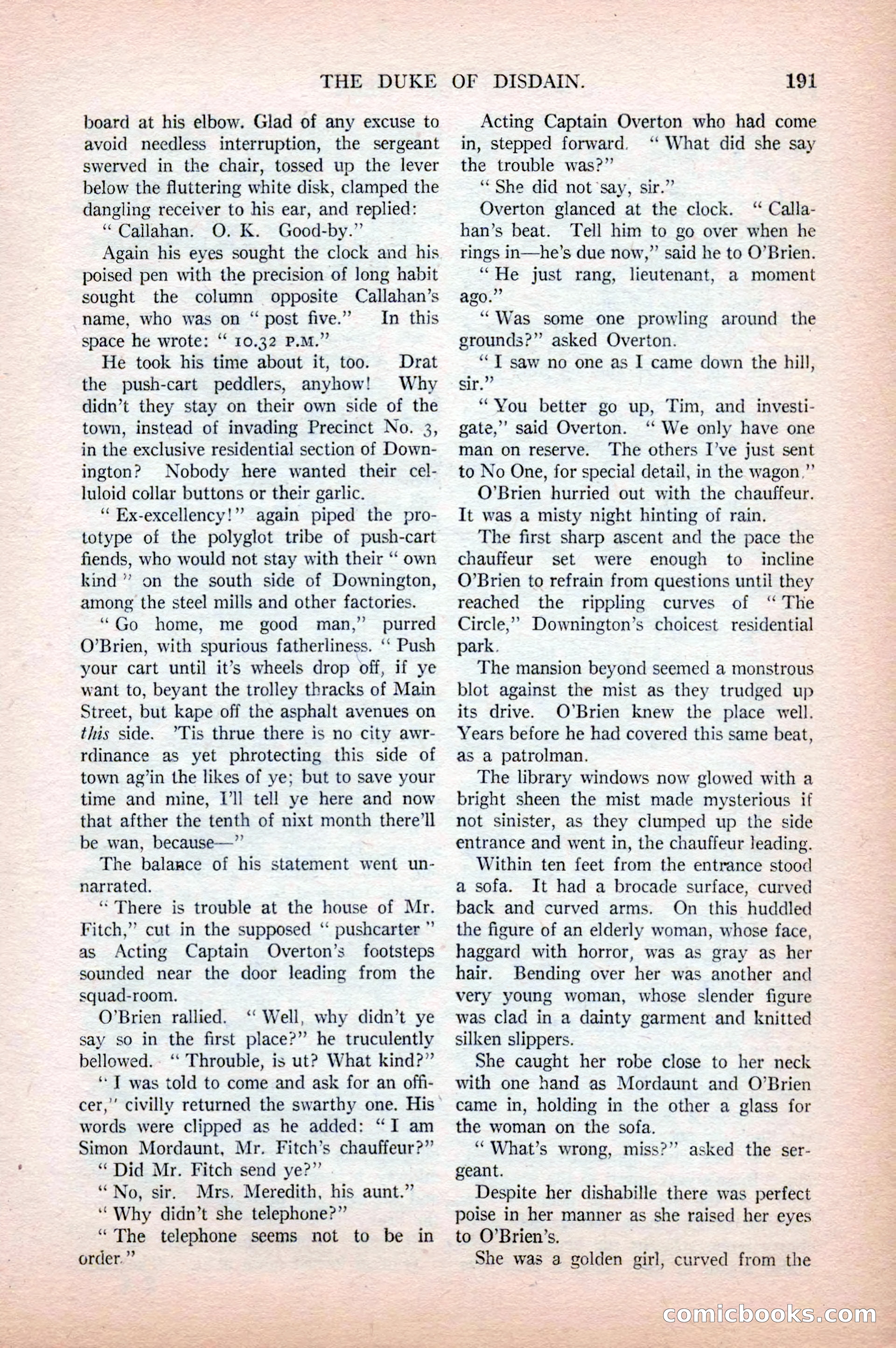
A restored page from Pulp Fiction, 1925. Page through the whole issue in the reader above.
📄 Transcribed text from this page (OCR, searchable)
Machine-transcribed from the original scan — historical spelling and the odd misread are preserved.
THE DUKE OF DISDAIN. board at his elbow. Glad of any excuse to avoid needless interruption, the sergeant swerved in the chair, tossed up the lever below the fluttering white disk, clamped the dangling receiver to his ear, and replied: “ Cajilahan. O. K. Good-by.” Again his eyes sought the clock and his poised pen with the precision of long habit sought the column opposite Callahan’s name, who was on “ post five.” In this space he wrote: ‘‘ 10.32 P.M.” He took his time about it, too. Drat the push-cart peddlers, anyhow! Why didn’t they stay on their own side of the town, instead of invading Precinct No. 3, in the exclusive residential section of Down- ington? Nobody here wanted their cel- luloid collar buttons or their garlic. ‘““ Ex-excellency!” again piped the pro- totype of the polyglot tribe of push-cart fiends, who would not stay with their ‘ own kind” on the south side of Downington, among the steel mills and other factories. “Go home, me good man,’ purred O’Brien, with spurious fatherliness. ‘‘ Push your cart until it’s wheels drop off, if ye want to, beyant the trolley thracks of Main Street, but kape off the asphalt avenues on this side. Tis thrue there is no city awr- rdinance as yet phrotecting this side of town ag’in the likes of ye; but to save your time and mine, 1’ll tell ye here and now that afther the tenth of nixt month there’ll be wan, because—’’ The balance of his statement went un- narrated. “ There is trouble at the house of Mr. Fitch,” cut in the supposed “ pushcarter ”’ as Acting Captain Overton’s footsteps sounded near the door leading from the squad-room. O’Brien rallied. ‘‘ Well, why didn’t ye say so in the first place?” he truculently bellowed. ‘‘ Throuble, is ut? What kind?” ‘J was told to come and ask for an offi- cer,’ civilly returned the swarthy one. His words were clipped as he added: “I am Simon Mordaunt, Mr. Fitch’s chauffeur?” “Did Mr. Fitch send ye?” ‘No, sir. Mrs, Meredith, his aunt.” ‘“Why didn’t she telephone?” “The telephone seems not to be in order.” 191 Acting Captain Overton who had come in, stepped forward. ‘‘ What did she say the trouble was?” ‘“‘ She did not say, sir.” Overton glanced at the clock. ‘ Calla- han’s beat. Tell him to go over when he rings in—he’s due now,” said he to O’Brien. ‘““He just rang, lieutenant, a moment ago.” ‘Was some one prowling around the grounds?” asked Overton. : ‘““T saw no one as I came down the hill, er, “You better go up, Tim, and investi- gate,’ said Overton. ‘‘ We only have one man on reserve. The others I’ve just sent to No One, for special detail, in the wagon.”’ O’Brien hurried out with the chauffeur. It was a misty night hinting of rain. The first sharp ascent and the pace the chauffeur set were enough to _ incline O’Brien to refrain from questions until they reached the rippling curves of “ The Circle,” Downington’s choicest residential park. The mansion beyond seemed a monstrous blot against the mist as they trudged up its drive. O’Brien knew the place well. Years before he had covered this same beat, as a patrolman. The library windows now glowed with a bright sheen the mist made mysterious if not sinister, as they clumped up the side entrance and went in, the chauffeur leading. Within ten feet from the entrance stood a sofa. It had a brocade surface, curved back and curved arms. On this huddled the figure of an elderly woman, whose face, haggard with horror, was as gray as her hair. Bending over her was another and very young woman, whose slender figure was clad in a dainty garment and knitted silken slippers. She caught her robe close to her neck with one hand as Mordaunt and O’Brien came in, holding in the other a glass for the woman on the sofa. ‘““What’s wrong, miss?’”’ asked the ser- geant. Despite her dishabille there was perfect poise in her manner as she raised her eyes to O’Brien’s. She was a golden girl, curved from the Gomichbooks (EC)