
Pulp Fiction, 1925 · page 170 of 172
Argosy All-Story Weekly, April 18, 1925 — page 170: what you’re looking at
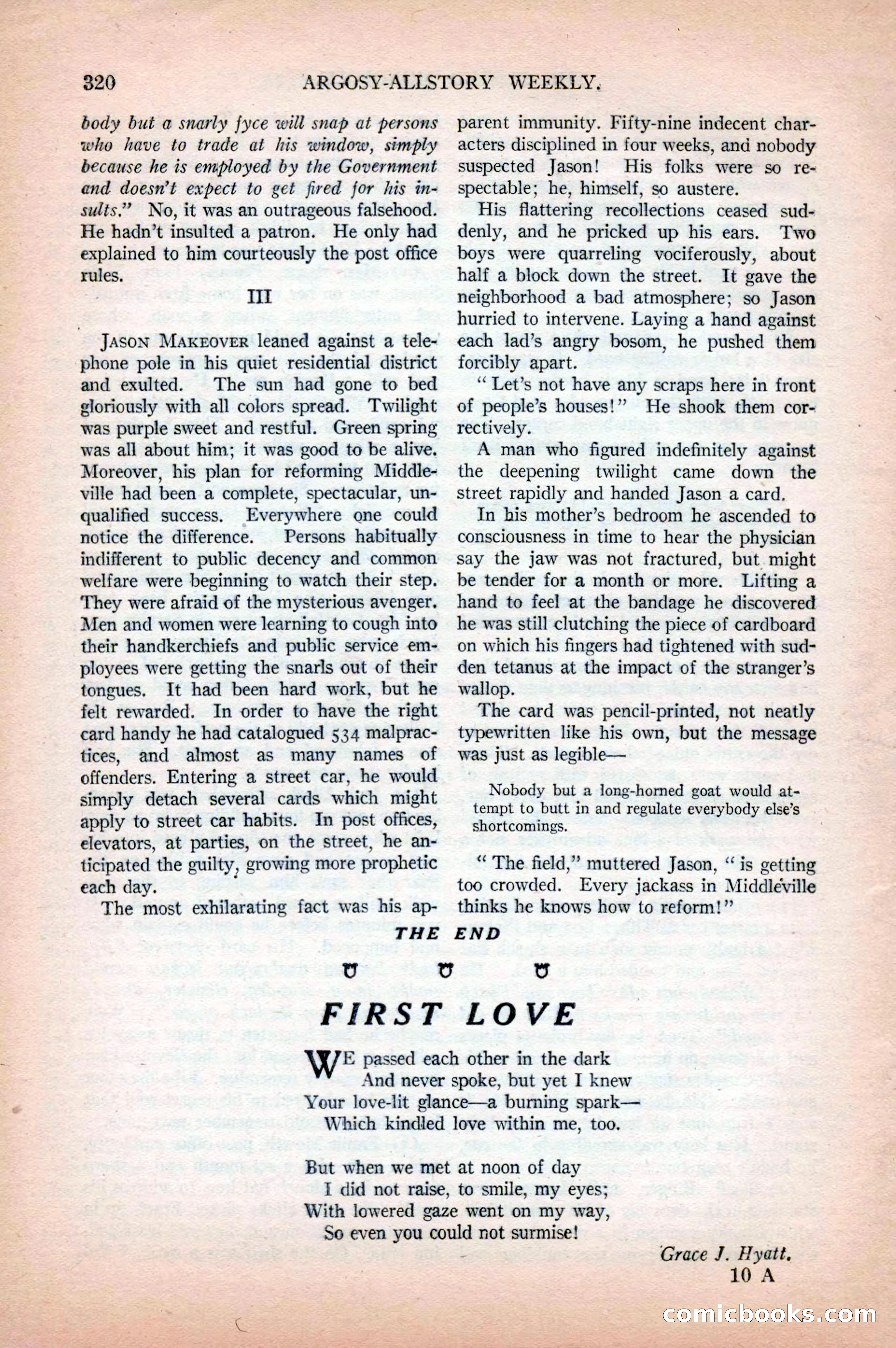
A restored page from Pulp Fiction, 1925. Page through the whole issue in the reader above.
📄 Transcribed text from this page (OCR, searchable)
Machine-transcribed from the original scan — historical spelling and the odd misread are preserved.
320 body but a snarly fyce will snap at persons who have to trade at his window, simply because he is employed by the Government and doesn’t expect to get fired for his in- sulis.” No, it was an outrageous falsehood. He hadn’t insulted a patron. He only had explained to him courteously the post office rules. Tit JASON MAKEOVER leaned against a tele- phone pole in his quiet residential district and exulted. The sun had gone to bed gloriously with all colors spread. Twilight was purple sweet and restful. Green spring was all about him; it was good to be alive, Moreover, his plan for reforming Middle- ville had been a complete, spectacular, un- qualified success, Everywhere one could notice the difference. Persons habitually indifferent to public decency and common welfare were beginning to watch their step. They were afraid of the mysterious avenger. Men and women were learning to cough into their handkerchiefs and public service em- ployees were getting the snarls out of their tongues. It had been hard work, but he felt rewarded. In order to have the right card handy he had catalogued 534 malprac- tices, and almost as many names of offenders. Entering a street car, he would simply detach several cards which might apply to street car habits. In post offices, elevators, at parties, on the street, he an- ticipated the guilty, growing more prophetic each day. The most exhilarating fact was his ap- THE U Lo] ARGOSY-ALLSTORY WEEKLY, parent immunity. Fifty-nine indecent char- acters disciplined in four weeks, and nobody suspected Jason! His folks were so re- spectable; he, himself, so austere. His flattering recollections ceased sud- denly, and he pricked up his ears. Two boys were quarreling vociferously, about half a block down the street. It gave the neighborhood a bad atmosphere; so Jason hurried to intervene. Laying a hand against each lad’s angry bosom, he pushed them forcibly apart. ‘“Let’s not have any scraps here in front of people’s houses!” He shook them cor- rectively. A man who figured indefinitely against the deepening twilight came down the street rapidly and handed Jason a card, In his mother’s bedroom he ascended to consciousness in time to hear the physician say the jaw was not fractured, but might be tender for a month or more. Lifting a hand to feel at the bandage he discovered he was still clutching the piece of cardboard on which his fingers had tightened with sud- den tetanus at the impact of the stranger’s wallop. The card was pencil-printed, not neatly typewritten like his own, but the message was just as legible— Nobody but a long-horned goat would at- tempt to butt in and regulate everybody else’s shortcomings. “The field,” muttered Jason, “is getting too crowded. Every jackass in Middleville thinks he knows how to reform!” END U FIRST LOVE WE passed each other in the dark And never spoke, but yet I knew Your love-lit glance—a burming spark— Which kindled love within me, too. But when we met at noon of day I did not raise, to smile, my eyes; With lowered gaze went on my way, So even you could not surmise! Grace J. Hyatt. 10 A (¢ com oe ye) ,< (E(0)