
Pulp Fiction, 1925 · page 155 of 172
Argosy All-Story Weekly, April 18, 1925 — page 155: what you’re looking at
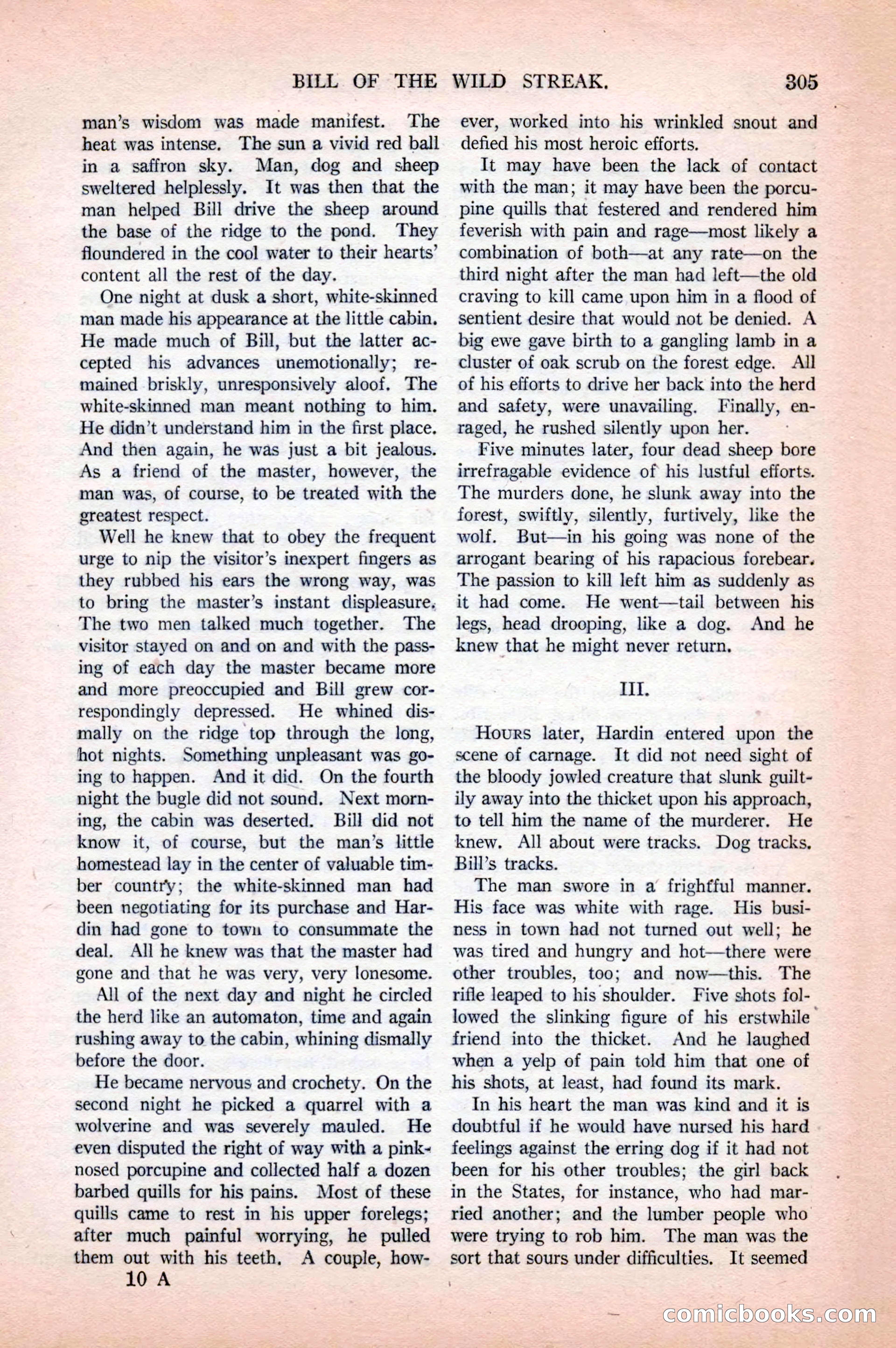
A restored page from Pulp Fiction, 1925. Page through the whole issue in the reader above.
📄 Transcribed text from this page (OCR, searchable)
Machine-transcribed from the original scan — historical spelling and the odd misread are preserved.
BILL OF THE man’s wisdom was made manifest. The heat was intense. The sun a vivid red ball in a saffron sky. Man, dog and sheep sweltered helplessly. It was then that the man helped Bill drive the sheep around the base of the ridge to the pond. They floundered in the cool water to their hearts’ content all the rest of the day. One night at dusk a short, white-skinned man made his appearance at the little cabin. He made much of Bill, but the latter ac- cepted his advances unemotionally; re- mained briskly, unresponsively aloof. The white-skinned man meant nothing to him. He didn’t understand him in the first place. And then again, he was just a bit jealous. As a friend of the master, however, the man was, of course, to be treated with the greatest respect. Well he knew that to obey the frequent urge to nip the visitor’s inexpert fingers as they rubbed his ears the wrong way, was to bring the master’s instant displeasure, The two men talked much together. The visitor stayed on and on and with the pass- ing of each day the master became more and more preoccupied and Bill grew cor- respondingly depressed. He whined dis- mally on the ridge top through the long, hot nights. Something unpleasant was go- ing to happen. And it did. On the fourth night the bugle did not sound. Next morn- ing, the cabin was deserted. Bill did not know it, of course, but the man’s little homestead lay in the center of valuable tim- ber country; the white-skinned man had been negotiating for its purchase and Har- din had gone to town to consummate the deal. All he knew was that the master had gone and that he was very, very lonesome. All of the next day and night he circled the herd like an automaton, time and again rushing away to the cabin, whining dismally before the door. He became nervous and crochety. On the second night he picked a quarrel with a wolverine and was severely mauled. He even disputed the right of way with a pink- nosed porcupine and collected half a dozen barbed quills for his pains. Most of these quills came to rest in his upper forelegs; after much painful worrying, he pulled them out with his teeth. A couple, how- 10 A WILD STREAK, ever, worked into his wrinkled snout and defied his most heroic efforts. It may have been the lack of contact with the man; it may have been the porcu- pine quills that festered and rendered him feverish with pain and rage—most likely a combination of both—at any rate—on the third night after the man had left—the old craving to kill came upon him in a flood of sentient desire that would not be denied. A big ewe gave birth to a gangling lamb in a cluster of oak scrub on the forest edge. All of his efforts to drive her back into the herd and safety, were unavailing. Finally, en- raged, he rushed silently upon her. Five minutes later, four dead sheep bore irrefragable evidence of his lustful efforts. The murders done, he slunk away into the forest, swiftly, silently, furtively, like the wolf. But—in his going was none of the arrogant bearing of his rapacious forebear. The passion to kill left him as suddenly as it had come. He went—tail between his legs, head drooping, like a dog. And he knew that he might never return, Til. Hours later, Hardin entered upon the scene of carnage. It did not need sight of the bloody jowled creature that slunk guilt- ily away into the thicket upon his approach, to tell him the name of the murderer. He knew. All about were tracks. Dog tracks. Bill’s tracks. The man swore in a frightful manner. His face was white with rage. His busi- ness in town had not turned out well; he was tired and hungry and hot—there were other troubles, too; and now—this. The rifle leaped to his shoulder. Five shots fol- lowed the slinking figure of his erstwhile friend into the thicket. And he laughed when a yelp of pain told him that one of his shots, at least, had found its mark. In his heart the man was kind and it is doubtful if he would have nursed his hard feelings against the erring dog if it had not been for his other troubles; the girl back in the States, for instance, who had mar- ried another; and the lumber people who were trying to rob him. The man was the sort that sours under difficulties. It seemed ‘ - CEOPMIG OOO KS 305 (E)