
Pulp Fiction, 1925 · page 111 of 172
Argosy All-Story Weekly, April 18, 1925 — page 111: what you’re looking at
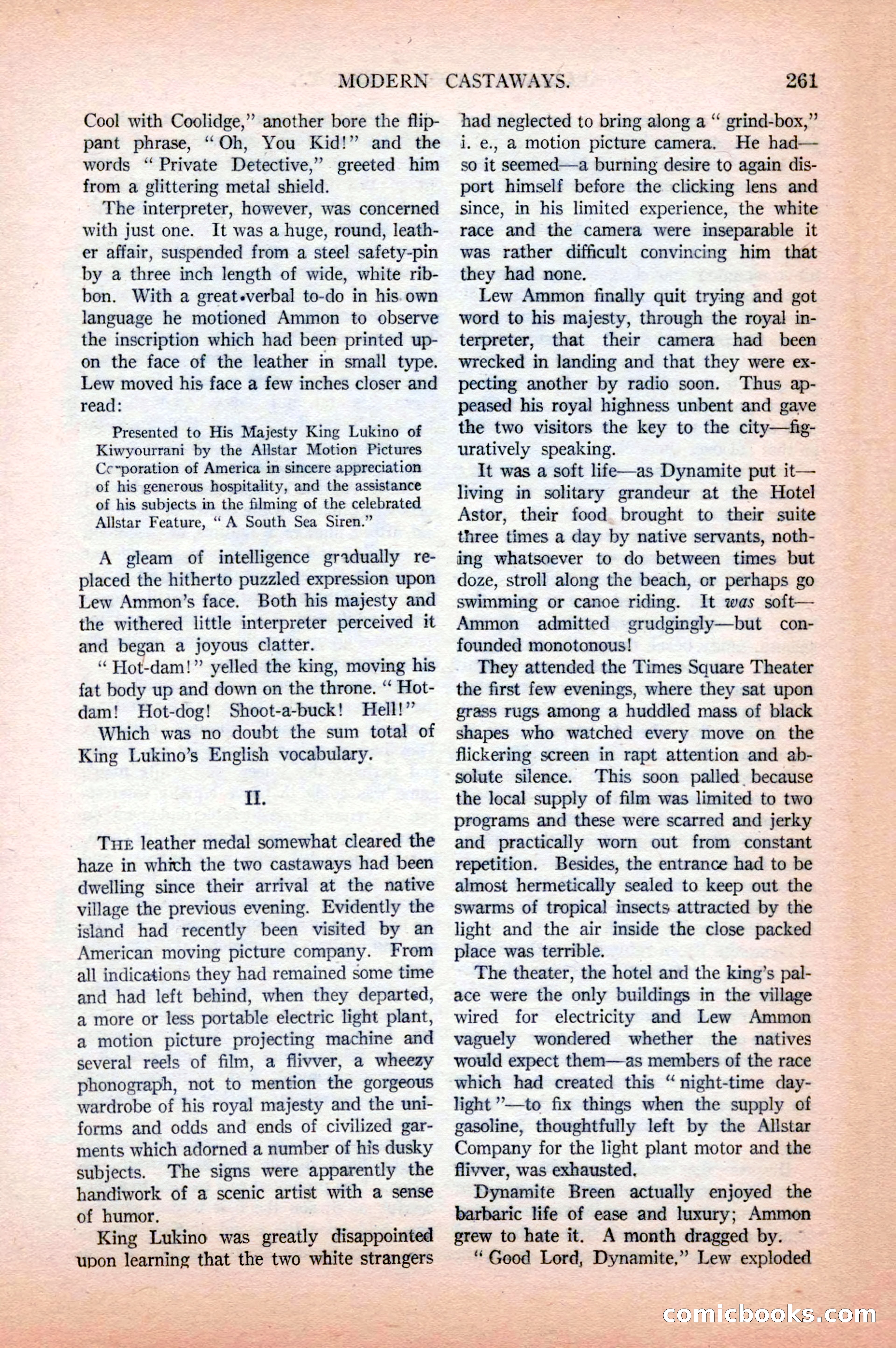
A restored page from Pulp Fiction, 1925. Page through the whole issue in the reader above.
📄 Transcribed text from this page (OCR, searchable)
Machine-transcribed from the original scan — historical spelling and the odd misread are preserved.
MODERN CASTAWAYS. Cool with Coolidge,” another bore the flip- pant phrase, “Oh, You Kid!” and the words “ Private Detective,” greeted him from a glittering metal shield. The interpreter, however, was concerned with just one. It was a huge, round, leath- er affair, suspended from a steel safety-pin by a three inch length of wide, white rib- bon. With a greateverbal to-do in his.own language he motioned Ammon to observe the inscription which had been printed up- on the face of the leather in small type. Lew moved his face a few inches closer and read: Presented to His Majesty King Lukino of Kiwyourrani by the Allstar Motion Pictures Cc~poration of America in sincere appreciation of his generous hospitality, and the assistance of his subjects in the filming of the celebrated Allstar Feature, “ A South Sea Siren.” A gleam of intelligence gradually re- placed the hitherto puzzled expression upon Lew Ammon’s face. Both his majesty and the withered little interpreter perceived it and began a joyous clatter. “ Hot-dam!” yelled the king, moving his fat body up and down on the throne. “ Hot- dam! Hot-dog! Shoot-a-buck! Hell!” Which was no doubt the sum total of King Lukino’s English vocabulary. I. Tuer leather medal somewhat cleared the haze in which the two castaways had been dwelling since their arrival at the native village the previous evening. Evidently the island had recently been visited by an American moving picture company. From all indications they had remained some time and had left behind, when they departed, a more or less portable electric light plant, a motion picture projecting machine and several reels of film, a flivver, a wheezy phonograph, not to mention the gorgeous wardrobe of his royal majesty and the uni- forms and odds and ends of civilized gar- ments which adorned a number of his dusky subjects. The signs were apparently the handiwork of a scenic artist with a sense of humor. - King Lukino was greatly disappointed upon learning that the two white strangers 261 had neglected to bring along a “ grind-box,” i, e., a motion picture camera. He had— so it seemed—a burning desire to again dis- port himself before the clicking lens and since, in his limited experience, the white race and the camera were inseparable it was rather difficult convincing him that they had none. Lew Ammon finally quit trying and got word to his majesty, through the royal in- terpreter, that their camera had been wrecked in landing and that they were ex- pecting another by radio soon. Thus ap- peased his royal highness unbent and gave the two visitors the key to the city—fig- uratively speaking. It was a soft life—as Dynamite put it— living in solitary grandeur at the Hotel Astor, their food brought to their suite three times a day by native servants, noth- ing whatsoever to do between times but doze, stroll along the beach, or perhaps go swimming or canoe riding. It was soft— Ammon admitted grudgingly—but con- founded monotonous! They attended the Times Square Theater the first few evenings, where they sat upon grass rugs among a huddled mass of black shapes who watched every move on the flickering screen in rapt attention and ab- solute silence. This soon palled_ because the local supply of film was limited to two programs and these were scarred and jerky and practically worn out from constant repetition. Besides, the entrance had to be almost hermetically sealed to keep out the swarms of tropical insects attracted by the light and the air inside the close packed place was terrible. The theater, the hotel and the king’s pal- ace were the only buildings in the village wired for electricity and Lew Ammon vaguely wondered whether the natives would expect them—as members of the race which had created this “night-time day- light ”—to fix things when the supply of gasoline, thoughtfully left by the Allstar Company for the light plant motor and the flivver, was exhausted. Dynamite Breen actually enjoyed the barbaric life of ease and luxury; Ammon grew to hate it. A month dragged by. ~ “ Good Lord, Dynamite,” Lew exploded a) choo Ss " an i ee, ee