
Pulp Fiction, 1924 · page 57 of 172
Argosy All-Story Weekly, October 25, 1924 — page 57: what you’re looking at
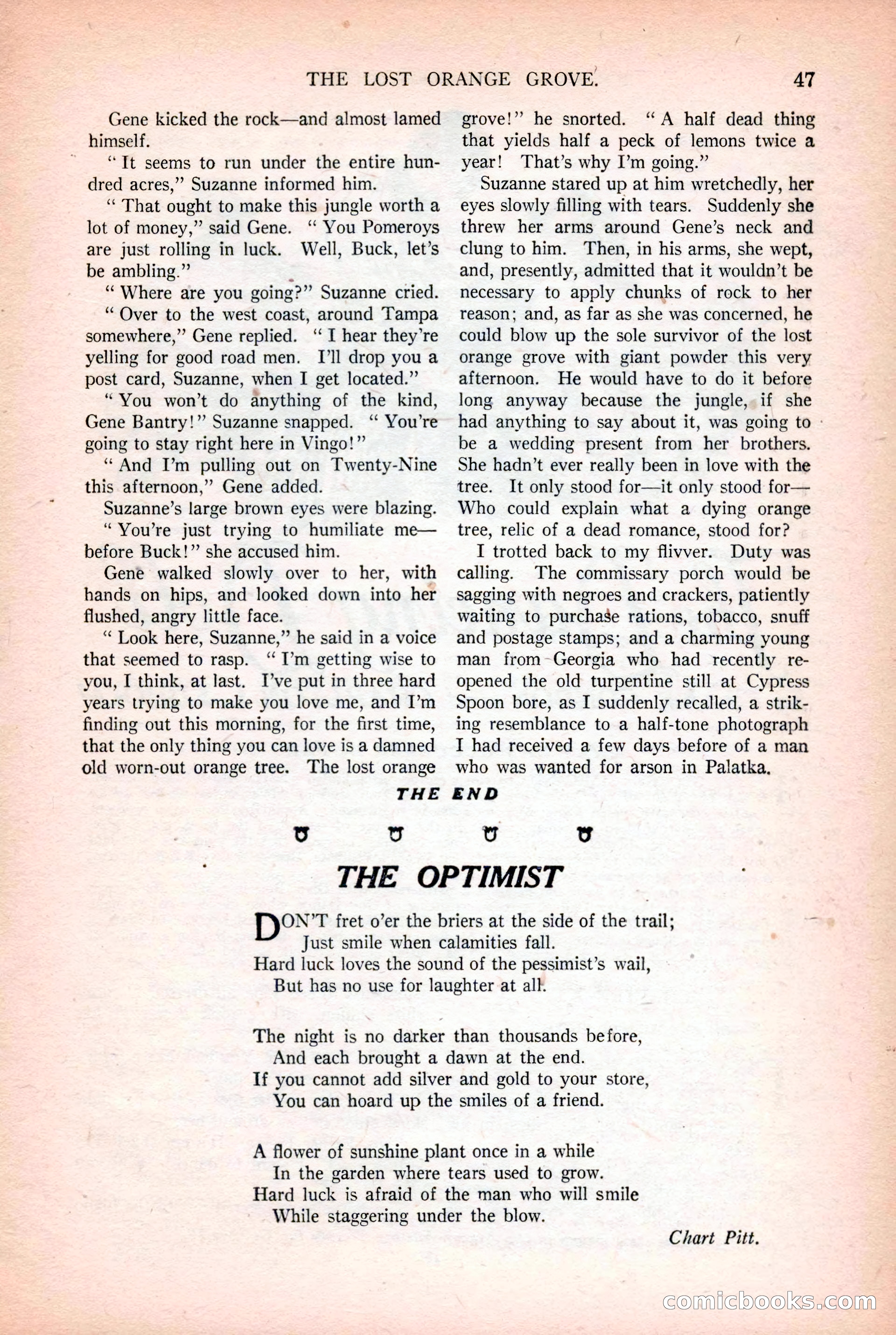
A restored page from Pulp Fiction, 1924. Page through the whole issue in the reader above.
📄 Transcribed text from this page (OCR, searchable)
Machine-transcribed from the original scan — historical spelling and the odd misread are preserved.
THE LOST ORANGE GROVE. Gene kicked the rock—and almost lamed himself. ~ © Tt seems to run under the entire hun- dred acres,” Suzanne informed him. “That ought to make this jungle worth a lot of money,” said Gene. ‘“‘ You Pomeroys are just rolling in luck. Well, Buck, let’s be ambling.” : ‘“‘ Where are you going?” Suzanne cried. “Over to the west coast, around Tampa somewhere,” Gene replied. ‘‘ I hear they’re yelling for good road men. I'll drop you a post card, Suzanne, when I get located.” “You won’t do anything of the kind, Gene Bantry!” Suzanne snapped. “ You're going to stay right here in Vingo!”’ “And I’m pulling out on Twenty-Nine this afternoon,” Gene added. Suzanne’s large brown eyes were blazing. “You’re just trying to humiliate me— before Buck!” she accused him. Gene walked slowly over to her, with hands on hips, and looked down into her flushed, angry little face. “Look here, Suzanne,” he said in a voice that seemed to rasp. “ I’m getting wise to you, I think, at last. I’ve put in three hard years trying to make you love me, and I’m finding out this morning, for the first time, that the only thing you can love is a damned old worn-out orange tree. The lost orange THE Lo] U AT grove!” he snorted. “A half dead thing that yields half a peck of lemons twice a year! That’s why I’m going.” Suzanne stared up at him wretchedly, her eyes slowly filling with tears. Suddenly she threw her arms around Gene’s neck and clung to him. Then, in his arms, she wept, and, presently, admitted that it wouldn’t be necessary to apply chunks of rock to her reason; and, as far as she was concerned, he could blow up the sole survivor of the lost orange grove with giant powder this very afternoon. He would have to do it before long anyway because the jungle, if she had anything to say about it, was going to » be a wedding present from her brothers. She hadn’t ever really been in love with the tree. It only stood for—it only stood for— Who could explain what a dying orange tree, relic of a dead romance, stood for? I trotted back to my flivver. Duty was calling. The commissary porch would be sagging with negroes and crackers, patiently waiting to purchase rations, tobacco, snuff and postage stamps; and a charming young man from-Georgia who had recently re- opened the old turpentine still at Cypress Spoon bore, as I suddenly recalled, a strik- ing resemblance to a half-tone photograph I had received a few days before of a man who was wanted for arson in Palatka, END 1 Lo THE OPTIMIST DoNxT fret o’er the briers at the side of the trail; Just smile when calamities fall. Hard luck loves the sound of the pessimist’s wail, But has no use for laughter at all. The night is no darker than thousands before, And each brought a dawn at the end. If you cannot add silver and gold to your store, You can hoard up the smiles of a friend. A flower of sunshine plant once in a while In the garden where tears used to grow. Hard luck is afraid of the man who will smile While staggering under the blow. Chart Pitt. COnmicloool< (C@